Translation note: This is an advocacy article from 14 December 2022. Reactor conditions, institutional roles and risk comparisons reflect the original account, not a current safety assessment. The source’s reference to a Chornobyl occupation lasting over three months is a dating error; the occupation lasted from 24 February to 31 March 2022.
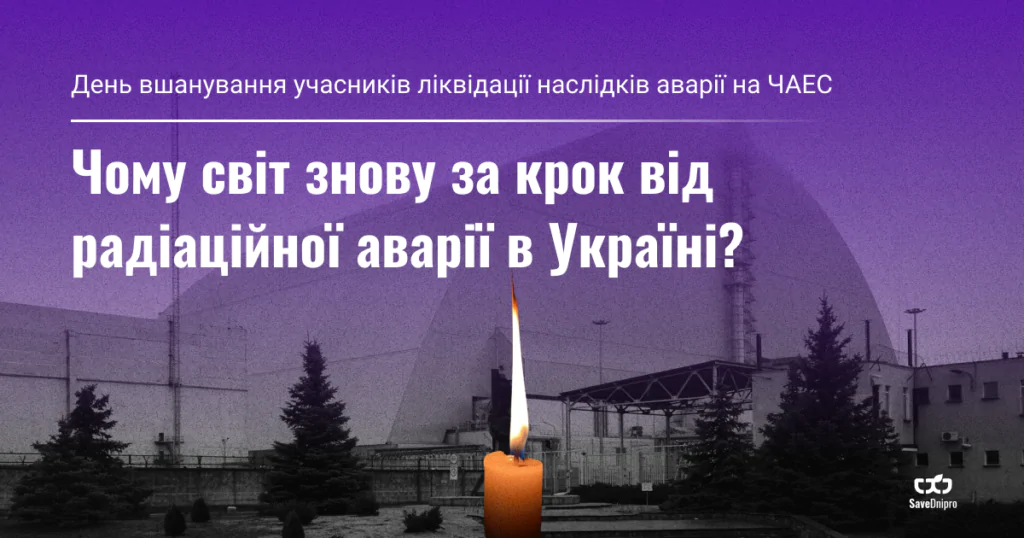
On 14 December, Ukraine honours those who worked to overcome the consequences of the Chornobyl accident. Thirty-six years ago, 600,000 courageous and dedicated people accepted the challenge of protecting Ukraine and the world from the largest radiation accident in history. Our duty is not only to remember them but to do everything possible to prevent another such disaster in Ukraine.
According to the Union Chornobyl of Ukraine NGO, 10% of the 600,000 emergency workers had died and 165,000 had acquired disabilities. The original article describes widespread cancers among them, particularly thyroid cancer, leukaemia and breast cancer. The consequences persist: radiation’s effects can emerge decades after exposure.
Russia’s war returned Chornobyl to international headlines in 2022. Russian troops entered the Exclusion Zone and occupied the plant on the first day of the full-scale invasion. Although years have passed since the accident and some isotopes have decayed, thousands of hazardous spent fuel assemblies remain in storage. During the occupation, from 24 February to 31 March, damage to spent fuel stores and containment structures could have caused a serious release. The original article warned of a release three times larger than in 1986; this was its risk comparison, not a verified prediction.
The night of 24–25 February was frightening: SaveEcoBot recorded radiation readings at the plant up to 30 times higher, unusual even for a site that had experienced an accident. We discussed possible causes in our article on Russia’s impact on background radiation in Ukraine. None of these increases would have occurred without the Russian invasion.
The occupation of Chornobyl and the Exclusion Zone involved more than radiation spikes. Russian troops dug trenches in the Red Forest, disturbing contaminated soil, and deliberately set fire to contaminated woodland, releasing radioactive substances into the atmosphere. Despite understanding the dangers of occupying nuclear facilities, politicians and international organisations largely remained concerned observers.
Feeling immune from consequences and confident of victory, Russian troops seized Zaporizhzhia on 4 March. By publication it had been occupied for nine full months, during which courageous Ukrainian staff repeatedly helped prevent another accident. The article reports four of six units in cold shutdown and two in hot shutdown to supply the plant’s needs and heating for Enerhodar. It was not supplying electricity to Ukraine’s integrated grid.
The article describes continuing shelling at Zaporizhzhia, loss of grid connections and reliance on diesel generators. Occupying forces used the site to store weapons, tortured staff and violated the seven nuclear safety pillars. Yet the international response remained inadequate, even amid warnings that a Zaporizhzhia accident could be worse than Chornobyl.
Why is the world again close to a radiation accident in Ukraine? Have politicians, nuclear specialists, civil society and influential organisations learned nothing about the danger of losing control of a nuclear plant?
Unfortunately, the past nine months have shown how unprepared the world was to confront nuclear terrorism.
On 28 February, Energoatom sent an open letter to the IAEA proposing 30-kilometre safe zones around Ukrainian nuclear facilities. Despite discussions and an IAEA resolution calling on Russia to stop its actions at Ukrainian nuclear sites and leave them, Russia continued occupying Zaporizhzhia and threatening the world with a radiation disaster.
Having built hundreds of nuclear power units, the world failed, or refused, to adequately consider their involvement in full-scale war. It naively believed major wars belonged to the past. It has now struggled to address threats of this scale: agreeing a demilitarised zone, establishing a no-fly zone or even removing Russian influence from nuclear energy institutions. At publication, Russian citizen Mikhail Chudakov remained IAEA Deputy Director General and Head of its Department of Nuclear Energy, while the article also criticised the Agency’s financial dependence on Russia.
Concern about Russian nuclear terrorism continued without sufficient practical progress. We must also take action ourselves. To address absent or inadequate state monitoring, SaveDnipro established alternative background radiation monitoring around Zaporizhzhia. This ambitious project was made possible with support from international partners’ projects uRADMonitor and Safecast. Online radiation monitoring stations were installed at different distances and in different wind directions from the plant, including Nikopol, Mykolaiv, Zaporizhzhia and Dnipro. Their readings are available on our radiation map in real time. Information about iodine prophylaxis in an emergency is available in our article.
To stop Russian nuclear terrorism, SaveDnipro and other civil society organisations sent a joint open letter to the IAEA’s governing and executive bodies. Civil society demanded Russia’s removal from the Board of Governors, suspension of its membership rights, removal of Russian citizens from executive duties, and suspension of ongoing technical cooperation and scientific and technological exchanges between the Agency, Rosatom and Rosenergoatom.