Translation note: This is a historical translation of an article published on 20 December 2022, not current legal or tax guidance. Generator, emissions and fuel-storage rules have changed since publication. Check the legislation applicable to your circumstances before relying on the requirements, exemptions or penalties described below.
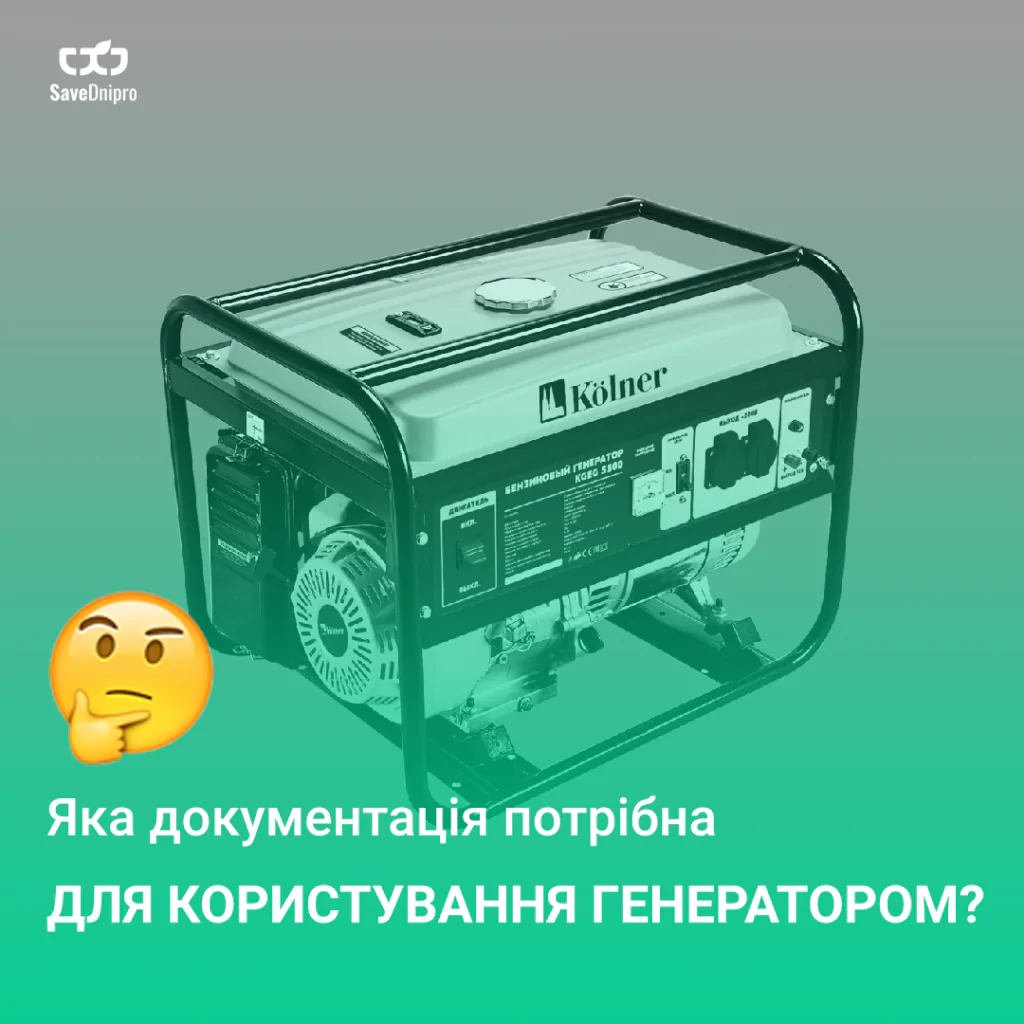
Repeated Russian attacks on Ukraine’s integrated energy infrastructure have forced Ukrainians to find alternative electricity supplies. Diesel and petrol generators are being imported in large numbers. Do businesses and individuals need special permits to use them? Here is the position described in this article at the time of publication.
Under Ukraine’s Law on Ambient Air Protection, stationary sources may emit air pollutants after the business obtains an emission permit, following the procedure in Resolution No. 302 of 13 March 2002. The permit authorises enterprises, institutions, organisations and individual entrepreneurs to operate facilities emitting pollutants or mixtures, subject to maximum permissible emission standards and technological emission-control requirements for the period specified.
The key question is whether a generator meets the criteria for a stationary emission source. Article 14.1.230 of the Tax Code defines this as an enterprise, workshop, unit, installation or other fixed facility that remains at specified coordinates for a period and emits pollutants. The article applies this to large, high-powered generators installed on foundations. Most generators currently used by Ukrainians are portable, relatively small and easy to move or transport.
Martial law also changed permit procedures through Cabinet Resolution No. 314 of 18 March 2022 on conducting business under martial law. Under it, businesses may acquire the right to operate by submitting a free declaration of business activityto licensing, permitting or public service bodies, containing the information listed in Annex 1, without obtaining permits, except for activities listed in Annex 2.
Businesses that installed stationary generators during martial law could submit a declaration instead of obtaining an air pollutant emission permit, according to the rules discussed here.
The article also notes that a business must hold a fuel storage licence for its own needs. It cites a UAH 500,000 fine for unlicensed storage. Licences whose payments were overdue or validity had expired before martial law was terminated or lifted, or in force-majeure circumstances, were treated as valid under the described arrangements.
The article identifies an exemption from the fuel storage licence requirement for businesses storing fuel exclusively in consumer containers of up to five litres.
It stresses that businesses using stationary generators must pay environmental tax. However, where generator operation produces less than 500 tonnes of carbon dioxide a year, the article describes an exemption from carbon dioxide environmental tax. Diesel and petrol generators also emit other taxable substances, but the applicable thresholds were unclear to the authors. We sent a request to the State Tax Service for clarification and planned to report its response later.
In 2022, the carbon dioxide tax rate was UAH 30 per tonne. Environmental taxpayers had to submit returns within 40 calendar days after the tax quarter ended and pay within ten calendar days after the filing deadline.
The article also describes a wartime provision under which, from 1 January 2022 to 31 December of the year specified in that provision, environmental tax on pollutants was neither assessed nor paid by taxpayers registered at stationary pollution sources in areas of current or past hostilities or territories temporarily occupied by Russian forces. More information about environmental taxes in Ukraine is available on the SaveEcoBot website, while key figures and statistics for 2020–2021 are presented in our concise infographic.
In summary, the article described the following martial-law requirements at publication:
• Businesses with stationary generators were to submit a declaration of business activity, pay applicable environmental taxes and hold a fuel storage licence.
• The original summary also stated that owners of portable generators needed a fuel storage licence when storing fuel in consumer containers exceeding five litres. This historical statement should not be used as current guidance for individuals.
To learn how air quality changes during blackouts, read our article. To check reported air quality in your city now, visit our map.