Translation note: This is a January 2023 article. Carbon monoxide from generators has no smell or colour: absence of an exhaust smell does not establish safety, and a PM2.5 map does not measure carbon monoxide. Never operate a generator indoors or in a garage, even with doors open. Follow current generator safety instructions. Sources: CDC: Generator Safety.
In recent years, large cities have increasingly experienced persistent fog lasting hours or even days. Fog itself is not pollution, but in heavily industrialised areas it can combine with pollutants to form smog. Let us explore when fog can become dangerous to people.
Fog is an atmospheric phenomenon in which condensed water vapour — tiny droplets, ice crystals or a mixture — accumulates in the air near the ground. Cooling fog forms when air cools below its dew point, as often happens in winter. Evaporation fog forms when vapour from a warmer surface mixes with cold air above water or damp ground, such as on summer mornings over ponds and lakes.
Cooling of the ground produces radiation fog. It usually forms at night under anticyclonic conditions and disperses quickly after sunrise. It often accompanies a temperature inversion that prevents air from rising. During cold weather and persistent anticyclones, it may last for days. In industrial areas, these conditions can allow polluted fog, or smog, to develop.
Fog occurs more often in settlements than outside them, partly because urban air contains more moisture-attracting condensation nuclei, such as dust and soot. Ukraine is estimated to experience an average of 35 foggy days a year. In Kyiv, fog is most common from October to April, with 80% of cases occurring between October and March.
Smog combines fog, smoke and dust. The article distinguishes smoky smog, ice smog in temperatures below −30°C and photochemical smog in hot conditions above +30°C. Smoky smog forms in near-saturated humidity, temperatures around freezing, prolonged still weather and high concentrations of combustion products such as sulphur dioxide, carbon monoxide and soot. It can develop in large cities during power cuts because operating generators release fuel combustion products: exhaust gases containing carbon monoxide, carbon dioxide, nitrogen oxides, hydrocarbons and aldehydes.
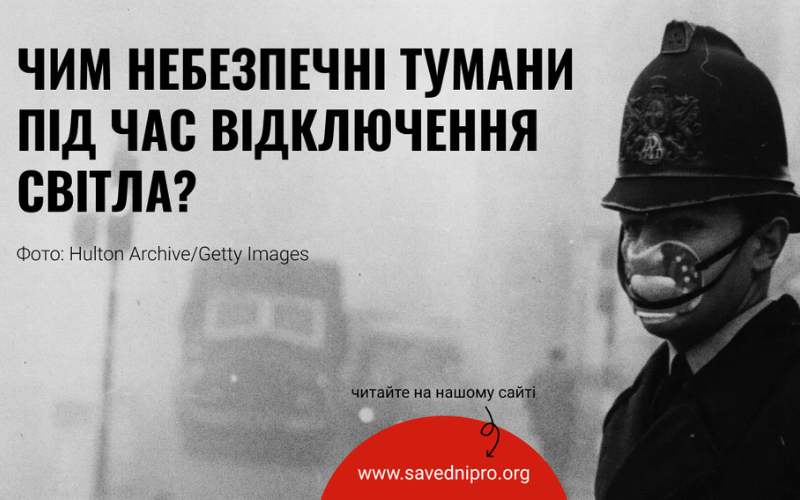
History offers examples of large-scale smoky smog killing thousands. In 1952, exceptionally cold fog settled over London, and residents burned more coal to heat their homes. Britain was still rebuilding after the war, and domestic coal use rose sharply.
London was one of the world’s most populous cities in 1952, with more than eight million residents. The authorities had recently modernised transport by replacing trams with diesel buses. When the cold fog arrived, enormous household heating emissions were added to the usual industrial and traffic pollution.
Normally, smoke and smog would rise and disperse. This time, an anticyclone pushed air down over London, creating a temperature inversion in which air near the ground was colder than the air above. The city was effectively trapped beneath a dome of polluted air.
The fog became so dense that it disrupted traffic. Concerts and film screenings were cancelled as smog entered buildings: audiences sometimes could not see the stage or screen.
Londoners were initially unconcerned because fog was familiar. But between 6 and 8 December, deaths during sleep rose sharply and many pets died. Around 4,000 deaths were recorded during the Great Smog of 5–9 December, with infants, older people and those with respiratory conditions particularly affected. The article also cites around 25,000 people seeking medical assistance and another 8,000 deaths by the end of the year, mainly linked to respiratory illness, hypoxia and acute purulent bronchitis.
The Great Smog of 1952 was a tragedy and a harsh lesson that led Britain to reconsider environmental protection laws. New standards restricted dirty industrial fuels and soot-containing emissions. Measures included the Clean Air Act and corresponding legislation for London.
Could Ukraine experience smoky smog on that scale now? The original article considers it unlikely: although generator and bus use has increased substantially, many industrial facilities have stopped, potentially offsetting some emissions. This is an assessment made at the time of publication, not a guarantee of safe air.
Locally, fog can coincide with poorer air quality, while exhaust pollutants undergo chemical reactions involving suspended water droplets. As we discussed previously, the resulting substances can harm health, especially among children, older people and those with respiratory conditions.
During fog, particularly when generators are operating, plan routes away from generators and roads. If there is a strong, persistent exhaust smell, reconsider the walk. Remember, however, that dangerous carbon monoxide is odourless. Ambient particulate air quality readings can be checked on our map.
This publication was produced with the support of the European Union. Its contents are the sole responsibility of SaveDnipro NGO and do not necessarily reflect the views of the European Union.