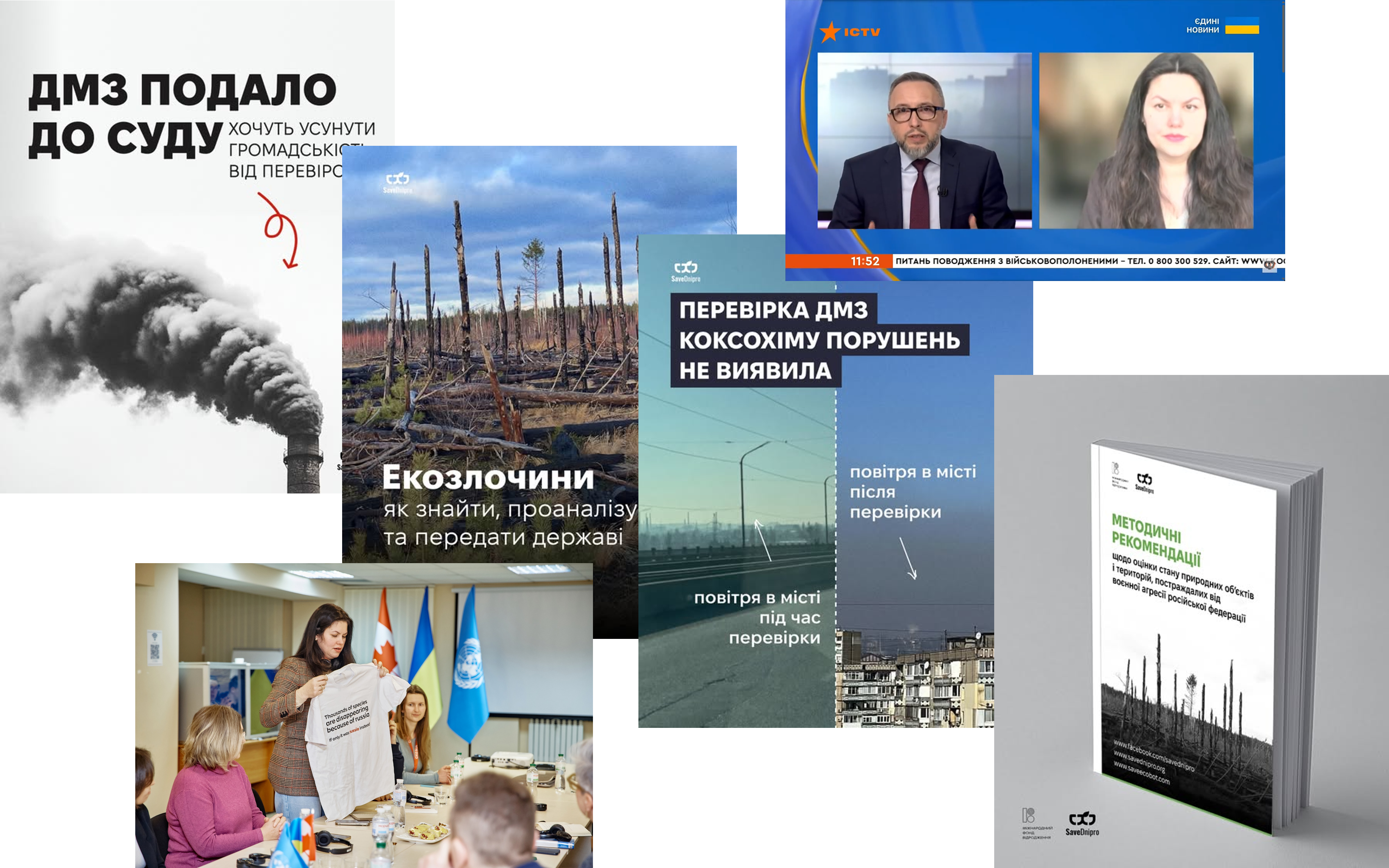
Continuing to defend Dnipro residents’ right to a clean and safe environment. We published information about the inspection findings for Dnipro Metallurgical Plant’s coke production by the State Environmental Inspectorate of the Prydniprovskyi District: the same controversial inspection from which our representative was excluded, leaving us unable to trust its results.
A new development was the company’s decision to challenge in court the lawfulness of involving our representative in the inspection. We are now participating in those proceedings.
Publishing methodological recommendations for assessing natural sites and areas affected by Russia’s military aggression. The purpose of the guidance is to provide an initial assessment procedure for areas and sites affected by military activity. It is intended both for specialists and for activists without specialist training. The document resulted from months of work by a team of SaveDnipro experts and external specialists we engaged, including scientists and lawyers.
We also highlighted problems with tools for reporting the aggressor’s environmental crimes to authorised state bodies.
Advocating Ukraine’s green recovery. We helped civil society organisations develop a green recovery roadmap, submitting proposals for its Environment and Climate section. One aim is a common civil society position at URC 2025.
We held working meetings with Ministry of Environmental Protection and Reform Support Team representatives on a digital green recovery platform concept we plan to develop for the ministry. We confirmed a shared wish to create it and began preparing the foundations – by adding a corresponding provision to the draft Law on Green Recovery and agreeing to include an announcement of the initiative at URC 2025.
On 13 February, we promptly reported deteriorating air quality in Ukraine. Iryna Chernysh provided recommendations on reducing adverse health effects on the national United News telethon, and explained the causes of worsening air quality for Snidanok 1+1’s Explainer section, without a video recording.
After an attack drone with a high-explosive warhead struck the shelter over Chornobyl Nuclear Power Plant’s fourth reactor, we again helped prevent panicby informing the public that radiation levels had not changed. Iryna Chernysh reported this on Channel 5. Pavlo Tkachenko commented to the Czech outlet Novinky on monitoring in the Chornobyl Exclusion Zone and around the Zaporizhzhia Nuclear Power Plant, and to Suspilne Dnipro on radiation in Dnipro and the region.
We published our own analysis based on official Ukrainian Hydrometeorological Centre air quality data from previous years for Mykolaiv and Odesa. In the context of the duty to develop air quality improvement plans under Cabinet of Ministers Resolution No. 827 of 14 August 2019, we highlighted to the ministry local authorities’ lack of sufficient expertise in determining individual sources’ contributions to background pollution.
We explained the differencesbetween citizen air quality monitoring data and measurements taken by state laboratories. Because of incorrect data comparisons, some regional Centres for Disease Control and Prevention under the Ministry of Health spread false claims that maximum permissible concentrations have not been exceeded. We drew the ministry’s attention to this as coordinator of monitoring bodies.
Building international contacts. SaveDnipro chair Iryna Chernysh took part in a meeting between Canada’s Ambassador Natalka Cmoc, UNDP Resident Representative Jaco Cilliers and civil society in Dnipropetrovsk region. Iryna stressed the importance of environmental considerations in future reconstruction and the heightened interest in resource extraction in Ukraine.
Iryna Chernysh attended a meeting of the expert council under the Ombudsman’s Representative for Social and Economic Rights. The council discussed and approved its 2025 work plan
Continuing our public education work:
- Six months before the main provisions of the Law ‘On Integrated Industrial Pollution Prevention and Control’ take effect, we recalled the substance of industrial pollution reform and the public’s role in environmental permitting.
- We refuted false media claims that a polluted cloud from Europe would cover Ukraine, explaining the real causes of deteriorating air quality.
- SaveDnipro chair Iryna Chernysh on Suspilne News described SaveEcoSensor 3.0 air quality monitoring stations
- Pavlo Tkachenko delivered a lecture to school pupils in Hatne, Kyiv region, where a SaveEcoSensor 3.0 station operates. He explained how the station works and how to follow air quality and analyse data in SaveEcoBot.
- Pavlo Tkachenko presented the Radnote monitoring station at a special event at Ivano-Frankivsk National Technical University of Oil and Gas.
Supporting joint civil society appeals:
- we called on the US and EU to stop importing Russian timber;
- we signed an open letter opposing the exclusion of industrial parks from the EIA procedure;
- we signed an open letter proposing improvements to implementation of the Ukraine Facility Regulation.