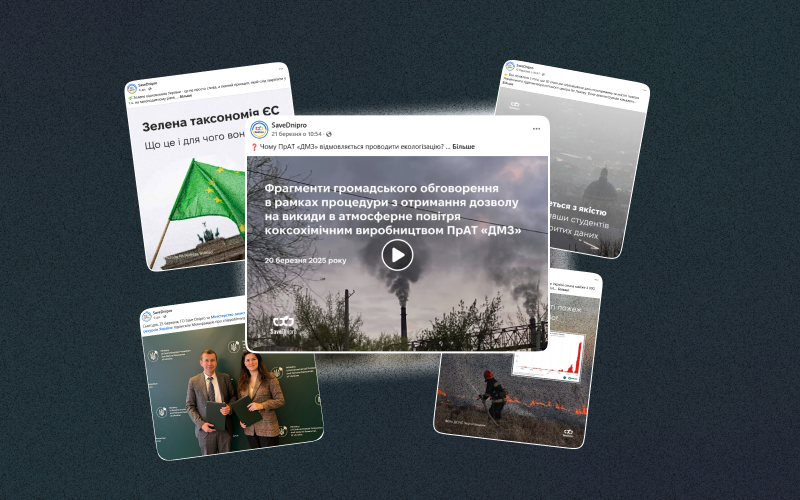
In March 2025 the SaveDnipro team represented Dnipro residents at hearings concerning Dnipro Metallurgical Plant; monitored radiation levels and air quality across Ukraine daily; worked to expand citizen radiation monitoring; continued developing a digital green recovery platform concept; tracked and commented to the media on a sharp rise in vegetation fires; signed a cooperation memorandum with the Ministry of Environmental Protection; and built cooperation with local authorities.
Read more about SaveDnipro’s achievements and important work in March 2025 in this digest.
Protecting public health in Dnipro. On 13 March, we published the date and time of the public consultation in the air emission permitting procedure for Dnipro Metallurgical Plant’s coke production. We obtained this information only through a request to the Dnipropetrovsk Regional Military Administration. On 21 March, together with other concerned Dnipro residents, we took part in the consultation. As expected, the public and the polluting company reached no agreement on any issue. The Ministry of Environmental Protection and Natural Resources of Ukraine must now decide the terms of the coke plant’s emission permit.
Strengthening cooperation with Ukraine’s Ministry of Environmental Protection and Natural Resources.On 25 March, we signed a cooperation memorandum. Many environmental initiatives depend on the ministry’s position, so we hope for its support. We particularly look forward to cooperation on new digital services and progress on open environmental data.
Continuing work on a digital green recovery platform concept. We held an interagency call with DREAM platform management, a ministry representative and the Reform Support Team. We presented the concept and discussed the platform’s operation, obtaining agreement in principle to exchange information with DREAM through an API.
Expanding the citizen radiation monitoring network. Forty Radnote radiation monitoring stations are already operating in Ukraine, and we continue developing the network with Safecast and Blues Inc. We received another batch of devices for installation nationwide. One was recently installed at Ivano-Frankivsk National Technical University of Oil and Gas.
To mark the occasion, the university organised an eventat which Pavlo Tkachenko explained the Radnote radiation monitoring station, which uses solar power rather than mains electricity and requires no wired or Wi-Fi internet connection.
We recorded a sharp rise in fires across Ukraine during the first ten days of March. SaveEcoBot automatically collects fire statistics from NASA’s FIRMS satellite system every hour. The fact that fires occur throughout Ukraine, not only along the front line, indicates that unauthorised burning of vegetation is often a cause, alongside the aggressor’s attacks and other military impacts.
We supported a hackathon addressing air quality in Lviv. At the hackathon organised by the Lviv Regional Military Administration, students worked with 2018–2025 ambient air quality data from the Ukrainian Hydrometeorological Centre in Lviv region, obtained through SaveDnipro’s cooperation with the administration. They explored possible causes of deterioration, public health impacts and solutions. Pavlo Tkachenko converted the Centre’s reports into machine-readable air quality data, shared his open data analysis experience and mentored one participating team.
Expanding air quality data for Cherkasy region. The Cherkasy Regional Military Administration approached us with a proposal to display data from the regional hydrometeorological centre’s observation posts and the regional disease prevention centre in SaveEcoBot. Iryna Chernysh and Pavlo Tkachenko took part in a working meeting at the administration on the mechanisms and procedures for transmitting information to SaveEcoBot.
Protecting Dnipro’s green spaces from development. SaveDnipro and the Public Oversight Platform once again won a court case. The appellate court overturned Dnipro City Council’s decision amending the master plan and ordered green protection boundaries to be shown on it. We thank the judges at both instances for their fair decisions and lawyers Serhii Bilokin and Vasyl Pidluzhnyi.
Continuing our public education work:
- We analysed the responsibilities of deputy ministers of environmental protection and natural resources and how these had recently been redistributed.
- On Hromadske Radio, Iryna Chernysh described the alarming fire situation and stressed that unauthorised vegetation burning is prohibited in Ukraine.
- We explained what green recovery means and the fundamental obstacles to implementing it. We provided an overview of the EU Taxonomy, which will play a key role in Ukraine’s green recovery. These two posts reached more than 80,000 social media users.
- We explained our position on uncertified citizen air quality monitoring stations. Comparing their readings with Kyiv’s certified municipal network, we found no significant differences. We stressed the need to develop state monitoring more actively rather than relying solely on concerned citizens’ private initiatives.
- We highlighted that 57% of Ukrainian companies had not heard of ESG standards, explaining their meaning and importance for Ukrainian business.
- We held working meetings with various regional military administrations and regional State Emergency Service offices on opening environmental data and developing digital tools to analyse it.