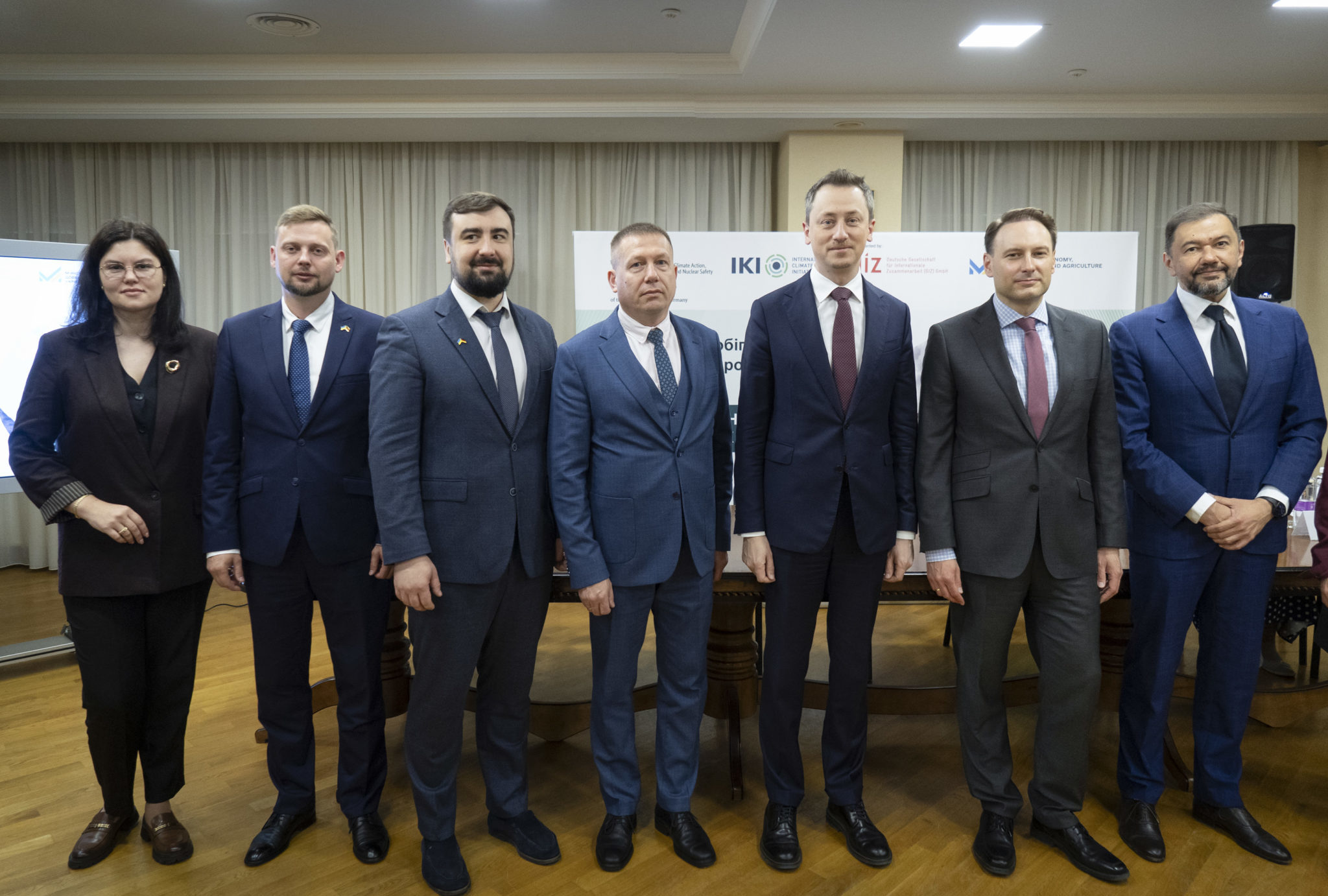
On 27 May, Kyiv hosted a roundtable entitled ‘Reform of industrial pollution prevention and control: introducing unified permits’. Participants included representatives of Ukraine’s Ministry of Economy, Environment and Agriculture, the Verkhovna Rada, GIZ, international partners, experts, business and civil society.
Participants discussed the reform of the environmental permitting system: integrated permits and a new stage of reform involving unified permits for companies not subject to integrated environmental permitting. They also discussed digitising procedures, aligning Ukrainian legislation with EU standards and launching an IT system for integrated environmental permits. Particular attention was paid to IT solutions and the practical challenges of creating a new digital system for environmental regulation.
SaveDnipro chair and co-founder Iryna Chernysh stressed that developing the new system must include laying the foundations for institutional memory and ensuring that government digitalisation departments play a more active role in developing environmental IT solutions.
‘We are already seeing initial procedural issues in the new system that need further work. Given the ambitious plans, we want to stress the importance of involving digitalisation departments at every stage of development, because these IT solutions are the direct interface for working with the permits,’ said Iryna Chernysh.
Deputy Minister of Economy, Environment and Agriculture of Ukraine Oleksandr Krasnolutskyi confirmed that the merger of several ministries had created organisational challenges, but said digital transformation departments would be more actively involved in further work on the reform.
‘We will involve the digital transformation department more actively in these processes. They have taken part in discussions and expressed their position, so they are not standing aside from this work’, said Oleksandr Krasnolutskyi.
GIZ representatives also reported that IT solutions for the new permitting system were being developed with the involvement of the relevant state bodies and would receive support for several years after the systems entered operation.
‘We are the principal commissioners of these IT solutions, and our work does not end until the systems operate as closely as possible to their intended objectives’, said GIZ deputy project director Andrii Hunko.
The future model for issuing integrated permits prompted a separate discussion. Iryna Chernysh asked whether the ministry planned to become the issuing authority for permits currently issued by regional military administrations and the State Water Resources Agency, and whether this would complicate matters for business.
Bohdan Semenenko, Head of the Department of Environmental Protection and Industrial Pollution Prevention and Control at Ukraine’s Ministry of Economy, Environment and Agriculture, explained that regional military administrations would remain the permitting authorities at the first stage, while all procedures would have to operate within a single digital ecosystem.
‘In the longer term, we would like to move to a single environmental permit model, in which the relevant bodies and departments act as competent authorities within a shared system’, said Bohdan Semenenko.
Industrial pollution prevention and control reform is one of Ukraine’s key environmental reforms for EU integration. Its purpose is to move from separate environmental permits to a single digital system of environmental regulation based on EU standards. The law on integrated industrial pollution prevention and control entered into force in 2025, but the full transition to the new system will take place in stages, taking account of martial law and a transition period for business expected to last until approximately 2029–2030.
This material was produced with funding from Sida and support from WWF. Its contents are the sole responsibility of SaveDnipro and do not necessarily reflect the views of Sida, the Government of Sweden or WWF.