
Translation note: This article was published on 24 February 2023. Its incident counts, reported threats and descriptions of nuclear plant conditions reflect the first year of the full-scale invasion, not the current situation.
On 24 February, we mark the anniversary of the full-scale invasion and the start of full-scale Russian nuclear terrorism. Seizing and shelling nuclear plants, emergency shutdowns, lies and blackmail are only some of Russia’s methods of pressuring Ukraine and the world. Despite the extreme danger, none of these actions has given Russia an advantage in this war. It is time to review what happened to Ukraine’s nuclear facilities during the year and draw conclusions.
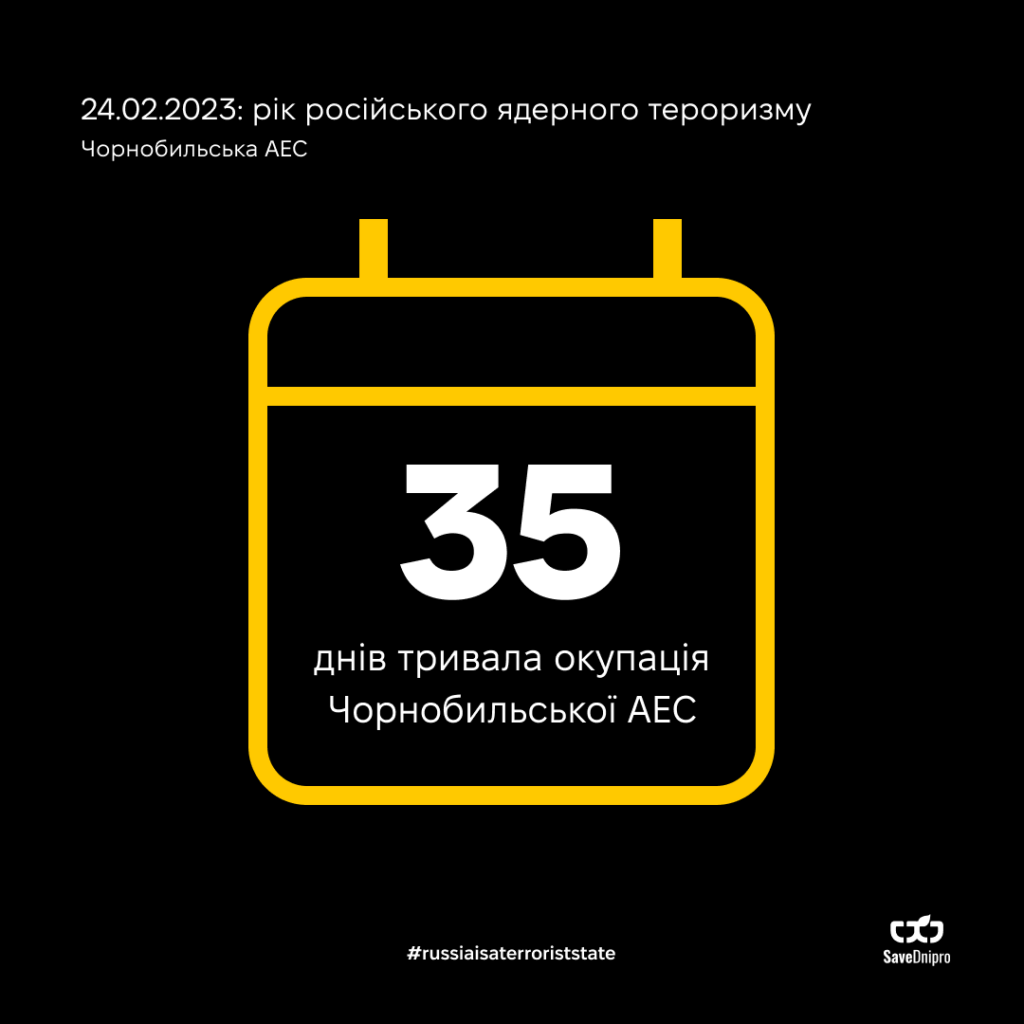
The occupation of Chornobyl Nuclear Power Plant and the Exclusion Zone lasted 35 days
On the first day of the full-scale invasion, Russian forces seized Chornobyl and its Exclusion Zone, areas kept restricted for decades because of their hazards. On the night of 24–25 February, SaveEcoBot recorded radiation readings up to 30 times higher at and around the plant. Occupying troops moved heavy military vehicles through the area, dug trenches in the Red Forest and deliberately set fire to contaminated woodland, releasing radioactive substances into the atmosphere.
From the outset, SaveDnipro has closely followed background radiation in Ukraine, collecting state and private monitoring data and installing our own stations, as well as documenting Russian nuclear terrorism. We created a landing page with a chronology of Chornobyl’s occupation and plan to add information on nuclear terrorism at other plants affected by Russian aggression. Available in Ukrainian and English, it aims to inform as many people as possible about Russia’s predatory actions. We must draw public and international institutions’ attention to Russian nuclear terrorism.
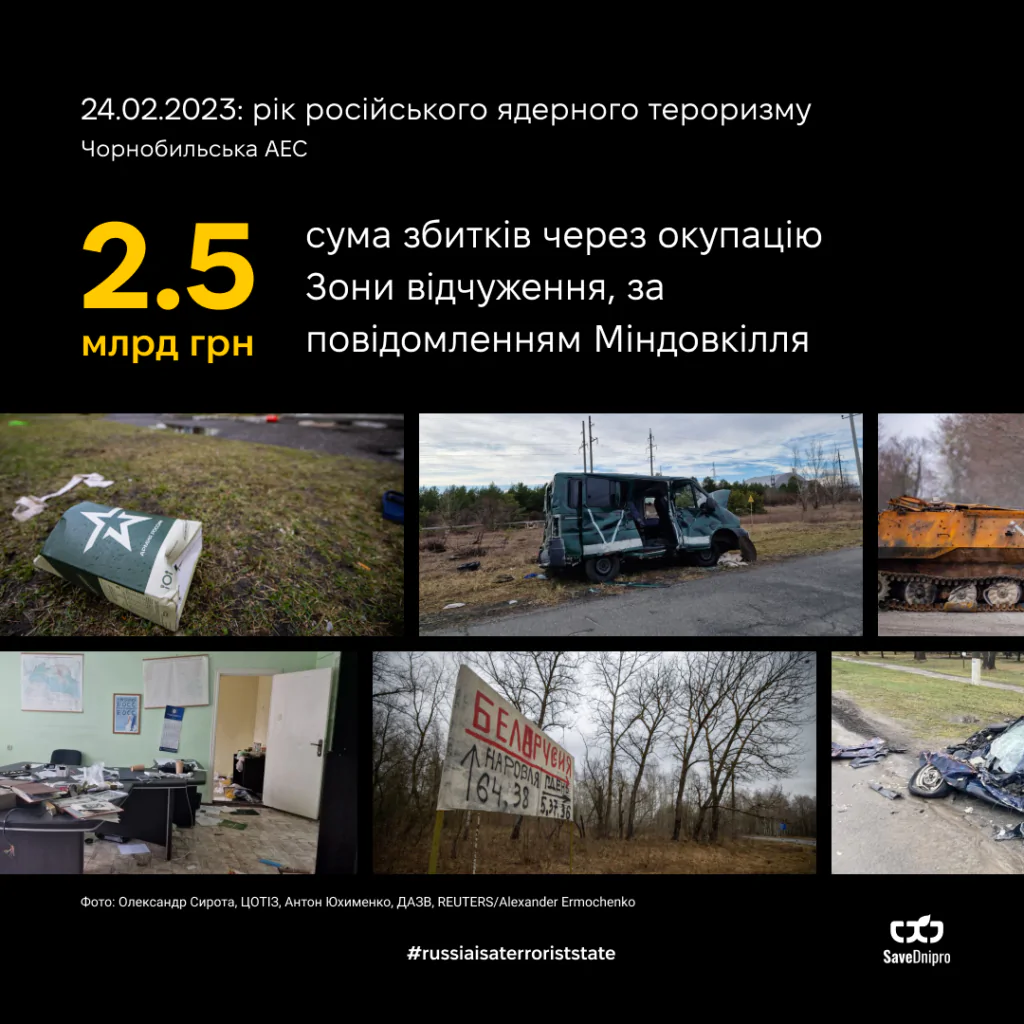
UAH 2.5 billion in damage from the occupation of the Exclusion Zone, according to the Environment Ministry
Chornobyl’s Exclusion Zone was occupied from 24 February to 31 March. During that time, occupying forces disabled radiation monitoring and destroyed almost 100 pieces of modern equipment at the Central Analytical Laboratory in Chornobyl. Repeated fires also destroyed almost 12,000 hectares within the unique Chornobyl reserve. Total damage from Russian actions reached UAH 2.5 billion. Ukraine will need considerable time to restore scientific research and work to their pre-invasion level.
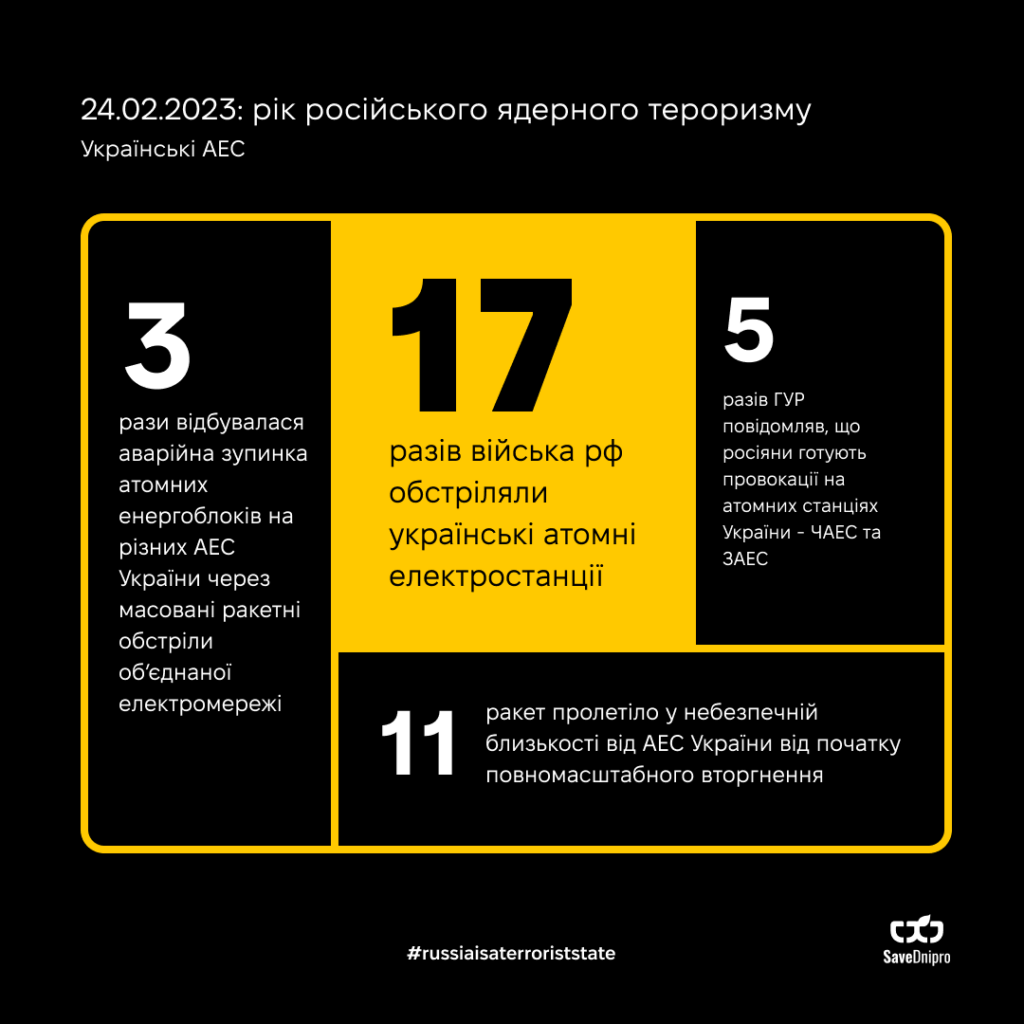
Eleven missiles passed dangerously close to Ukrainian nuclear plants after the full-scale invasion began
Russian forces appear never to have seriously considered the consequences of their actions. Otherwise, it is hard to explain cruise missiles repeatedly passing dangerously close over Ukrainian nuclear plants: seven over South Ukraine, two over Khmelnytskyi and two over Zaporizhzhia. It is frightening to imagine what could have happened had one accidentally fallen onto a plant.
Three emergency shutdowns occurred at Ukrainian nuclear plants because of large-scale missile attacks on the integrated electricity grid
When Russia realised Ukrainians could not be defeated on the battlefield, it began large-scale missile attacks on critical energy infrastructure. Power supply disruptionscaused three emergency shutdown events at different plants. On 15 November, Khmelnytskyi and Rivne were partially disconnected. On 23 November, falling grid frequency triggered emergency protection at Rivne, South Ukraine, Khmelnytskyi and Zaporizhzhia, automatically disconnecting all power units. The large-scale attack of 10 February 2023 also shut down one Khmelnytskyi unit. Although plants are designed to handle emergency shutdowns, these remain dangerous: all need electricity for their own systems, including reactor fuel cooling. Diesel generators can operate only for a limited period. Failure to repair the grid could have had terrible consequences.
Russian forces shelled Ukrainian nuclear plants at least 17 times
Russian nuclear terrorism has no limits. On 19 September, Russian forces attacked South Ukraine Nuclear Power Plant, probably with an Iskander missile. It exploded 300 metres from a reactor, leaving a crater four metres wide and two metres deep.
Occupied Zaporizhzhia suffered the most shelling because of its proximity to the front line and its value as leverage for Russia. Russian forces effectively turned it into a military base. From the night it was seized, impacts struck the industrial site, areas near power units, the dry spent fuel storage facility, welding facilities and radiation source storage areas. Shelling seriously damaged the nitrogen–oxygen station on 5 August and a plant building on 20 August, creating risks to radiation and fire safety. At least 12 impacts on 20 November damaged condensate storage tanks and caused a non-radioactive leak.
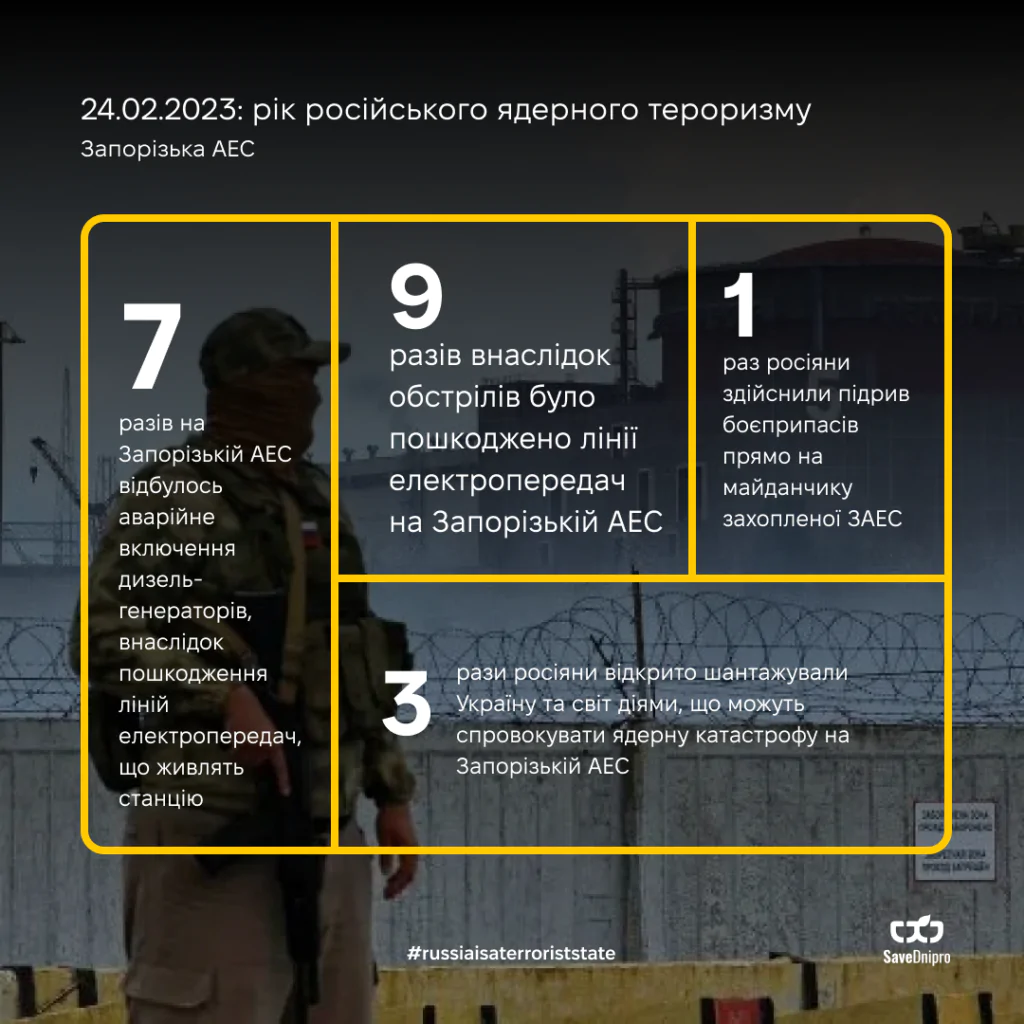
Russian forces detonated ammunition on the occupied Zaporizhzhia plant site on one occasion
Indiscriminate shelling was not enough: on 14 March 2022, occupying troops detonated ammunition near the ruins of the training centre and Power Unit 1 at Zaporizhzhia.
Shelling damaged Zaporizhzhia’s power lines at least nine times
Repeated shelling damaged both buildings and power lines connecting the plant to Ukraine’s integrated grid. A nuclear plant’s safety depends on reliable electrical supplies and grid connections. Recurring high-voltage line damage forced Zaporizhzhia’s units to shut down or reduce output to meet only the plant’s own needs.
Damage to external power lines triggered emergency diesel generators at Zaporizhzhia at least seven times
Nuclear plants are complex facilities whose safety depends on many factors. Their engineers accounted for physical hazards, but could hardly have imagined an adversary acting as an unprincipled nuclear terrorist. Damage to Zaporizhzhia’s power lines could not always be managed simply by reducing output. When the plant lost all grid connections, emergency diesel generators started. This happened at least seven times during the year, leaving extremely limited margins for avoiding catastrophe. Fortunately, Ukrainian energy workers repaired the damage in time.
The longer Zaporizhzhia remains occupied, the clearer the need for stronger action. To help develop a new radiation safety mechanism, SaveDnipro organised the roundtable “Ukraine’s Nuclear Safety Is the World’s Safety: An Action Plan for Ukraine”, held on 21 February.
Participants included representatives of Ukraine’s Energy, Foreign Affairs and Environment ministries, the State Emergency Service, Ukrainian Hydrometeorological Centre, State Nuclear Regulatory Inspectorate and Cherkasy Regional Military Administration. Civil society and expert participants included SaveDnipro head Iryna Chernysh, SaveEcoBot lead developer Pavlo Tkachenko, Greenpeace nuclear energy and energy policy experts Shaun Burnie and Jan Vande Putte, who had undertaken missions to Chornobyl and Zaporizhzhia, former MP and International Centre for Ukrainian Victory member Viktoriia Voitsitska, and Ecoaction representative Artem Kolesnyk.
The roundtable aimed to develop a roadmap for stakeholders’ further efforts to uphold Ukraine’s interests in wartime nuclear safety internationally and domestically.
Russia openly threatened Ukraine and the world three times with actions capable of causing a nuclear disaster at Zaporizhzhia
Blackmail is integral to terrorism, including nuclear terrorism. Occupying and shelling Zaporizhzhia was not enough for Russia: it openly threatened actions capable of triggering a disaster at Europe’s largest nuclear plant on at least three occasions.
On 8 August, the occupying forces announced that they had mined Zaporizhzhia and were ready to blow it up. The original account attributes the following statement to Major General Valery Vasilyev, then commanding the plant’s Russian garrison: “This will either be Russian land or a scorched desert.” On 18 August, the same commander threatened: “The possibility of placing Power Units 5 and 6 into cold reserve may be considered,, which would stop the plant.” If the units stopped, their electricity could no longer be used to cool fuel if the plant lost external power. This would bring a radiation accident scenario closer.
Later, on 20 October, reports emerged that Russian forces had mined the Kakhovka dam and generating equipment. The original account cites a reservoir volume of around 18 million cubic metres. It warned that destruction of the dam would threaten the water supply used to cool Zaporizhzhia’s units.
Russia spread false claims at least five times about Ukraine making a dirty bomb or planning a provocation involving radioactive substances
Terrorists lie and bluff, and Russian nuclear terrorists are no exception. The occupying forces spread falsehoods about nuclear safety violations at Zaporizhzhia, including claims that heavy military equipment and ammunition they had brought in belonged to Ukraine. In October 2022, they accused Ukraine of preparing a dirty bomb using spent nuclear fuel and radioactive waste stored at the plant. In January 2023, they falsely alleged that weapons and ammunition supplied to Ukraine were being stored at Rivne Nuclear Power Plant. In February, Russia’s Defence Ministry accused Ukraine of planning radioactive contamination of its own territory to blame Moscow before the UN General Assembly’s extraordinary session on 22 February.
In contrast, Ukraine has maintained its IAEA commitments and the seven pillars of nuclear safety at its nuclear facilities. On the invasion’s anniversary, reported background radiation levels remained safe. Readings can be checked on our radiation map.
Ukraine’s Defence Intelligence reported preparations for Russian provocations at Chornobyl and Zaporizhzhia at least five times
Ukraine’s Defence Intelligence repeatedly reported preparations for provocations at occupied nuclear plants. In March, it warned of a planned terrorist attack at Chornobyl that Russia would try to blame on Ukraine. Alarming reports also came from Zaporizhzhia. The latest warning at the time was in early December, when Russian forces brought several Grad multiple-launch rocket systems onto the occupied site. Such provocations share a purpose: to convince the world of Russia’s readiness for extreme brutality and serious crimes in pursuit of its demands. Ukraine and the world are prepared to resist.
The IAEA lost communications with occupied Chornobyl and Zaporizhzhia for at least 28 days
Industries using nuclear technologies are highly regulated and closely supervised nationally and internationally. The IAEA promotes peaceful nuclear energy and seeks to prevent its military use, including nuclear weapons. Its programmes support peaceful nuclear science and technology, safeguards against misuse of nuclear materials and technologies, and the development and implementation of safety standards. Continuous communication with member states’ nuclear plants is therefore vital. Russian aggression nevertheless left the Agency without communications with Chornobyl and Zaporizhzhia for 28 days.
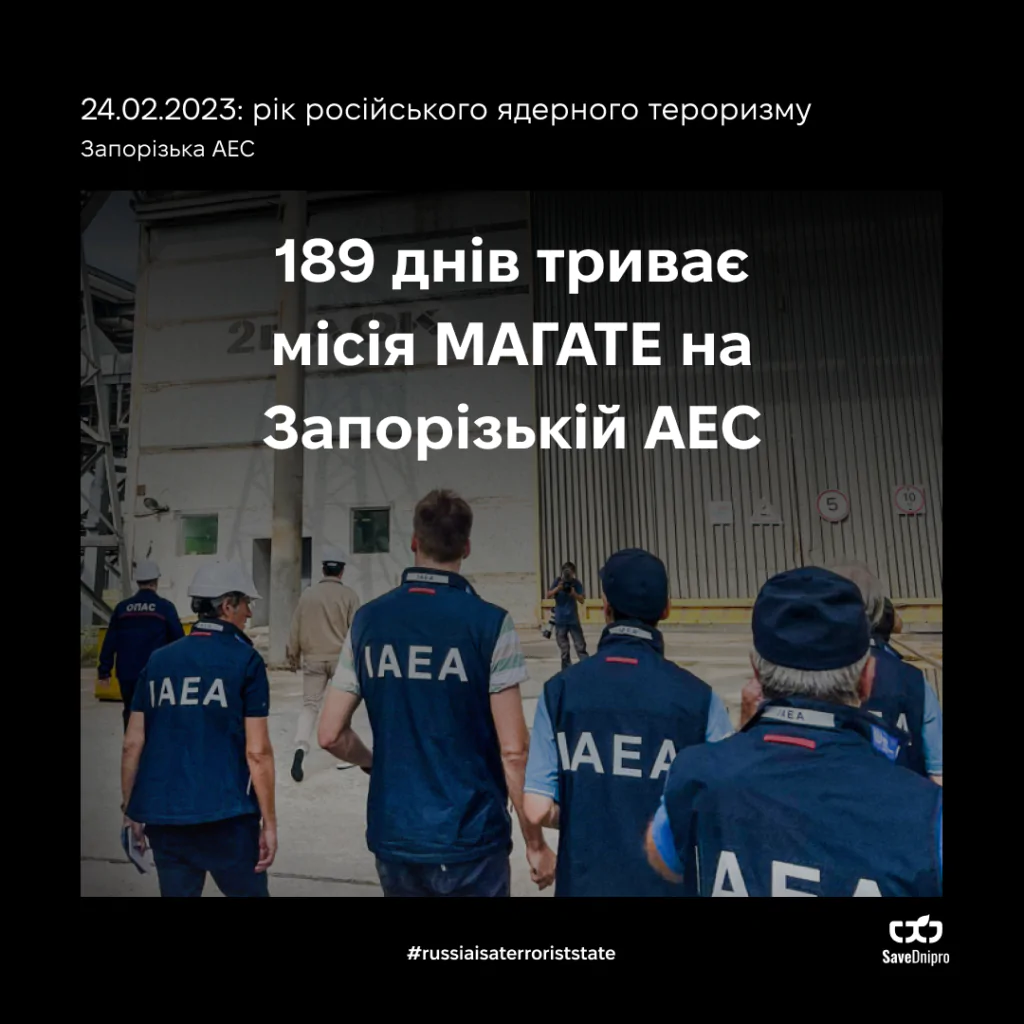
The IAEA mission at Zaporizhzhia had continued for 189 days, according to the original account
Despite the IAEA’s important role in global nuclear safety, its first mission reached Zaporizhzhia only on 1 September. On the anniversary of the full-scale invasion, the original account reports its continuous presence for 189 days. Independent experts’ presence is vital because it enables a more objective assessment of the situation. Inspectors can see Russian actions at the plant for themselves, helping expose false claims.
To stop Russian nuclear terrorism, SaveDnipro and other civil society organisations sent a joint open letter to the IAEA’s governing and executive bodies and held a protest in Vienna during the Agency’s 66th General Conference. Civil society demanded Russia’s removal from the Board of Governors, suspension of its membership rights, removal of Russian citizens from executive duties, and suspension of current technical cooperation and scientific and technological exchanges between the Agency, Rosatom and Rosenergoatom.
On the anniversary of the full-scale invasion, it is appropriate to review a year of Russian nuclear terrorism. It is difficult to count how many times the world stood one step from disaster. The year exposed the shortcomings of the global security system and how much time and how many crises are needed to confront new challenges. Despite daily danger, threats, blackmail and shelling, the world has neither stopped the war nor even established a demilitarised zone around Zaporizhzhia. The danger remains as acute as on the first day. The international community must intensify its efforts, and civil society must increase pressure on international organisations to end this nuclear terrorism sooner. Only together can we stop this nuclear madness!