Translation note: This article records the information and estimates cited in December 2022. Damage totals, wildlife losses and descriptions of nuclear plant conditions are historical and have not been updated; figures from different assessments are not necessarily directly comparable.
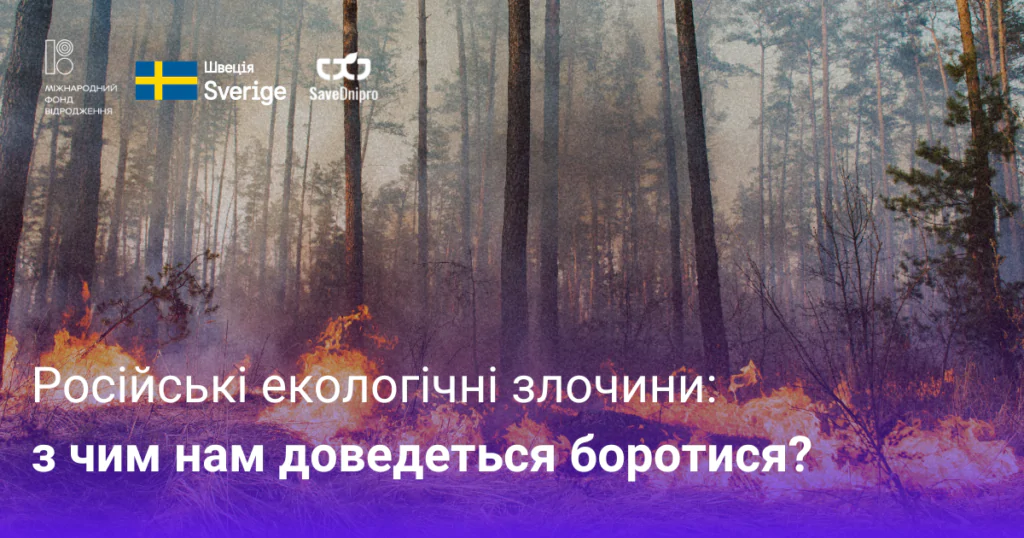
In the quantity of weapons used and the brutality and uncompromising violence involved, the full-scale war in Ukraine can be compared only with the Second World War. By late December, conservative estimates indicated that Russian aggression had caused UAH 441 billion in environmental damage. These are only preliminary calculations: we do not yet know the true scale or cost of the harm Russia has inflicted. We can nevertheless analyse environmental crimes now so that restoration can begin immediately after victory.
War affects every component of Ukraine’s ecosystems: it pollutes water and air, destroys soils, burns forests and unique protected areas, and kills thousands of animals. Let us review the major environmental crimes to understand what work lies ahead.
Atmospheric pollution
The atmosphere may face the war’s greatest impact, as hostilities involve constant fires and explosions. Both sides strike opposing positions, ammunition stores and equipment. Millions of tonnes of emissions enter the atmosphere: fine particles, nitrogen oxides, sulphur oxides, aldehydes, anhydrides and more. These substances alter air quality and, after chemical transformations, affect water, living organisms and soils, and contribute to climate change. The mechanisms linking war, air quality and climate are explained in our article.
In attempts to weaken Ukraine’s Defence Forces, Russia has attacked oil depots and refineries since the start of the full-scale invasion. The first such attack was a ballistic missile strike on an oil depot in Vasylkiv district, Kyiv region, on 27 February 2022. The fire was visible from central Kyiv and burned for days until the petroleum products were consumed. The original article cites a preliminary environmental damage estimate of UAH 810 billion for this attack.
The war’s atmospheric impact is immense. Most alarmingly, we cannot simply clean the entire atmosphere. We can stop the war and wait for emissions to disperse, become assimilated in natural systems and undergo chemical reactions. We can also continuously monitor pollutant transformations to understand these processes and their effects on people and environmental components. This will not undo the damage but can help develop clear response procedures for similar events. You can check current reported air quality in your city on our map.
Destruction of protected areas
Another terrible consequence is the destruction of protected sites. Hostilities have put 900 protected areas at risk, covering 1.2 million hectares, or 27% of Ukraine’s protected land.
Losing even one protected site is a tragedy: unique protected animals and plants die, while distinctive landforms, soils and ecosystems are destroyed and may be almost impossible to restore.
One of the gravest crimes against Ukraine’s protected areas is destruction of the Kinburn Spit ecosystem. Bordered by the Black Sea, Dnipro–Buh estuary and Yahorlyk Bay, it preserves virgin sandy steppe, relict forests, floodplains, wetlands, fresh and salt lakes, saline soils and natural spawning grounds. It supports 415 rare animal species, including 166 listed in Ukraine’s Red Data Book, and at least 47 rare plant, fungal and lichen species. Some estimatesput the affected area at up to 10,000 hectares, around 30% of Kinburn’s forests.
Another major tragedy is destruction of the unique ecosystem of Zmiinyi, or Snake Island, a nationally protected reserve. It is also a unique historical site, sacred to the ancient Greeks. Will we be able to restore its natural environment?
After victory, restoring protected areas will require enormous effort, funding, commitment and assistance. It is a challenge that Ukrainian and international scientists must accept.
Hostilities at Chornobyl and its Exclusion Zone, and Russian nuclear terrorism at Zaporizhzhia
Russia’s use of Ukrainian nuclear plants as military bases and instruments of blackmail and terrorism is unprecedented in warfare. Chornobyl was seized in the war’s first days, frightening Ukraine and the world when radiation readings suddenly rose thirtyfold. Seeking an advantage through surprise, Russian troops drove heavy vehicles through the Exclusion Zone and dug trenches, raising radioactive dust. With Chornobyl back under Ukrainian control, the article reports radiation levels normal for an area that has experienced a nuclear accident. Readings can be explored on our map of background radiation.
Russia then seized Zaporizhzhia, Europe’s largest nuclear plant, and used it for daily blackmail and terrorism. Repeated shelling, storage of military equipment and ammunition on site, torture of staff and disregard for all seven nuclear safety pillars form part of its strategy. The world again stands close to a radiation accident in Ukraine because it was too naive and indecisive, as we discussed previously.
Our global task is now to change how international organisations and the wider community respond to such events, develop a rapid response to nuclear terrorism, and create effective safeguards against another security catastrophe.
Soil destruction and landmines
Hostilities destroy Ukraine’s fertile soils. Every day, missiles and artillery shells leave deep craters, change soil structure and contaminate land with rocket fuel and fragments.
According to a report by the State Environmental Inspectorate, as of 30 November 2022 armed aggression had contaminated 291,826,950 square metres and littered 8,099,793,440 square metres of Ukrainian land, causing UAH 448.9 billion in damage. Mining is another form of contamination: the article cites 30% of Ukraine’s territory, or 170,000 square kilometres.
The impact on soil is immense, affecting ecosystem resilience and balance as well as food security. Ukraine has some of the world’s most extensively ploughed land, and there is a risk of converting further areas to meet demand, to the environment’s detriment. Before the full-scale invasion, Ukraine was a leading supplier of wheat, barley, maize, rapeseed, sunflower oil and rapeseed oil. Its share of global grain exports alone was 10% in 2020–2021 and 14% in 2021–2022.
Russia’s invasion damaged farmland and prevented sowing, leaving war-affected land without harvests. Nevertheless, we continue planting and sowing because we understand our soils’ value and believe in victory.
Can our land be restored? How can it be cleaned of explosive residues, fuel and lubricants? Should contaminated topsoil be taken to specialised treatment sites? We face many questions and the ambitious goal of reclaiming Ukraine’s soils.
Water contamination — surface water and groundwater
Hostilities also pollute water. Missiles strike rivers and lakes, naval mines fill our coastal waters, and large quantities of petroleum products and dead Russian soldiers’ bodies enter them. It is difficult to establish which combinations of pollutants occur near the front or which reach other parts of Ukraine through transport and transformation, such as smoke from ammunition depots.
Modern warfare is unique in many respects. Military industries and thousands of scientists have continually developed new weapons, rocket fuel mixtures and explosives. Their composition is secret, leaving us uncertain about the substances entering our waters, their quantities, reaction rates, resistance to hydrolysis and uptake by aquatic organisms. We do not know their full human effects and have very limited knowledge of pollution from modern weapons.
Another pressing question is whether war-contaminated water reaches soil-water and groundwater layers. What happens to pollutants there, and which reactions occur? We do not yet know. These processes must be studied so that methods can be developed for cleaning Ukraine’s waters.
Mass animal deaths caused by Russian aggression
Repeated shelling, fires and chemical, physical and mine contamination of habitats have caused mass deaths of wild and domestic animals. More than 80 species face extinction. While the war continues, Ukrainians’ ability to help is severely limited: we cannot save even half the animals at risk.
The article cites an estimated 50,000 dolphin deaths in the Black Sea, attributed to sonar used by Russian warships disrupting their ability to navigate. It reports 2,500 carcasses found on the Ukrainian, Bulgarian and Romanian coasts and cites international research suggesting only 5% of dead dolphins wash ashore.
Animals also die on numerous farms under occupation or near the front. One major tragedy was at the Chornobaivka poultry farm in Kherson region, where around four million chickens died.
The war continues, and we cannot know how many more such disasters may occur. We must develop not only conservation plans but also mechanisms to protect animals during hostilities and obtain reparations for restoring wildlife.
The year 2022 was tragic, destructive and merciless for Ukraine’s environment and the planet’s natural world. Our first goal is victory, towards which we are moving resolutely. The next is environmental restoration, because our future depends on it. We must study, document and calculate the damage to seek reparations and develop clear restoration methods. Nature will flourish again. In the new year, our series on restoring Ukraine’s environment will explore the best and most modern approaches.
Since the full-scale invasion began, SaveDnipro has documented Russia’s environmental war crimes through our bot in Telegram and Viber. Join the initiative, follow environmental monitoring maps for your safety and report environmental crimes so that Russia is held accountable for every one of them!
This material was produced within the Environmental Policy and Advocacy Initiative in Ukraine, implemented by the International Renaissance Foundation with financial support from Sweden.