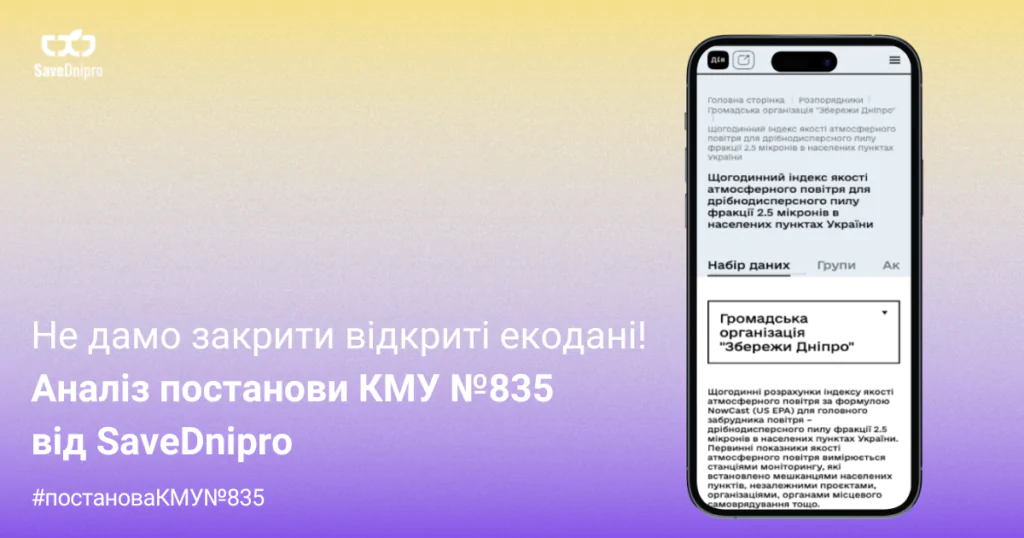
The Ministry of Digital Transformation proposes closing a large number of datasets through amendments to Cabinet resolutions No. 835 of 21 October 2015 and No. 867 of 30 November 2016, citing the new security conditions of martial law.
SaveDnipro opposes closing critically important environmental data. We have analysed the datasets and prepared arguments for keeping this information openly available.
We reviewed the full list of environmental datasets proposed for closure under the draft amendments to Cabinet Resolution No. 835 and identified 22 for which open, machine-readable access remains essential even under martial law.
Taking the new conditions into account, our proposals insist on retaining all data. We suggest limiting businesses’ registered and operating addresses to the settlement name while keeping that information public, because:
– it enables local assessment of the environmental and public health consequences of business activities;
– access to environmental information is protected by the Aarhus Convention and Article 50 of Ukraine’s Constitution. The public needs these data to participate in environmental decision-making and access justice.
For periodically published information, such as electricity generation data, we propose retaining open access with a delay of 30 calendar days to address security concerns. Public access to these datasets is important because the electricity sector directly affects climate change and emits air pollutants.
You can find the full dataset list, analysis and SaveDnipro’s arguments in our section on opening environmental data.
We also have good news to share!
As you know, SaveDnipro champions open data. We recently became a data publisher ourselves by releasing our dataset of hourly air quality index calculations. The ambient air quality index for fine particulate matter of 2.5 micrometres in Ukrainian settlements, calculated by SaveEcoBot , is now an official source, with SaveDnipro as the owner of the data listed in the state open data register. Anyone interested in working with air quality data can now readily use this structured, machine-readable information.