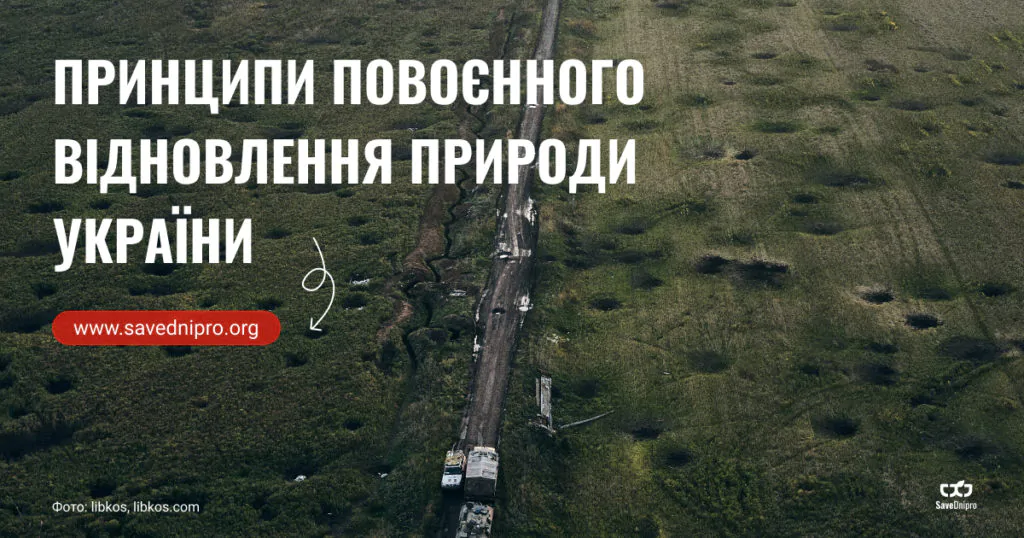
The full-scale war continues, and Ukraine’s natural environment continues to suffer immense damage. According to the Ministry of Environmental Protection and Natural Resources, in 2022 it recorded 2,278 incidents of environmental harm worth more than UAH 1.6 trillion. Losses will keep growing until victory, but the main pollutants and contamination mechanisms are already apparent, allowing us to plan further action.
The goal of post-war environmental recovery should not be to return ecosystems to their pre-war condition. It should be to build an entirely new system of natural resource management in which the value and integrity of the environment matter as much as those of society. Reconstruction planning must be inseparable from a vision of a sustainable future for coming generations. We need systemic changes across public sectors and society. Here are the principles we believe should guide nature’s recovery.
Principle one: changing our mindset
Building a new country requires a different attitude to the environment. Our Soviet inheritance includes not only management systems, industrial facilities and infrastructure, but also a way of thinking. The Soviet Union pursued a self-centred policy of conquering nature for gain: ploughing land, cutting forests and extracting minerals. Loud slogans were imposed on Ukrainians, such as the claim that we should not wait for nature’s favours but take them ourselves.
This created a value system in which people could use resources without limit and operate without assessing environmental impacts. Natural riches were assumed to be endless, humanity all-powerful against nature, and economic development more important than the environment. This shaped personal attitudes too, treating the environment as secondary and its degradation as something not worth considering.
Unfortunately, Ukrainians have not yet fully overcome this attitude. One principle of future reconstruction must therefore be sustained work to change thinking and raise environmental awareness. People need a clear understanding of ecosystem integrity and balance, their own place within nature, and the environmental significance of their actions. Administrative, economic and social changes can then account for environmental concerns and gain public support.
Principle two: green recovery
Green recovery seeks a balance between the interests of communities, businesses and the environment. Every reconstruction measure must include an environmental dimension so that the new Ukraine is comfortable and safe for everyone. Green recovery rests on:
- embedding environmental and climate policy across all sectors: environmental considerations should be part of every political and administrative decision, just as people are inseparable from nature;
- recovery that serves society’s needs and supports sustainable development;
- developing a green economy;
- introducing and strictly observing environmental standards at every level;
- involving the public and local communities in environmental decisions.
Principle three: innovation
Researchers in many fields make new discoveries every day, and the world is full of technologies capable of making life easier and more comfortable. Environmental innovations abound, including technologies developed in Ukraine. We must actively use these opportunities in rebuilding the country.
Rebuilding is always harder than destroying. Sadly, the list of things to restore or build anew is long: homes, energy infrastructure, industry, roads and more. We must ask ourselves whether to use the same technologies as 30 years ago or embrace innovation.
Industrial reconstruction should introduce climate-neutral technologies, modern filters and improved production lines. Could suitable used plastics and safe industrial residues help rebuild roads, and construction waste help rebuild homes? Could cities be restored with vertical greenery, rain gardens and alternative energy sources? Ukraine’s recovery is our chance to build a modern country where every step considers environmental impacts.
Principle four: science-based ecosystem restoration
We recently wrote about Russia’s environmental crimes against aquatic, soil and other ecosystems, and the challenges ahead. The consequences of active warfare remain a largely unexplored field for natural sciences. During the Second World War, researchers could not study, for example, soils baked by missile strikes: how do their physical properties and fertility change? Which plants are best for reclamation? Should such soils be collected and treated at specialised sites? The scientific community still needs answers.
Some environmental harm remains extremely difficult to address. Air pollution, for example, is harder to remedy once it has dispersed. Wartime fires release fine particles and gases that spread rapidly and react with other substances. We often have to wait while pollutants undergo chemical transformations and disperse. In such situations, our immediate capacity is largely limited to studying and monitoring these processes and developing methods for rapid emergency response.
Restoring Ukraine’s environment could become a unique scientific challenge and ambitious project for researchers worldwide. Returning it exactly to its pre-war condition is impossible, but we can mobilise scientific expertise to improve the situation and help ecosystems gradually reach a new balance.
Principle five: open environmental data
Greater environmental awareness and recognition that people are inseparable from nature will inevitably increase interest in the country’s environmental condition. Open environmental data are a public necessity.
Demand for environmental information will encourage both the opening of datasets and greater public involvement in environmental decision-making. Communities will understand the value of this information and influence both data holders and public authorities. This will also support renewal and expansion of monitoring networks. Soviet-era monitoring stations and methods still operate in parts of Ukraine despite many newer technologies worldwide. The state network does not even cover half the country, leaving only fragmented empirical information about environmental conditions.
SaveDnipro actively campaigns for open environmental data. We recently presented an analysis of Cabinet Resolution No. 835, available here. We also recently published our dataset of hourly air quality index calculations. The index for fine particulate matter of 2.5 micrometres in Ukrainian settlements, calculated by SaveEcoBot , is now an official data source, with SaveDnipro as the owner of the data listed in the state open data register. Anyone interested in working with these data can therefore readily use the structured, machine-readable information.
Principle six: integration into international green programmes
Ukraine chose its European path long ago and demonstrated that choice in 2022 through determined resistance to Russian forces. Full EU integration is possible only on the basis of sustainable development and the European Green Deal, also supporting compliance with the Copenhagen accession criteria.
The European Green Deal is highly ambitious, aiming for a climate-neutral continent by 2050. Ukraine looked towards this programme before the full-scale invasion, though achieving its goals was extremely difficult. With renovation now critically necessary, the opportunity to pursue that goal becomes more tangible.
Restoring Ukraine’s natural environment after the war is another challenge for Ukrainians. A new vision and sound reconstruction principles can help us build an environmentally responsible country where society’s needs respect environmental limits. We have substantial human and scientific potential, resources, motivation and support from international partners. What remains is to develop an action plan and follow it consistently. We believe that together we can succeed!
This publication was produced with the support of the European Union. Its contents are the sole responsibility of SaveDnipro NGO and do not necessarily reflect the views of the European Union.