Translation note: This article was published in March 2023. Figures and forecasts are those cited in the original account at that time, rather than updated estimates.
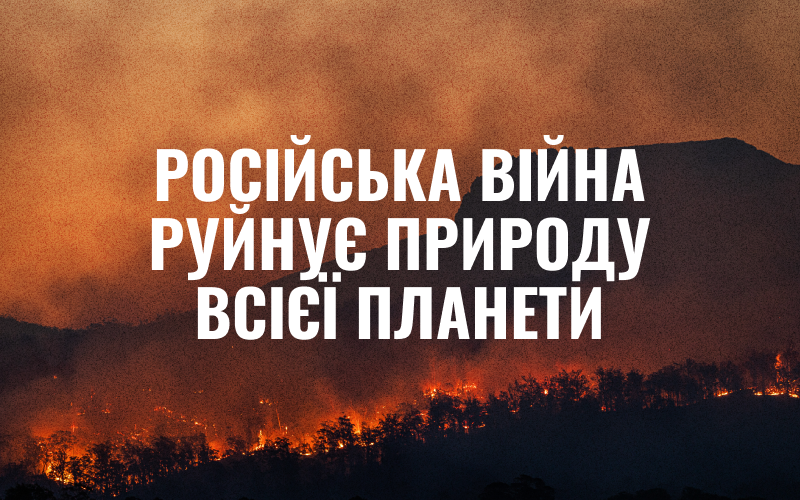
Earth Day is marked on 20 March, the spring equinox, to draw public attention to our planet and remind us of the need to care for it. Given the day’s peacebuilding and humanitarian focus, SaveDnipro wants not only to highlight once again the devastating environmental effects of Russia’s war against Ukraine but also to explain how the war affects nature across the planet.
It may seem that only Ukraine’s environment suffers from the war, but that is far from true. Nature is a vast system of interdependent elements. Major changes in one element inevitably produce changes throughout the system over time. Environmental destruction knows no borders, and sooner or later all humanity will feel its effects.
Russian aggression pollutes the air and accelerates climate change
War means constant fires in many different places, from forest fires to especially harmful fires at oil depots and ammunition stores. Large quantities of carbon monoxide, carbon dioxide, benzo[a]pyrene, sulphur oxides, nitrogen oxides, gaseous and solid products of incomplete fuel combustion, vanadium compounds, sodium salts and other substances enter the atmosphere. These emissions harm human health, while climate-warming components add to the greenhouse effect. Depending on wind strength and direction, pollutants can travel hundreds of kilometres beyond Ukraine.
Soot also has a destructive effect on the climate. According to scientists’ calculations , the overall contribution of fine soot to Earth’s heat balance exceeds that of any individual greenhouse gas except carbon dioxide. Fine particles affect the climate because their small size enables them to travel long distances and remain airborne for extended periods. This is particularly pronounced in dry seasons, when air masses can carry them even to permanently frozen regions. Normally, bright white ice reflects sunlight, limiting heating. When soot darkens frozen surfaces, less solar radiation is reflected, increasing warming and accelerating melting.
Two different mechanisms are at work: soot particles absorb solar energy, while greenhouse gases impede the escape into space of heat emitted by the Earth, including energy absorbed during the day.
Climate change is already apparent in exceptional summer heat, drought in some regions and abnormal rainfall in others. The war in Ukraine is therefore not a local problem: it is contributing to changes in the climate of the entire planet!
Russian aggression pollutes the planet’s water resources
Water is one of our most important natural resources. Humans lived for centuries without gas, coal or oil, but can survive only days without water and minutes without air. Clean water is essential not only for people but also for thousands of animal and plant species. Water sustains life and connects everything into one vast system. This is why war has such devastating effects on water resources.
Missiles strike our rivers and lakes, our coast is filled with naval mines, and enormous quantities of petroleum products and the bodies of dead Russian soldiers enter the water. Pollutants entering even small water bodies can eventually reach groundwater and, through the river network, the Black and Azov seas and then the world ocean. These war-related contaminants undergo chemical transformations, affect aquatic flora and fauna, and in some cases accumulate in aquatic animals’ bodies.
Russian aggression reduces biodiversity and disrupts ecosystem balances
Fires and water and air contamination do more than transform and burn the environment: they kill animals and plants from dozens of species. As a result of hostilities, 900 protected areas, 600 animal species and around 750 plant and fungal species were reported to be at risk. Losing even one protected site is a tragedy: unique animals and plants die, and distinctive landforms, soils and ecosystems are destroyed, with restoration often almost impossible.
The effects of losing large numbers of animals, or even entire species, may not be immediately visible. Over time, however, the affected ecosystem begins changing and may eventually become an entirely different one. For example, the original article cites an estimate of 50,000 dolphin deathsin the Black Sea. Such a loss would strongly affect the marine ecosystem: fewer dolphins mean larger populations of their prey, which in turn reduce the organisms they feed on. If dolphin populations fail to recover, other organisms could eventually occupy their ecological niche amid climate change and other pressures. This could transform the Black Sea ecosystem, with consequences for coastal countries and their people that are impossible to predict precisely.
Russian aggression contaminates soils and undermines global food security
According to a report by the State Environmental Inspectorate, armed aggression had contaminated more than 280,000 square metres of Ukrainian land and littered 14 million square metres. Mining is another form of contamination: the article cites 30% of Ukraine’s territory, or 170,000 square kilometres. This land has become wholly or partly unsuitable for agriculture. Some areas are too dangerous to enter because of mines; others are so contaminated with harmful substances that crops grown there could contain those substances and threaten human health.
The war’s impact on soil is immense. These changes affect not only ecosystem resilience and balance but also food security. Before the full-scale invasion, Ukraine was a leading supplier of wheat, barley, maize, rapeseed, sunflower oil and rapeseed oil. Ukraine’s share of global grain exports alone was 10% in 2020–2021 and 14% in 2021–2022.
Everything in nature is connected: Russian aggression destroys Earth’s natural world
Believing that the war’s effects stay within Ukraine’s borders is an illusion. Russian military aggression pollutes the air and contributes to climate change, contaminates water, and poisons and kills animals and plants. Most frighteningly, some areas of Ukraine’s natural environment may never return to their pre-war condition, while others will change radically over time. The true changes will only become visible over years and decades. We must remember that war affects the planet’s entire natural world and humanity as a whole.SaveDnipro is helping document Russian war crimes against the environment. Open @SaveEcoBot in Telegram or Viber and report environmental crimes around you. Together, we can protect the environment and hold the aggressor country accountable!