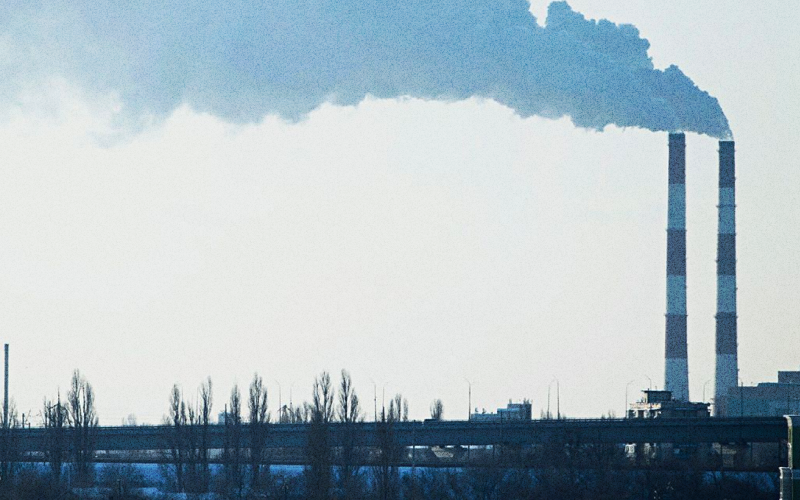
Do you know which polluting companies operate in your region and exactly what they emit? What about across the country? You would probably struggle to give a precise figure.
Yet each of us has a right to this information under the Aarhus Convention’s Kyiv Protocol. Yes, Ukraine directly participated in decisions of global significance. Signatory countries must conduct environmental policy openly, engage with citizens and involve them in environmental decisions. Establishing a national Pollutant Release and Transfer Register (PRTR) was one requirement of this international instrument.
Ukraine has already made some progress. In 2021, the Ministry of Environmental Protection presented a National PRTR concept: a map showing information about four thousand polluting companies. SaveDnipro chair Iryna Chernysh attended the official event. Unfortunately, this service is now unavailable. It was insufficient in any case: the map was only the beginning of PRTR development in Ukraine.
So what is a Pollutant Release and Transfer Register? Let us find out.
How did it begin?
Predecessors of modern systems include:
- a list of 155 chemicals from more than 7,000 industrial facilities created in New Jersey in 1978
- a form of PRTR database that existed in the Netherlands from 1974
The clear idea of a system collecting and distributing information on environmental releases emerged after India’s Bhopal disaster in 1984. More than 500,000 people were exposed to highly toxic gas, and 2,259 died immediately. Tragically, major disasters often prompt humanity to develop ways to prevent their recurrence.
PRTRs began developing in response and following the 1992 UN Conference on Environment and Development, which reaffirmed communities’ and workers’ right to know about toxic chemicals and other substances of concern.
The United States was the first to develop its Toxics Release Inventory (TRI), in 1985. Europe achieved a more established legislative framework in 2003–2006. The E-PRTR now brings together register information from EU member states, Iceland, Liechtenstein, Norway, Switzerland, Serbia and the United Kingdom, covering 35,000 industrial facilities.
Australia, Canada and Mexico also have registers, demonstrating the system’s global reach.
Is there a model PRTR?
Fortunately or unfortunately, no. Systems take different forms. Their scope and implementation details vary, but the objectives remain the same:
- provide pollution and waste data to everyone free of charge;
- organise transparent reporting to government;
- facilitate reporting under international commitments such as CLRTAP and the UNFCCC;
- make data more accessible to different government bodies;
- harmonise international pollution data standards.
Another shared and very important approach is that polluting companies themselves are responsible for submitting emission data to the register.
In the US, businesses are legally required to submit emissions information. The European Parliament regularly analyses approaches to registers and the information they contain and makes recommendations for improvement. The process and changes are continuous.
How is the data used in practice?
A PRTR is neither an abstract concept nor a formality. Its data is updated and used. For example:
- CaptureMap is a Norwegian map-based service using, among other sources, E-PRTR carbon emissions data to develop distinctive business intelligence on industry’s best decarbonisation opportunities.
As an active user of the European register, the service identifies shortcomings:
- facility location data is not always correct;
- published CO2 quantities contain errors;
- not every country updates data on time;
- historical data becomes harder to trace over time.
On the positive side, the register identifies facilities’ parent companies and provides annual emissions reports covering most locations with emissions above reporting thresholds.
- Taking Stock is a North American service aggregating and analysing Canadian, Mexican and US PRTR data. Its detailed reports and interactive tools give the public a combined view of emissions throughout the region.
- Blue Map Database is a Chinese NGO project with maps for tracking greenhouse gas emissions, the global air quality index, industrial environmental performance and more in real time.
PRTRs also underpin scientific research, for example:
- “Using E-PRTR point source emission data for air and water — first steps towards a national chemical footprint’, which used Sweden to assess the potential human toxic effects of 54 substances.
- “Factors influencing temporal variability of atmospheric methane emissions from Upper Silesian coal mines: a CoMet mission case study’, which compared register data with researchers’ measurements. Emission volumes often differed, with overestimates or underestimates ranging from 4% to 60%.
Whatever registers’ problems, working on emissions is clearly much harder without any consolidated, accessible data.
The Ukrainian reality
The Law ‘On the National Pollutant Release and Transfer Register’ entered into force on 8 October 2023. Polluting businesses then had six months to register facilities required to report. The deadline passed on 8 April 2024 with only 407 facilities registered, an unconvincing figure for an entire country. By comparison, 1,827 businesses hold air emission permits across the first, second and third polluter groups.
SaveDnipro requested clarification from the ministry. It replied that under Ukraine’s law protecting the interests of those submitting reports and other documents during martial law or war, legal entities submit documents required by current legislation in paper and/or electronic form within three months after martial law or the state of war ends or is lifted, covering the whole period of non-reporting or outstanding document obligations.
In other words, no one can currently be compelled to report. But does this also apply to registering with the PRTR itself?
Notably, last year the authorities planned to introduce liability for PRTR legislation violations, but this has not happened.
The PRTR is already a reality: our national register exists and its legislation has been adopted. Despite the country’s difficult circumstances, we advise businesses not to postpone everything. They will have to learn to use the PRTR anyway. Better not to lose time now and regret it later.
This publication was produced with financial support from the European Union. Its contents are the sole responsibility of SaveDnipro and do not necessarily reflect the views of the European Union.