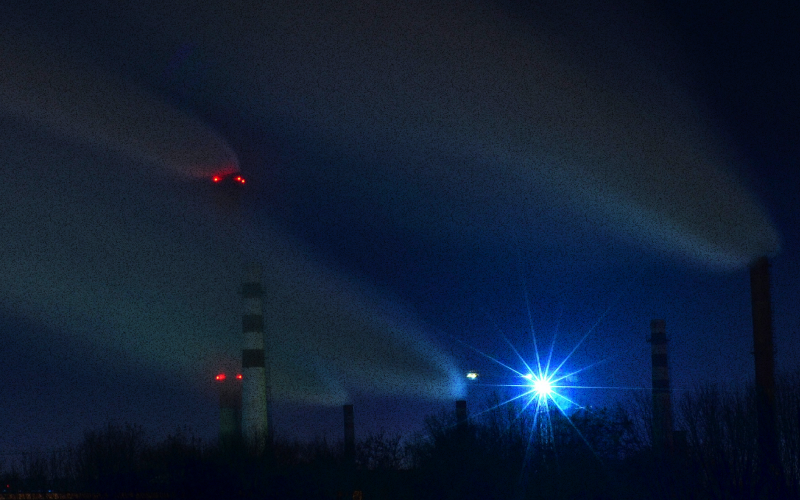
The State Environmental Inspectorate’s inspections of polluting companies, and the procedures and conditions governing them, have long been debated by the public.
Green Alternative of Ukraine set itself the goal of shifting and refining the focus so that genuinely harmful companies would face the most frequent and thorough scheduled inspections. This was to be implemented through the EMITTER project with SaveDnipro’s active involvement.
The idea versus the realities of implementation
An ambitious task requires commitment and focus. Green Alternative of Ukraine was preparing for a lengthy process of engagement with a state institution to introduce important changes. Russia’s full-scale invasion changed everything. Instead of the activities planned over two and a half years, the team had to focus on entirely different, non-environmental problems, such as temporary accommodation for internally displaced people.
Six months later, once the initial shock had passed and the country began recovering, it became clear that abandoning plans to modernise state environmental oversight would be a major mistake. However long the war lasted, progress towards change had to continue.
Preparatory steps
Under martial law, the Inspectorate cannot operate as usual. Its work is currently limited to documenting wartime environmental damage and inspecting businesses following citizens’ complaints. For example, ArcelorMittal Kryvyi Rih was recently fined UAH 10.2 million for air pollutant emissions following such complaints. Legislative changes have suspended scheduled inspections altogether.
Green Alternative of Ukraine therefore gradually returned to its core work by:
- reviewing environmental inspection recommendations developed for Moldova by the Organisation for Economic Co-operation and Development (OECD);
- consulting Ion Bulmaga, head of Moldova’s Inspectorate for Environmental Protection, about practical implementation of these changes;
- presenting its proposals for changing scheduled environmental oversight in Ukraine at the OECD’s Regional Workshop on Improving Environmental Inspections for Greater Environmental Resilience.
These activities reassured the team that it was moving in the right direction.
What was achieved
The organisation undertook extensive work and developed several documents important for reforming environmental inspection.
1. Proposals to amend Cabinet of Ministers Resolution No. 182 and change the criteria used to assess business activity risks.
What is the idea?
The calculation and distribution of business assessment criteria are flawed. They often assign the same environmental risk to an industrial giant and a kindergarten’s boiler house. Green Alternative therefore proposes considering:
- the monetary value of damage caused rather than the number of violations;
- the number of citizens’ complaints rather than the number of unscheduled inspections;
- requiring unjustified refusal to admit inspectors to result in mandatory inclusion in the following year’s inspection plan;
- a company’s proximity to residential areas, natural sites and similar locations.
It also proposes encouraging:
- modernisation;
- risk insurance to compensate for potential environmental damage;
- automated pollutant emissions monitoring systems, allowing less frequent Inspectorate checks.
Result: the State Environmental Inspectorate confirmed that these proposals would be considered when making the relevant legislative amendments.
2. Proposals for the «Strategy for Reforming State Supervision and Control of Environmental Protection and the Rational Use, Restoration and Protection of Natural Resources in Ukraine, and approval of its operational implementation plan for 2024–2026».
What is the idea?
Several aspects of the existing oversight system can and should change. In Green Alternative’s view, opportunities include:
- eliminating duplication between institutions;
- improving the criteria used to assess the degree of
- risk from business activity;
- adding more information about businesses subject to oversight to the information and analytical system (IAS);
- creating an internal register of environmental law offenders and exchanging this data with Ukraine’s integrated police information and search system.
Result: the Inspectorate confirmed that some proposals would be considered when the Strategy’s final text was approved.
3. Recommendations on correctly updating the IAS with court decisions.
What is the idea?
Violations recorded by environmental inspectors at polluting companies are often challenged in court and may be overturned entirely or in part. These updated findings frequently do not reach the IAS, leaving inspectors to rely solely on their own inspection reports. Court proceedings may also place a business in a different risk category from the one assigned during inspection.
Regular audits comparing all court and appeal decisions with inspection findings would allow information to be updated promptly and added to the system.
Result: the Inspectorate sent these recommendations to territorial and interregional offices as a special instruction. The IAS now includes all court decisions and adjusted inspection results.
This became one of the organisation’s most significant project achievements: the initiative was fully implemented, showing how it would work once scheduled inspections resume.
4. Databases of businesses potentially subject to environmental inspections.
What is the idea?
The Inspectorate’s database is populated unsystematically through several routes: inspectors’ own searches, regional statistics offices, environmental departments and others. Unfortunately, these methods do not cover every existing company.
The war further reduced opportunities to identify new businesses; many relocated from eastern to western regions. SaveDnipro, meanwhile, already has a tool for searching and analysing businessesin SaveEcoBot’s database using criteria ranging from permit numbers to financial reporting.
Comparing SaveDnipro’s and the Inspectorate’s databases — 240,000 and 35,000 businesses respectively — identified 205,000 companies needing inclusion and review. The next step should be checking them against risk criteria and adding them to the IAS for future scheduled inspections. Unfortunately, this requires changes to IAS functionality first.
Result: the database was provided to the Inspectorate, which confirmed it had distributed it to territorial and interregional offices with recommendations for its use and for populating the IAS.
5. Green Alternative of Ukraine also established productive cooperation with the Inspectorate, involving various units, departments and territorial offices. It also conducted an advocacy campaign, including:
- publishing an explanation of environmental oversight reform, its key principles and the bill’s current status on the RBC website;
- participating in hearings of the Verkhovna Rada’s environmental committee, where team member Denys Kaplunov spoke on the panel devoted to state environmental oversight reform;
- producing thematic videos explaining the reform’s main principles, changes for business and the bill’s new anti-corruption provisions.
What next?
Green Alternative of Ukraine is continuing work outside the project, including monitoring the Inspectorate and waiting for all its proposals to be reflected in the bill intended to change environmental inspection procedures.
The organisation also sees public education as part of its role: explaining through concrete examples what the bill could change, including for business, and why the reform matters for Ukraine’s post-war recovery. The changes envisage expanding the environmental inspector network. Veterans with relevant experience, such as operating drones or handling weapons, could also become inspectors.
Green Alternative of Ukraine’s proposed amendments will certainly remain relevant and become even more important once scheduled inspections resume.
This publication was produced with financial support from the European Union through the EMITTER project. Its contents are the sole responsibility of SaveDnipro and do not necessarily reflect the views of the European Union.