Translation note: This article records the information, preliminary estimates and forecasts available on 20 June 2023. Descriptions of environmental damage and nuclear safety conditions below are historical, not a current assessment.
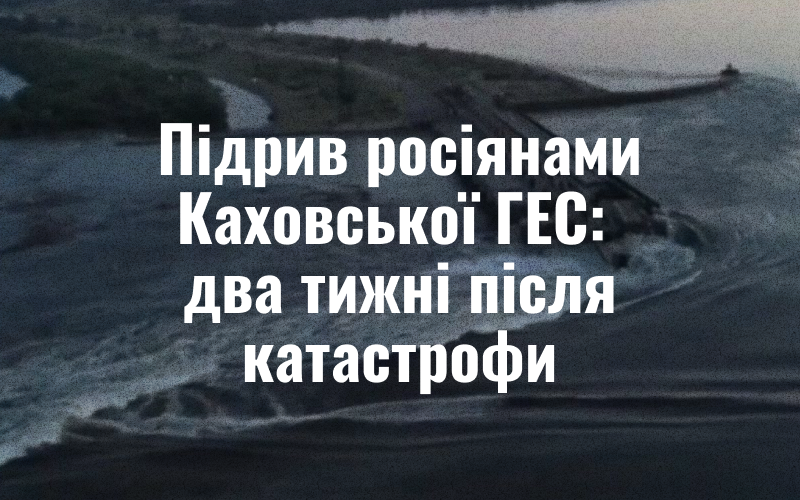
At 02:50 on 6 June 2023, Russian forces blew up the dam of the Kakhovka Hydropower Plant. This marked the beginning of the largest human-made disaster of the 21st century, whose consequences have yet to be established. Now, two weeks after Russia’s terrorist attack, we can identify the initial effects of draining the Kakhovka Reservoir and outline the challenges Ukraine will face in the months and years ahead.
The destruction of the Kakhovka dam drained a reservoir that held more than 18 cubic kilometres of Dnipro River water. This enormous volume began flowing uncontrollably into the Black Sea, flooding dozens of settlements, industrial facilities and ecosystems, including valuable protected areas. At the most critical points in Kherson region, water on flooded land reached five metres in depth and the flooded area approached 140 square kilometres. Settlements in Mykolaiv region were also affected.
The first consequence was chemical contamination of the water. As early as 6 June, at least 150 tonnes of oil from the Kakhovka Hydropower Plant entered the water , with a risk of more than 300 additional tonnes leaking. Flooding covered dozens of square kilometres, submerging not only homes but also businesses of various kinds, oil refineries, thermal power plants, planted fields, warehouses, cemeteries and animal burial sites. According to estimates by Greenpeace Ukraine, 11 petrol stations containing thousands of litres of fuel were also flooded. According to the Ministry of Environmental Protection and Natural Resources, water washed away almost 4,000 tonnes of municipal solid waste from landfills and illegal dumps.
The redistribution of water from the Kakhovka Reservoir caused a rapid decline in biodiversity across the affected region. The rapid fall in water volume caused mass fish deaths. Preliminary estimates put the loss of aquatic biological resources at 95,000 tonnes, with total damage estimated at UAH 7,612,920. As land flooded, thousands more terrestrial animals belonging to hundreds of species, from field rodents to deer, also died.
Protected areas are also suffering catastrophic effects. The draining of the Kakhovka Reservoir directly affected the Nyzhniodniprovskyi, Velykyi Luh and Kamianska Sich national nature parks. Oleshkivski Pisky and Biloberezhzhia Sviatoslava national nature parks were potentially affected. Habitat changes will alter ecosystems valuable to Ukraine’s natural heritage and cause substantial biodiversity losses there. In total, 76,000 hectares of protected land have been affected. According to a preliminary assessment by the Ministry of Environmental Protection and Natural Resources, 1,140 animal species are affected, including 117 protected species. Several Emerald Network sites and wetlands of international importance are also affected. Given the intensity and scale of the disaster, it is currently difficult to say whether these areas will be able to recover.
Terrestrial and aquatic ecosystems without special protected status are also heavily affected. More than 50,000 hectares of Ukrainian forests have been flooded, and at least half are likely to die, significantly affecting the future microclimate. The Ministry of Environmental Protection and Natural Resourcesestimates that around 300 million seedlings will be needed to replace all the forests lost. Meanwhile, the enormous influx of fresh water has already reduced salinity in some parts of the Black Sea to a third of its previous level, which will also kill marine organisms.
All these consequences of Russia’s terrorist attack on the Kakhovka Hydropower Plant will be compounded by the forced displacement of mines: Russian minefields and ammunition depots were submerged and washed downstream. This will worsen chemical contamination of the water and kill living organisms through explosions.
Once the Kakhovka Reservoir has drained and all its water has reached the Black Sea, new problems will emerge: desertification will begin on the exposed reservoir bed, while flooded areas will have to contend with chemical contamination and the aftermath of the flood. The scale of these problems remains unknown. Forecasting is difficult, as there have been no comparable disasters in recent history from which experience could be extrapolated to this situation.
The formation of desertified areas will also cause dust pollution. Reservoir beds are usually covered with silt, a fine sediment easily carried by the wind when dry. This poses a serious threat to human health, particularly because chemicals and heavy metals from nearby industrial facilities accumulated over the lifetime of the Kakhovka Reservoir. Inhaling them can worsen overall health and exacerbate chronic respiratory and cardiovascular conditions. You can check ambient air quality based on fine particulate matter, PM2.5, on our map.
The disaster caused by Russia’s destruction of the Kakhovka Hydropower Plant will change the local climate in the near future. Flooding almost 55,000 hectares of forest in Kherson region will reduce the amount of greenhouse gases absorbed by forests. The shrinking surface area of the water and disruption of wetland hydrology will increase greenhouse gas emissions. The region’s climate will become drier and average temperatures will rise, making southern Ukraine even more vulnerable to climate change.
Over time, this human-made disaster will also affect ecosystems neighbouring the damaged areas: Black Sea organisms sensitive to changes in salinity will begin dying; migratory birds may change their routes; and some vulnerable species may disappear altogether. It is difficult to say which effects scientists and conservationists will be able to address and which changes will be irreversible.
The impact on food, humanitarian and energy security in Ukraine and worldwide is considerable. Southern Ukraine’s farmland was a breadbasket producing hundreds of thousands of tonnes of grain for export. Will it be suitable for farming as soon as next year? We do not know. The Kakhovka Reservoir also supplied water to cities and communities in Kherson, Donetsk and Zaporizhzhia regions. Problems with water supplies for household needs have already arisen in these regions.
Against this background, the nuclear threat is the most alarming, as the Kakhovka Reservoir supplied water to the cooling ponds of the Zaporizhzhia Nuclear Power Plant. Although the IAEA and Energoatom currently report stable water levels in the plant’s technical reservoirs, the possibility of a nuclear accident remains. In this situation of profound uncertainty, we recommend monitoring background radiation levels in Ukraine, which you can do on the SaveEcoBot map.
The scale of the disaster caused by Russia’s destruction of the Kakhovka dam is immense. The Security Service of Ukraine has already opened proceedings under Article 441 of the Criminal Code, “Ecocide”. Yet we still do not know the full extent and manifestations of this ecocide. Waters are still receding and ecosystems are stabilising in new forms. Only when these processes end will the true scale and range of problems become clear. Let us support one another and keep following developments.
This publication was produced with the support of the European Union. Its contents are the sole responsibility of SaveDnipro NGO and do not necessarily reflect the views of the European Union.