Urban air pollution is an enormous problem. According to WHO estimates, polluted outdoor air is linked to more than four million deaths worldwide each year. By comparison, all road traffic incidents account for 1.3 million deaths annually. The number of people who become ill because of polluted air runs into hundreds of millions.
That is why researchers study the many factors that can reduce harmful substances in urban air. Green spaces have not escaped their attention.
Scientific evidence for the obvious
The first thing one encounters when reviewing the scientific literature is a large body of research indicating that urban green spaces help reduce pollutant concentrations. An overview of such findings was presented in an analytical review by a research centre of the Chinese Academy of Sciences.
The researchers’ conclusions draw on 56 field studies from around the world. The figures are striking: urban vegetation helps reduce air pollutant concentrations by 16.5–26.7% for particulate matter (PM), 13.9–36.2% for nitrogen oxides (NOx), and 20.5–47.8% for sulphur dioxide (SO₂).
Looking more closely, however, reveals that these studies record a simple truth: air in parks is cleaner than air beside roads. Experimental measurement points were located in urban parks and other green areas without major emission sources, while control points were in places with little vegetation, near motorways and in industrial areas. It is hardly surprising that harmful substances are more concentrated near emission sources and decrease with distance.
These studies therefore do not reveal how much plants themselves reduce pollution concentrations. They do confirm, however, that green spaces give city residents somewhere to breathe relatively clean air.
More complicated than it first appears
Swedish researchers, who also reviewed many studies on the subject, point out that vegetation’s effect on urban air quality depends on how it is planned.
On the one hand, urban greenery can improve air quality by promoting pollutant deposition and absorption: vegetation greatly increases the surface area available to remove pollutants from the air. On the other, vegetation can restrict ventilation in so-called street canyons, allowing local pollution to accumulate.
Much depends on planning. Vegetation can also act as a barrier, changing airflow direction and increasing turbulence. Green barriers can promote air mixing and prevent polluted air from entering places where good air quality matters. Those planning green spaces therefore need to account for aerodynamics so that vegetation helps disperse local pollution rather than obstructing it.
Research shows that air quality effects depend on plant species, planting density and whether vegetation has one or several layers. Measures that work better for some pollutants may perform worse for others.
For example, a dense avenue of oaks produces the greatest reduction in PM2.5 concentrations, while birches and lindens have very little effect on PM2.5. Dense rows of oaks, however, had an adverse effect on NO₂ concentrations, whereas a dense avenue of lindens had a small positive effect. More widely spaced rows of birches, oaks or lindens all had a greater positive effect on air quality with respect to NO₂.
Planning green spaces correctly is a science in itself. We therefore need specialists in integrating vegetation into urban air quality management.
Addressing the cause
It would be unfair to overlook research arguing that green spaces’ effects on air quality are an order of magnitude smaller than pollutant deposition and dispersion caused by meteorological factors such as precipitation, humidity and wind speed. We often observe weather’s powerful influence on air quality on our air quality map SaveEcoBot).
The authors of one such study — a group of Norwegian researchers — recommend focusing on green spaces’ other benefits. Trees and other urban vegetation shape the microclimate and can reduce deaths among urban residents from extreme temperatures. Urban green spaces can also encourage physical activity and improve mental health, ultimately improving community wellbeing.
‘By continuing to promote the assumption that vegetation can substantially reduce pollution, we risk diverting resources from the most important strategy for improving air quality: reducing human-caused emissions,’ the Norwegian researchers note.
It is hard to dispute that final point. As for the other aspects, let science have the final say. Research into vegetation’s effects on air quality continues.
Inspiring examples
Finally, let us look at how green spaces are already helping address major cities’ problems when combined with other measures.
Paris, France
Over the past twenty years, the city has made systematic changes: roads have been converted into cycle routes, more green spaces created and 50,000 parking spaces removed. Compared with 2005, PM2.5 levels have fallen by 55% and nitrogen dioxide by 50%.
Seoul, South Korea
In 2005, the authorities removed an expressway and converted it into a green area with a stream and walking and cycling paths extending 3.5 kilometres. This helped reduce temperatures in the city centre by 3.6°C, improve air quality and restore biodiversity.
Barcelona, Spain
The city is implementing a sustainable urban design concept that combines several blocks into pedestrian areas and restricts vehicle traffic. In the Poblenou district, this reduced traffic by 60%, noise by 7 dB and air pollution by 42%.
Milan, Italy
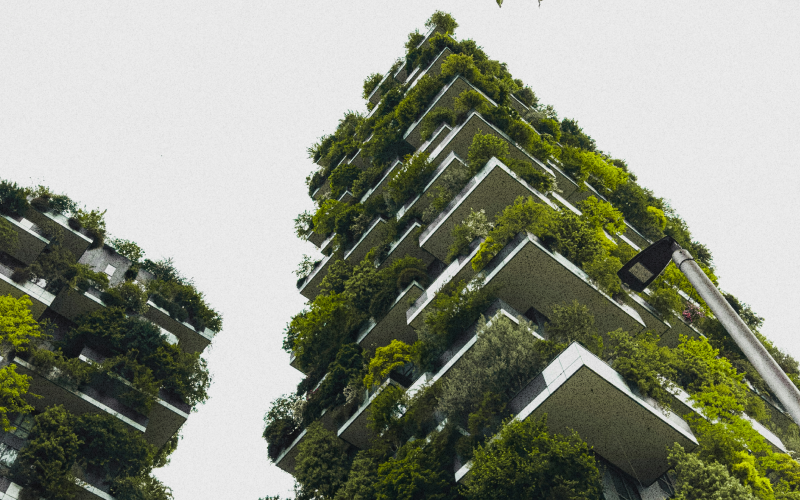
The city’s Vertical Forest, Bosco Verticale, consists of two residential towers whose facades are planted with more than 900 trees and 20,000 plants. This forest absorbs carbon dioxide, reduces dust levels and improves the microclimate.
Copenhagen, Denmark
The city set itself the ambitious goal of achieving carbon neutrality in the near future. Investment in green energy, cycling infrastructure and greening has reduced carbon emissions by 75% compared with 2005.
What about Ukraine?
Unfortunately, in Ukraine the debate is often less about expanding green spaces than about allowing the public at least to oversee their removal. Open data is an important tool for such oversight. Under Cabinet of Ministers Resolution No. 835 of 21 October 2015, city councils must publish timely data on vegetation scheduled for removal under issued vegetation inspection reports.
As SaveDnipro’s monitoringshowed, many city councils fail to publish this data properly on the Unified State Open Data Portal. Kyiv, Dnipro, Kharkiv and Odesa city councils are among those failing to comply with Resolution No. 835. This considerably hinders public participation in planning Ukrainian cities’ green infrastructure.