To the Prime Minister of Ukraine,
Denys Shmyhal
To the Minister of Environmental Protection and Natural Resources,
Ruslan Strilets
To the Chair of the Committee on Environmental
Policy and Nature Management,
Oleh Bondarenko
To the Minister of Justice of Ukraine,
Denys Maliuska
Regarding revocation of the Cabinet of Ministers’ decision on the procedure for introducing
automated pollutant emission monitoring systems
and holding a new public consultation
On 28 March 2023, Minister of Environmental Protection and Natural Resources Ruslan Strilets posted on Facebook about what was presented as an important step towards European integration, reduced industrial pollution, public access to environmental information and digital interaction: the Cabinet of Ministers’ approval of a procedure for introducing automated pollutant emission monitoring systems.
Since the official text has not yet been published on official websites, the public can rely only on the information in that post.
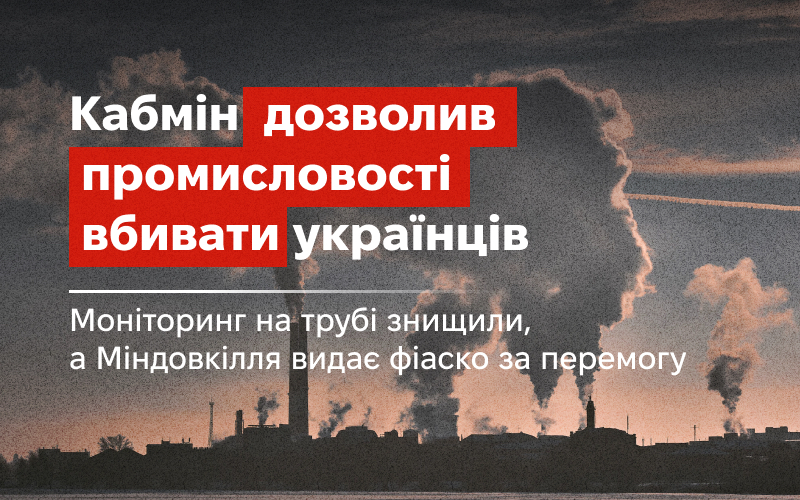
Our main concern is that the post effectively extinguishes any hope of so-called stack emissions monitoring, which Ukraine’s environmental civil society has advocated for years as a key tool for observing emissions from the country’s major industrial polluters!
Mr Strilets’s post states that, under the new Cabinet resolution:
mandatory installation applies only to automated monitoring systems on new equipment. The requirement does not extend to existing equipment;
businesses will have time to prepare for the changes: five years after martial law is terminated or lifted in Ukraine.
What does this Cabinet decision mean for people in heavily industrialised regions and for a united Europe?
- It allows all old industrial facilities to avoid monitoring their emissions:
The Soviet industrial legacy, for decades the main source of heavy metals, pesticides and hazardous fine dust — and consequently of cancers, respiratory and allergic illnesses, and other dangerous acute and chronic conditions — has been granted an indulgence for effectively unchecked harm to Ukrainian society, already gravely wounded by war.
Industrial facilities that have operated in Ukraine for more than 50–60 years are critically worn and fail even to meet their original Soviet emission standards. Communities in industrial regions have never had adequate tools to prove these businesses’ excess emissions, because continuous monitoring at those sources has not been conducted. Meanwhile, state ambient air monitoring in heavily polluted cities such as Kryvyi Rih, Dnipro, Mariupol, Zaporizhzhia and Kyiv has consistently shown critical exceedances of industrial gases and compounds: nitrogen oxides, sulphur compounds, dust, phenol, formaldehyde and others.
Even a cursory assessment of the number of existing Group 1 air-polluting facilities suggests that this decision is driven neither by European integration nor by a desire to reduce industrial pollution, but by an inability to resist industrial lobbyists seeking to squeeze every last resource from businesses once bought for next to nothing without paying a fair price for poisoning Ukraine’s environment and citizens. It may even indicate shared interests between unscrupulous businesses and the authorities. As of November 2022, Ukraine had 369 registered Group 1 polluting businesses, each with anything from a few to several dozen major air pollutant emission sources. Thanks to the Cabinet, they will never be required to install sensors on their stacks. This provision also fails to meet the requirements of the Industrial Emissions Directive, 2010/75/EU.
- Even new businesses will be allowed to avoid emissions monitoring for another five years after Ukraine wins the war.
It bears repeating that the main polluters and taxpayers are old businesses with the largest pollutant emissions, which substantially underpay environmental taxes on their air emissions. New businesses built to new standards after full implementation of European best available techniques and production requirements will be orders of magnitude cleaner than Ukraine’s existing polluters. Legislation for businesses established after the war therefore has no reason to defer monitoring at their emission sources for five years: such a delay makes no economic sense when planning and commissioning new installations.
Nor is there a clear rationale for setting the deadline at five years after martial law is terminated or lifted. Martial law could continue indefinitely after actual hostilities end in Ukraine, while people’s lives and the national economy continue.
Most importantly, the public concerned must be able to participate in environmental decision-making under the Aarhus Convention on Access to Information, Public Participation in Decision-making and Access to Justice in Environmental Matters, which takes precedence over domestic regulatory acts. Yet the public had no opportunity to challenge these provisions during consultation because these formulations were absent from the draft published on the Ministry’s website for public consultation on 18 October 2022. That draft did not exempt all old or existing industrial facilities, nor did it state that the five-year deferral would run from the termination or lifting of martial law. The public could therefore not object to these provisions and was deprived of rights under the Aarhus Convention and Ukrainian legislation governing public consultation on environmental decisions. In substance, this is a different regulatory act.
Furthermore, neither Ukrainian legislation nor central executive authorities’ practice currently takes account of limited public access to official information caused by persistent problems with government websites and unstable access to communications and electricity. These are essential for timely responses to government initiatives. In particular, the website of the Environment Ministry, which initiated this draft resolution, has recurring critical problems and is unavailable for long periods. We therefore cannot say that public consultation periods for draft laws and subordinate legislation are being effectively respected.
In view of the above, during these severe
upheavals and considering the war’s effects on Ukraine’s environment and Ukrainians’ physical and mental health, we demand:
- Revoke the Cabinet of Ministers’ decision approving the procedure for introducing automated pollutant emission monitoring systems, as it does not serve Ukrainians’ interests or the course towards European integration.
- Hold a new public consultation on the draft resolution, taking account of residents of heavily industrialised regions, Ukraine’s economy and progress towards cleaner air in Europe, of which Ukraine is a part!
- Conduct additional or repeated environmental and legal assessments of the draft regulatory act in accordance with Ukraine’s Law on Regulatory Legal Acts.
- The Ministry of Justice should refuse state registration of this subordinate regulatory act because it does not meet the requirements for protecting human rights and fundamental freedoms.
In the hope that this mistake will be corrected promptly,
the following civil society organisations and representatives of Ukrainian society:
- SaveDnipro NGO, Iryna Chernysh
- Environment–People–Law International Charitable Organisation
- Danube–Carpathian Programme NGO
- Ukrainian Environmental Club Green Wave NGO, Yevheniia Mykytianska
- ANTS National Interests Advocacy Network
- Environment Office NGO, Denys Kaplunov