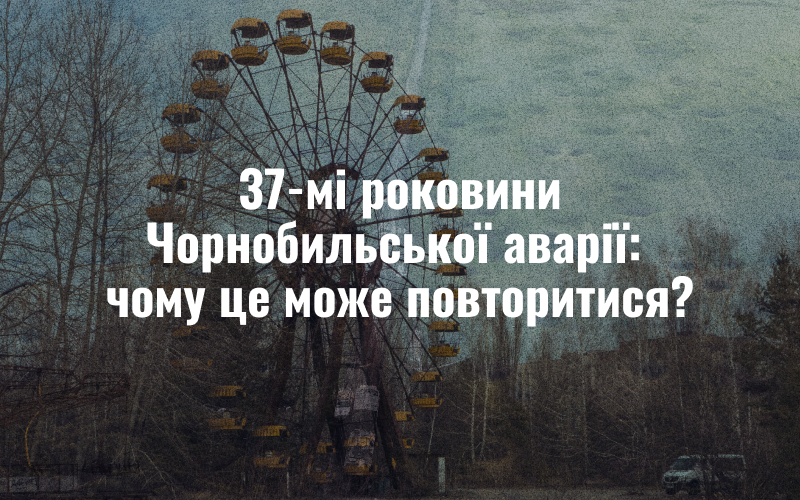
Translation note: This is a translation of an advocacy article published on 26 April 2023. Its statistics, historical interpretations and descriptions of nuclear plant conditions reflect the original account at that time. It is not a current radiation safety assessment.
Every year on 26 April, Ukraine marks the anniversary of the Chornobyl tragedy, the largest radiation accident in human history. In 2023, we mark 37 years since that terrible event. Yet for the second time on this date, we are discussing not only the accident itself but also the possibility of another disaster. It is time to remember both the terrible night when explosions destroyed Reactor 4 and the heroism of the emergency workers — and to consider why it could happen again.
How did the Soviet authorities turn Ukraine into the world’s nuclear capital?
Thirty-seven years ago, on the night of 26 April, a series of low-power tests below 700 megawatts was planned during a scheduled maintenance shutdown of Chornobyl’s fourth power unit. The original account explains that the reactor design was not intended for operation under those low-power conditions and that staff lost control of the situation. Emergency protection was activated, producing the so-called positive scram effect and two thermal explosions that completely destroyed Reactor 4.
Following a series of investigations, the original article identifies a central cause of the accident: Chornobyl personnel had not been given full and comprehensive information about the plant’s design and operating characteristics.
The consequences of the Chornobyl accident were terrible and vast. The original article compares the radioactive release with the atomic bombings of Hiroshima and Nagasaki in 1945, citing a figure 100 times greater, and reports a release of 50 million curies of radioactive substances. The radioactive cloud spread beyond Ukraine, Belarus, Russia and neighbouring countries, reaching Finland, Norway, Sweden, Italy, Ireland, France including Corsica, Britain and the eastern United States. The article reports that the 1986 accident affected more than three million Ukrainian citizens and ten million people worldwide, as well as 2,293 settlements. A closed, radioactively contaminated Chornobyl Exclusion Zone covering 2,600 square kilometres was established, while the total contaminated area reached 150,000 square kilometres.
The disaster could have been even worse had 600,000 courageous and dedicated people not accepted the challenge 37 years ago: protecting Ukraine and the world from the effects of the largest radiation accident in history. According to the Union Chornobyl of Ukraine NGO, 10% of these 600,000 emergency workers had died and 165,000 had acquired disabilities. The original article describes cancers among emergency workers, particularly thyroid cancer, leukaemia and breast cancer. The consequences persist: radiation’s effects can emerge decades after exposure.
The Chornobyl accident resulted from the design of the fourth power unit and inadequate technical regulations. But failing to provide plant personnel with complete information was not the Soviet authorities’ only wrongdoing. Particularly devastating for the health and future of Soviet Ukraine’s citizens was their refusal to cancel the May Day demonstrations, which were important to Soviet ideology. The article cites declassified Security Service of Ukraine documents reporting radiation levels in Kyiv tens or hundreds of times above background. Thousands nevertheless took to the streets. The original account describes subsequent radiation-related illness and says Kyiv hospitals became so crowded that patients were admitted outside the city.
Why does Russia still keep Ukraine at the centre of nuclear danger?
The Chornobyl disaster was shocking, immense and extraordinarily destructive. The world did more than recoil: it recognised the dangers that peaceful nuclear energy could pose and drew lessons. Nuclear plants worldwide improved safety protocols and protection systems, and international documents regulating nuclear facility safety were adopted. Yet this proved insufficient. Since 24 February 2022, Russia’s terrorist actions have again brought humanity close to disaster.
The 1949 Geneva Conventions and their subsequent Additional Protocols regulate armed conflicts and seek to limit their effects. The First Additional Protocol of 1977, in Article 56 , addresses the protection of works and installations containing dangerous forces, specifically including nuclear power plants. These rules apply to both Ukraine and Russia, as both countries are parties to the agreement. Paragraph 1 states that nuclear power plants must not be attacked even where they are military objectives if an attack could release dangerous forces and consequently cause severe civilian losses. For nuclear power plants, the danger in question is radioactive exposure.
Nevertheless, Russian forces seized the Chornobyl Nuclear Power Plant and the Exclusion Zone on the first day of the full-scale invasion. The occupation lasted 35 days and included a particularly alarming spike in background radiation readings at and around the plant on the night of 24–25 February. During the occupation, Russian forces disabled the radiation monitoring system and destroyed almost 100 pieces of modern equipment at Chornobyl’s Central Analytical Laboratory. Ministry of Environmental Protection and Natural Resources specialists estimated the total damage in the area at UAH 2.5 billion.
To draw global attention to nuclear terrorism, SaveDnipro created a dedicated landing page with a complete chronology of Chornobyl’s occupation. We carefully compiled the available information on events at the plant from 24 February to 19 May 2022, when the damage caused by Russia’s barbaric actions was assessed. The landing page also presents the occupation in figures and explains the consequences of Russian nuclear terrorism for the plant and the Exclusion Zone.
But Russia did not stop at occupying and devastating Chornobyl’s facilities and the surrounding environment. Our team closely follows manifestations of Russian nuclear terrorism and has compiled genuinely frightening statistics. Since 24 February 2022, 11 missiles had passed dangerously close to Ukrainian nuclear plants by the time this article was published. Russian forces had shelled Ukrainian nuclear plants at least 17 times. Impacts were recorded near reactors, on industrial sites, near power units, close to the on-site dry spent fuel storage facility, and near welding facilities and radiation source storage areas, among other locations. Repeated shelling and large-scale missile attacks on Ukraine’s integrated electricity grid had caused three emergency shutdowns of power units at different plants, while power lines at the Zaporizhzhia plant had been damaged at least nine times.
The situation at Zaporizhzhia, Europe’s largest nuclear power plant, was deeply alarming after more than a year of occupation. One reckless Russian action could bring the world face to face with another radiation accident. Russia uses the plant as leverage over the international community, understanding that any emergency involving a radioactive release could affect not only Ukraine but all of Europe. The scale of the risk is also demonstrated by at least seven emergency activations of diesel generators after damage to the plant’s power supply lines. Loss of grid connection is itself an emergency condition that can potentially lead to an accident. Fortunately, the worst had not happened at the time of publication. Background radiation readings across Ukraine can be checked on the SaveEcoBot map.
The longer Russia’s nuclear terrorism continues, the clearer it becomes that stronger, more coordinated action is needed. To help develop a mechanism for achieving radiation safety, SaveDnipro organised an interagency roundtable entitled “Ukraine’s Nuclear Safety Is the World’s Safety: An Action Plan for Ukraine”, held on 21 February.
The time for state bodies, active civil society and experts to work separately is over. A safer world can only be built together. SaveDnipro brought the relevant institutions and organisations together on a common platform, almost for the first time, to hear one another and share their experience. They discussed measures to increase international pressure on Russia, suspend its Agency membership, remove it from the IAEA’s governing bodies, impose sanctions on representatives of Russia’s energy sector, and block their economic and technical activities in the EU. The roundtable produced a resolution available on the SaveDnipro website.
The 37th anniversary of the Chornobyl accident is therefore more than a day to honour the emergency workers and remember the destructive consequences of the Soviet authorities’ negligence. In the second year of the war, 26 April is a warning of what Russia’s actions could cause again unless its nuclear terrorism is stopped; unless Russian occupying forces are driven out of the Zaporizhzhia plant and all of Ukraine; and unless Russia is firmly isolated from influence over the civilised world. We must learn this lesson and act decisively to prevent another Chornobyl. We must stop Russian nuclear terrorism, and only joint efforts can achieve that.