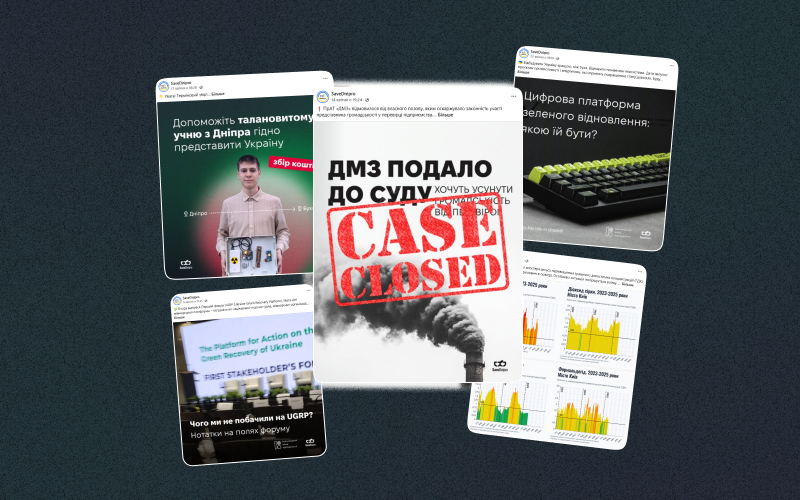
In April 2025 the SaveDnipro team defended public participation rights in a case brought by Dnipro Metallurgical Plant, continued developing a digital green recovery platform concept, raised funds for a talented school pupil from Dnipro, and monitored radiation levels and air quality across Ukraine every day.
Read more about SaveDnipro’s achievements and important work in April 2025 in this digest.
Protecting public health in Dnipro. Dnipro Metallurgical Plant withdrew its own lawsuit challenging the legality of a SaveDnipro representative’s participation in an inspection of the company. We published a joint post about this development with the online outlet ProDnipro. We now await the Ministry of Environmental Protection’s decision on the terms of the company’s new air emission permit.
Developing a concept for a digital green recovery platform. We conducted interviews with potential platform users to establish which functions would help them. We shared our vision of the future platform’s goals, tasks and main components with social media readers. We attended the first Ukraine Green Recovery Platform (UGRP) forum, hearing views on green reconstruction from state authorities, business, local government and civil society.
Supporting talented young people who remain in Ukraine. We organised a fundraiser for Heorhii But, a pupil at Dnipro Gymnasium No. 128, enabling him to take part in the international final of the Infomatrix young inventors competition in Bucharest on 22–26 May 2025. We raised UAH 14,855. SaveDnipro will provide the balance of the required EUR 575 from donations received in March and April.
Helping financial institutions improve environmental and social business assessments. We held consultations with financial sector representatives to update our understanding of the environmental information needed to assess potential clients’ ESG risks.
Running an information campaign on industrial pollution reform.
- We revisited the legal regulation of automated emissions monitoring systems at stationary sources. We recalled that, even after the Law ‘On Integrated Industrial Pollution Prevention and Control’ enters into force, Cabinet of Ministers Resolution No. 272 of 28 March 2023 will continue to apply to major polluters choosing a ‘permit to die’. These businesses will therefore remain without adequate monitoring of emission volumes.
- We outlined the timeframes for submitting documents to obtain an integrated environmental permit.
- We explained the consequences of violating EU environmental legislation after Ukraine joins the European Union.
We called for faster development of a unified national integrated automated radiation monitoring system. We asked the Ministry of Environmental Protection about progress on the strategy for an integrated automated radiation monitoring system until 2024. We learned that the ministry was ‘finalising and consolidating information on implementation of the operational plan submitted by monitoring bodies’. In other words, the objective of creating the system by the end of 2024 was not met.
Helping draft a Cabinet of Ministers resolution approving the procedure for transmitting emissions monitoring results in real time. Pavlo Tkachenko held a working meeting with GIZ-38 project representatives and submitted proposals for the document.
Continuing our public education work.
- We presented data from the Ukrainian Hydrometeorological Centre showing unsatisfactory air quality in Kyiv.
- We explained the European Near-Zero Energy Buildings standard for energy-efficient buildings.
- We analysed the subjects of public investment projects submitted by the Ministry of Environmental Protection in 2024, noting that none received funding in 2025
- We presented findings from scientific research on how vegetation reduces pollutant concentrations in urban air.
- We highlighted an alarming fact: in 2024, average global temperature exceeded the symbolic threshold of 1.5°C above pre-industrial levels for the first time.
- On Ukrainian Radio, Iryna Chernysh explainedthat Russian attacks on our cities also threaten residents’ health through environmental pollution.