
On 22 May, during the online event organised by Ukraine’s Ministry of Digital Transformation, ‘Open data as a foundation for government transparency’, ESG SaveEcoBot co-founder and developer Pavlo Tkachenko took part in the panel discussion ‘The anti-corruption impact and use of open data by government, business and journalists’.
The discussion focused on the practical use of open data and ESG analytics to identify environmental, regulatory and potential corruption risks. ESG SaveEcoBot creates companies’ ESG profiles using open government data from more than 160 sources, including registers, declarations, environmental reporting, inspections, permits, sanctions and court cases.
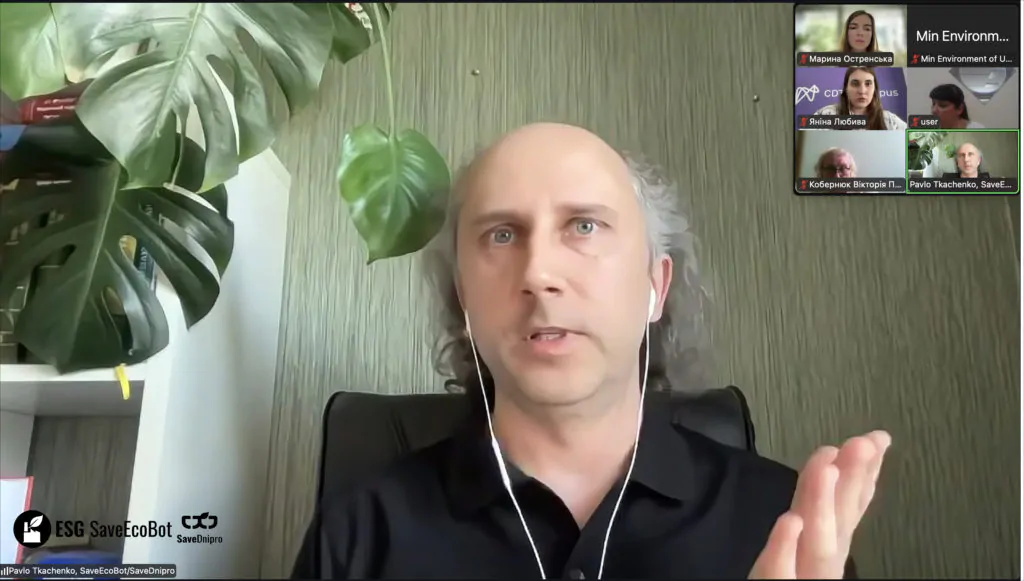
‘We look not only at whether a company has a particular document. We look at whether the overall picture adds up. A risk often becomes visible not in an individual record but in inconsistencies between different open datasets,’ said Pavlo Tkachenko.
The discussion paid particular attention to waste management. SaveEcoBot analyses almost 200,000 waste movement records from more than 30,000 declarations. This makes it possible to identify cases where companies actually carry out waste operations but do not have the necessary declarations, permits or licences.
According to Pavlo Tkachenko, such discrepancies can signal potential environmental, regulatory or corruption risks and help state authorities move towards a more risk-based approach to oversight.
‘Open data does not replace an inspection, but it is very good at showing where to look more closely. It is a signal, rather than a verdict. But it is a signal already based on facts from public sources, rather than rumours’, stressed Pavlo Tkachenko.
The discussion also covered the use of ESG analytics by banks and state authorities and in transparent recovery processes in Ukraine. In particular, open data enables financial institutions to assess client and partner risks more quickly, while helping authorities prioritise oversight and analytical work more effectively.
As part of our social impact work, ESG SaveEcoBot is already used by more than 300 representatives of state authorities, including the Ministry of Economy, the State Environmental Inspectorate, the National Police, the Specialised Environmental Prosecutor’s Office within the Office of the Prosecutor General, the Accounting Chamber and other institutions.
‘During the war and the moratorium on inspections, ESG SaveEcoBot has become one of our most practical tools for working with open data. It enables us to quickly identify discrepancies between a company’s activities and its permits, licences or reporting — for example, when a company is actually operating in waste management or subsoil use but lacks the necessary documents. This helps us focus more effectively on high-risk cases’, said the head of the department organising procedural supervision of pre-trial investigations and public prosecution in regional prosecutor’s offices at the Specialised Environmental Prosecutor’s Office of the Office of the Prosecutor General, Ihor Shkolnyi.
Participants also discussed the role of open data in improving accountability, strengthening public oversight and establishing more transparent rules for government, business and those involved in Ukraine’s recovery.