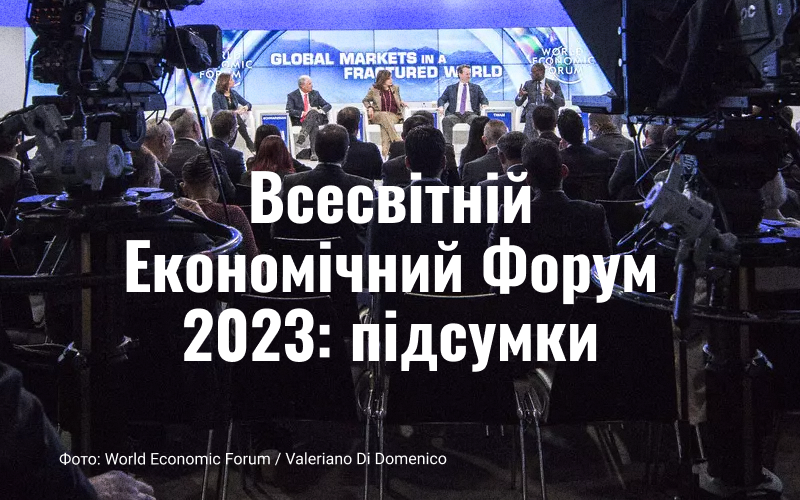
The World Economic Forum took place in Davos, Switzerland, on 16–20 January under the theme “Cooperation in a Fragmented World”. Here are the key events and the Ukrainian delegation’s achievements.
In 2023, Davos returned to its traditional in-person winter format after a break. The previous winter gathering in that format had taken place in 2020, before the coronavirus pandemic. A record number of heads of state and government from 52 countries came to Switzerland this year.
The Forum covered many issues, with four receiving particular attention: Russia’s invasion of Ukraine, rapidly rising inflation, the threat of global recession and climate change. Other widely discussed subjects included rising energy and food prices, the transition to green energy, greenhouse gas emission reductions, restoring food, water and ocean systems, circular resource use, artificial intelligence and the metaverse.
One phrase captured the spirit of many panels: the planet is now a stakeholder. Participants discussed how economic tools can help the planet. More than 80 companies, for example, pledged to plant over seven billion trees in 65 countries to help curb climate change.
There were also discussions about better ecosystem management and the financial losses biodiversity decline could cause. Securing Indigenous Peoples’ control over their territories was identified as one of the most effective ways to conserve ecosystems. Although they represent only 5% of humanity, Indigenous Peoples protect 80% of Earth’s biodiversity, according to the report“Embedding Indigenous Knowledge in the Conservation and Restoration of Landscapes”. This finding also matters for Ukraine: during post-war recovery, Crimea’s Indigenous Peoples could potentially make a major contribution to restoring the peninsula’s natural environment.
One promising development was the creation of the Coalition of Trade Ministers on Climate, bringing together more than 50 ministers. It will provide political leadership to strengthen inclusive international cooperation on climate, trade and sustainable development. Its membership spans all regions and includes countries at different stages of development and with different levels of climate vulnerability.
The World Economic Forum is a powerful platform for political statements. European Commission President Ursula von der Leyen stressed in her speech that competition and trade are key to accelerating clean technology and climate neutrality. The EU sees trade as essential to reducing dependence on monopolised supply chains for critical materials, including lithium and rare earth elements.
UN Secretary-General António Guterres addressed the Forum on its second day. He described the world as being in a sorry state because of interconnected challenges, including climate change and Russia’s war in Ukraine.
Ukraine’s delegation was active in Davos. Volodymyr Zelenskyy addressed the international community online, while First Lady Olena Zelenska and Prime Minister Denys Shmyhal spoke at the event. Their speeches emphasised Ukraine’s Peace Formula, the need for more heavy weapons and financing for post-war reconstruction.
Olena Zelenska again called on the international community to prevent another radiation accident in Ukraine and free Zaporizhzhia Nuclear Power Plant from occupation. Denys Shmyhal stressed that Ukraine’s recovery is an opportunity for profitable investment rather than charity and presented investment opportunities across different sectors.
Importantly, the international community is already interested in Ukraine’s future recovery. Larry Fink, CEO of the world’s largest asset manager, BlackRock, said he planned to coordinate a reconstruction financing project worth billions of dollars. He believes such an initiative could turn Ukraine into a beacon of capitalism. Goldman Sachs CEO David Solomon likewise said that Ukraine’s recovery would create strong economic incentives for real returns and investment.
Overall, the Davos Forum of 16–20 January provided another platform for Ukraine to advance its agenda. It matters that some of the world’s most influential people were ready to listen. Ending the war and rebuilding the country were key themes. Participants also discussed humanity’s role in climate change and further steps to curb global warming and achieve sustainable development. Some conclusions look promising; their implementation will show how they shape the future.