
Translation note: This article describes incidents and preliminary estimates available in April 2022. Damage figures are reproduced as reported at the time, not updated or reconciled totals.
Since the full-scale invasion began, SaveDnipro has worked with partners to document Russian environmental war crimes through Telegram and Viber. The “Report an environmental crime” feature was developed with Ukraine’s Ministry of Environmental Protection and Natural Resources. All reports are confidential and go to its operational headquarters to support International Court of Justice compensation claims against the aggressor. Report counts and breakdowns by type and region are available on our website.
Today we begin a series on the harm caused by Russian occupying forces and why these actions constitute environmental war crimes.
Oil depots as targets
An oil depot is a facility for receiving, storing, transferring and distributing crude oil and petroleum products.
Oil depots across Ukraine became targets of Russian attacks from the first days of the full-scale invasion. By 24 April, we knew of strikes in Volyn, Dnipropetrovsk, Zhytomyr, Zaporizhzhia, Kyiv, Luhansk, Lviv, Odesa, Poltava, Rivne, Sumy, Ternopil, Kharkiv, Khmelnytskyi and Chernihiv regions. Open sources had reported more than 30 strikes on oil infrastructure across Ukraine, most of them oil depots.
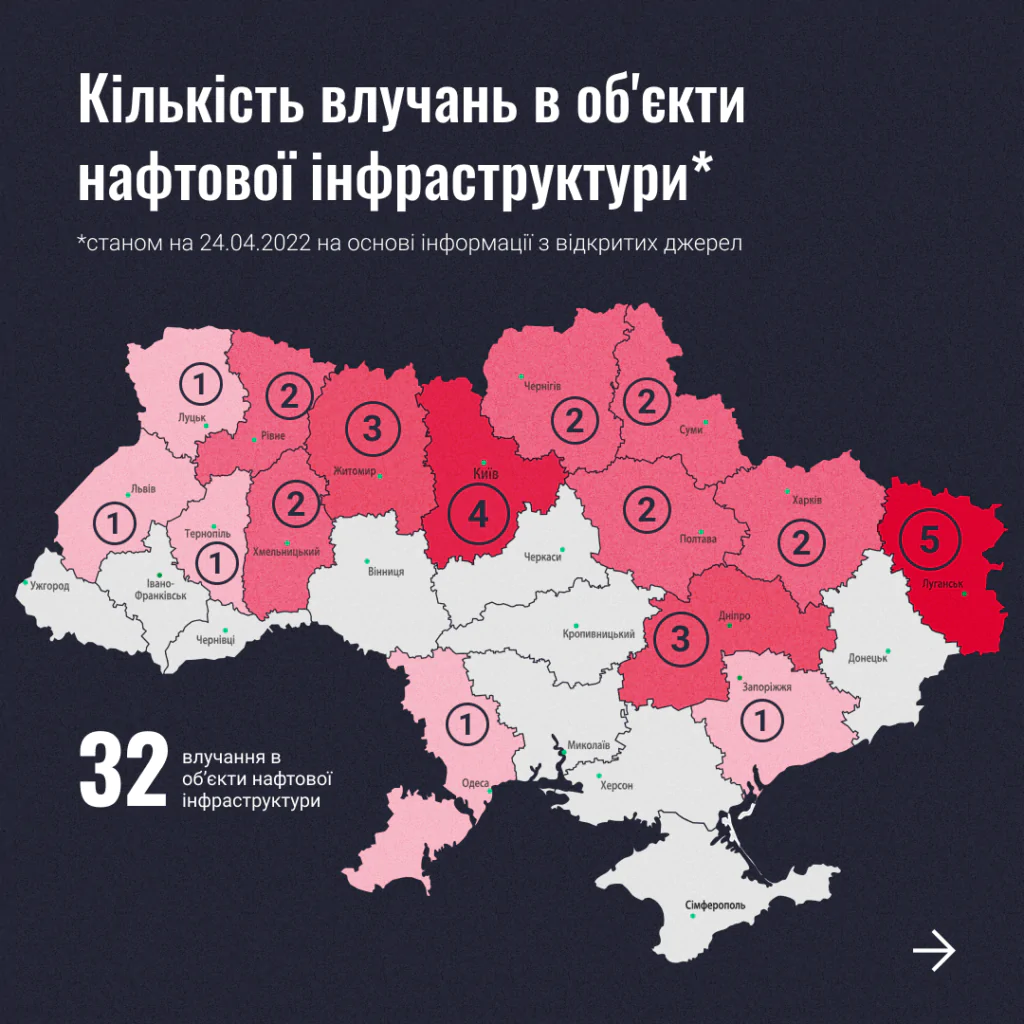
Here are just a few examples.
On 27 February 2022, Russian forces struck an oil depot in Vasylkiv district, Kyiv region, with a ballistic missile.
On 3 March, Russian forces destroyed an oil depot in Chernihiv.
On 7 March, deliberate Russian airstrikes set two oil depots ablaze in Zhytomyr region.
On 13 March, shelling damaged the TT-Nafta depot in Chernihiv.
On 24 March, an oil depot in Kalynivka, Kyiv region, caught fire after an attack.
A missile strike on 26 March completely destroyed an oil depot near Lviv.
On 27 March, Russia struck an oil depot in Lutsk with missiles.
On 28 March, an oil depot in Rivne region was targeted.
On 2 April, enemy attacks caused fires at petroleum storage facilities in Kremenchuk.
On the night of 6 April, the enemy attacked a fuel depot in Dnipropetrovsk region.
On 16 April, Russian occupying forces fired on an oil depot in Lysychansk, Luhansk region.
On 24 April, the Kremenchuk refinery was attacked again.
Consequences
Such incidents can cause casualties. Five people were injured in the missile strike on the depot near Lviv.
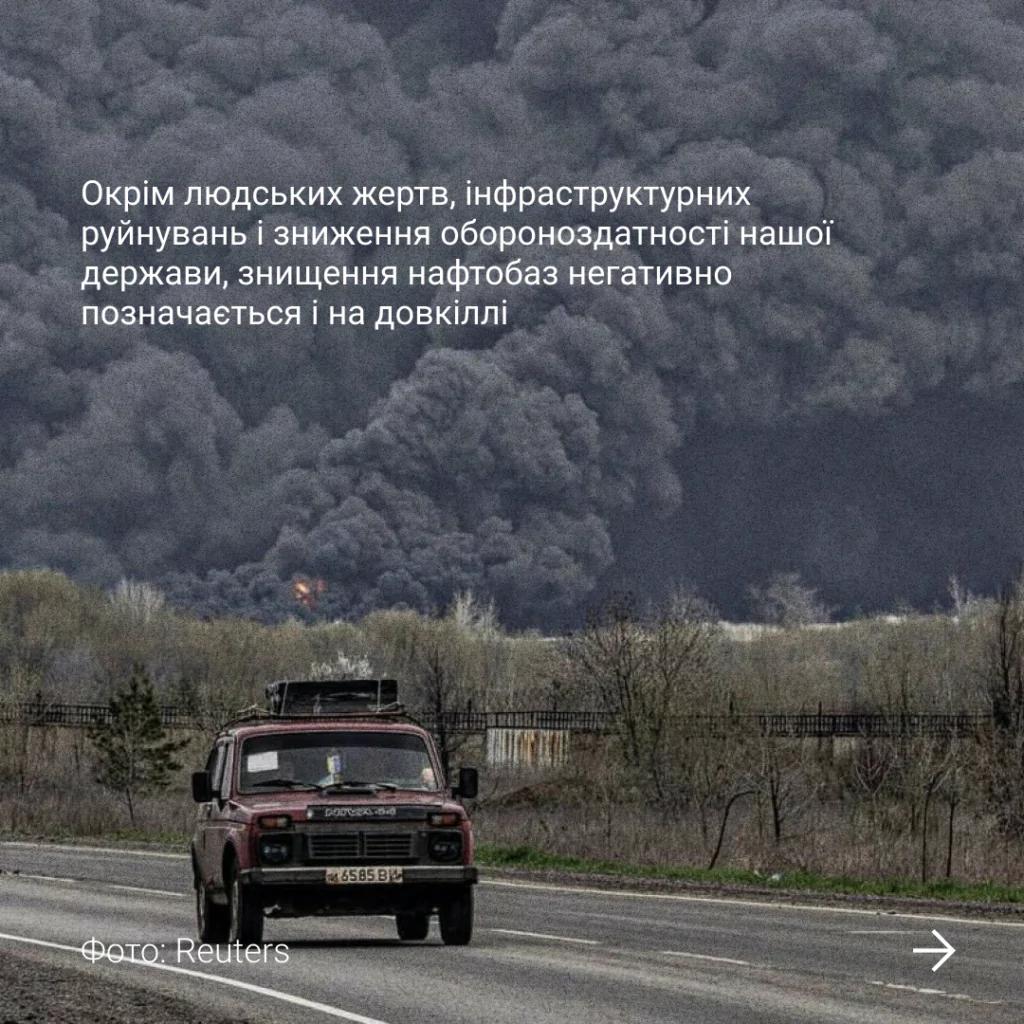
Beyond casualties, infrastructure destruction and weakened defence capacity, oil depot destruction severely harms the environment.
On 27 February, Environment Minister Ruslan Strilets reported a preliminary environmental damage estimate of UAH 810 billion for the fire at the Kriachky depot in Kyiv region. Specialists were still calculating the exact figure. Several weeks later, the Ministry announced a methodology for assessing environmental harm from burning petroleum products.
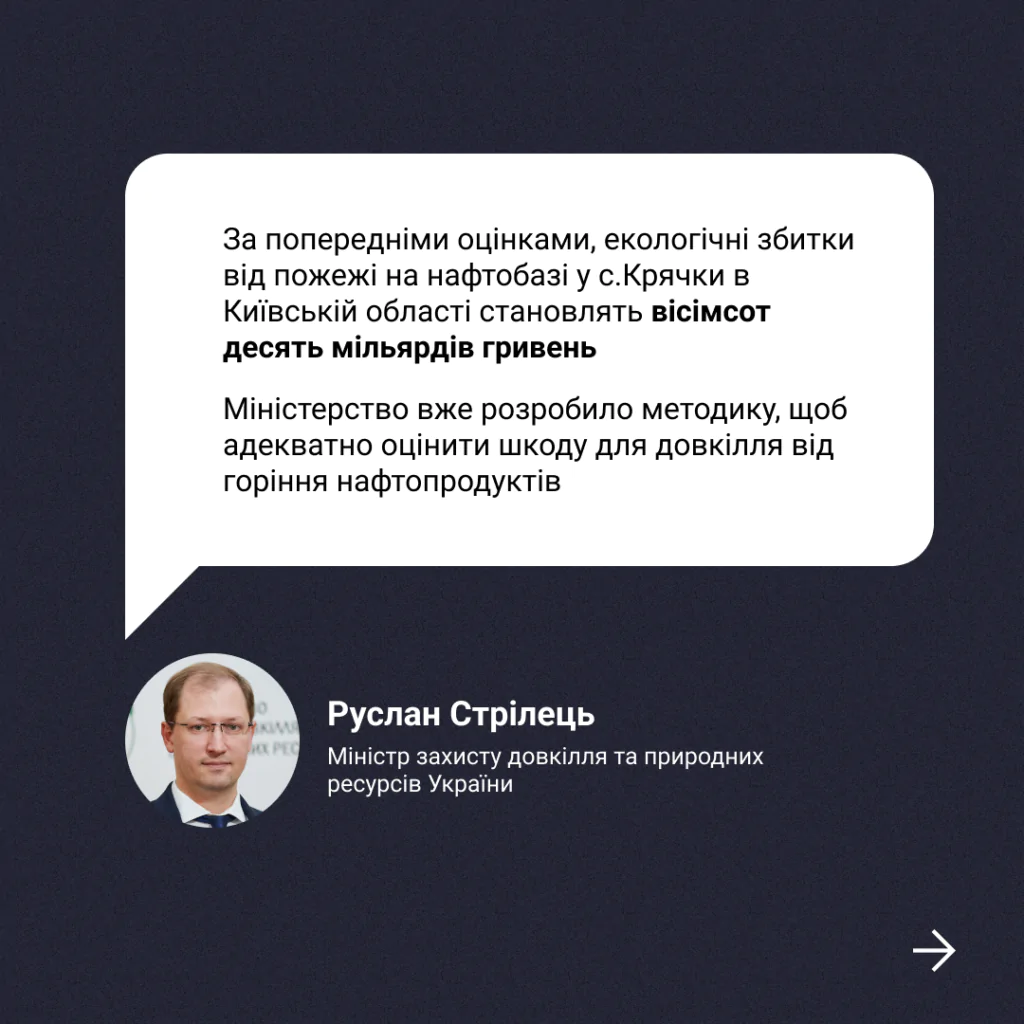
Airstrike-related oil depot fires cause uncontrolled atmospheric emissions, affecting nearby areas and potentially spreading into residential neighbourhoods.
Burning petroleum products releases large quantities of carbon monoxide, which can cause fatal poisoning.
Smoke also contains benzo[a]pyrene, sulphur oxides, carbon dioxide, nitrogen oxides, gaseous and solid products of incomplete combustion, vanadium compounds, sodium salts and other substances.
Benzo[a]pyrene, formed when hydrocarbon fuels burn, is a potent carcinogen and mutagen, making oil depot smoke highly toxic.
Acid-forming gases can react with water, including on moist mucous membranes in the body.
Combustion also releases aromatic compounds, aldehydes and ketones, alongside hazardous soot containing carcinogenic substances.
These are only the human effects. Separate assessments are needed for soils, water bodies and vegetation. Sulphur dioxide can damage plants and forests, causing chlorosis, yellowing or discolouration, and stunted growth. Petroleum products can penetrate tens of centimetres into soil, severely damaging a vital ecosystem component.
A comparison: the 2015 BRSM-Nafta fire
A tragedy in Kyiv region several years ago illustrates the potential scale of oil depot fires.
On 8 June 2015, an explosion at the BRSM-Nafta depot near Kriachky ignited three petrol tanks and spread to others. A neighbouring depot, forest and military ammunition site were threatened. The fire was extinguished only on 16 June. Five people died during the response, and damage reached approximately UAH 1.2 billion. Media later called it Ukraine’s second-largest environmental disaster after Chornobyl.
What were the environmental effects?
Experts at the National Academy of Sciences’ Institute for Sorption and Problems of Endoecology estimated a petroleum spill of around 240 tonnes: 90 into soil and 150 into water bodies. Carcinogens and other substances dangerous to people and the environment entered the air.
The All-Ukrainian Environmental League found petroleum saturation to depths of 20–45 centimetres at the depot. Nearby waters were covered by a dense oil film. Residents reported headaches, nausea, throat irritation and worsening chronic respiratory conditions.
Soil testing by the Ukrainian Laboratory of Quality and Safety of Agricultural Products found benzo[a]pyrene, polycyclic aromatic hydrocarbons and sulphur exceeding limits by factors of four to 26 at different locations.
Unfortunately, dozens of wartime attacks causing oil depot fires may have much greater cumulative consequences for public health and Ukraine’s environment.
How can you document an environmental crime?
Russian destruction of oil depots causes casualties, damages infrastructure and weakens defence, but also contaminates soils, water and food. This environmental harm must be documented as part of accountability for wartime crimes.
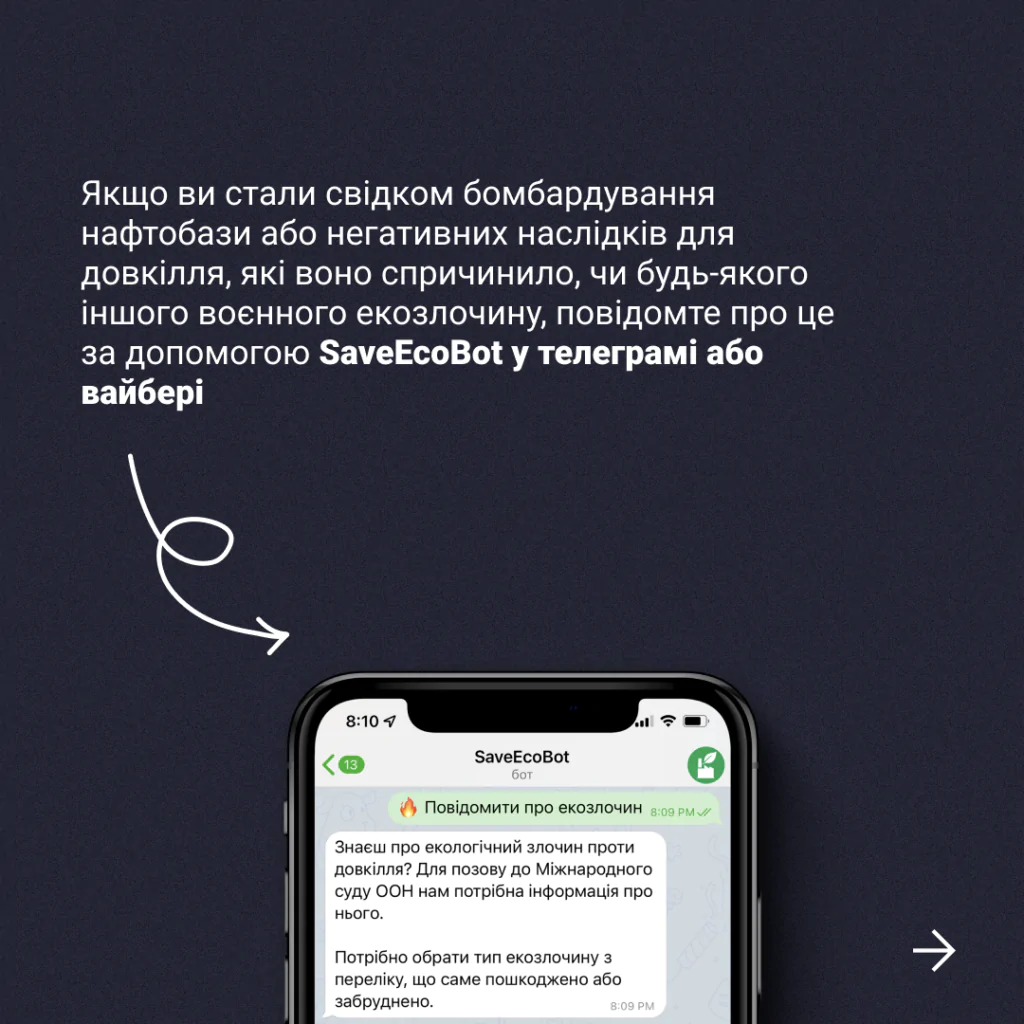
If you witness an attack on an oil depot, resulting environmental harm or another environmental war crime, report it anonymously to the Environment Ministry’s operational headquarters through SaveEcoBot in Telegram or Viber.
A video guideexplains how to do so.
Let us protect our environment, one another and Ukraine!
This publication was produced with the support of the European Union. Its contents are the sole responsibility of SaveDnipro NGO and do not necessarily reflect the views of the European Union.