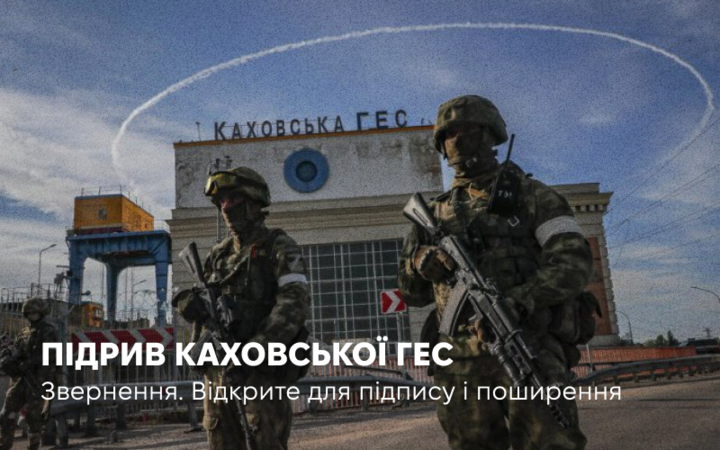
Representatives of Ukraine’s environmental movement appeal to our fellow conservationists, international experts, institutions whose purpose is environmental protection, secretariats of international environmental conventions, and authorised United Nations bodies and officials to respond, within their mandates and capacities, to another act of ecocide committed by the Russian Federation through the destruction of the Kakhovka Hydropower Plant.
On 6 June 2023, Russian occupying forces committed another act of ecocide, threatening unprecedented environmental consequences for southern Ukraine and the entire Black Sea region.
Hydropower dams have always been facilities posing heightened technological hazards. The consequences of their criminal destruction, in this case at Kakhovka, include:
- destruction and severe disruption of the ecosystems of the Kakhovka Reservoir and the water bodies flowing into it where water was held back, the lower Dnipro and the Dnipro estuary, and disruption of Black Sea ecosystems near the river mouth;
- possible mass deaths of aquatic organisms, including fish, molluscs, crustaceans, microorganisms and aquatic plants, in the Kakhovka Reservoir, followed by declining water quality as dead organisms decompose;
- disruption of the habitats of fish, molluscs, crustaceans, birds, amphibians and other animals inhabiting the waters and coastal habitats from the Kakhovka dam downstream to the Kinburn Peninsula;
- disruption of habitats and possible deaths of animals living on land that will be flooded. Rodent populations face substantial risks, including endemic species and species listed in Ukraine’s Red Data Book;
- disruption of plant communities’ habitats: coastal aquatic vegetation upstream of the Kakhovka dam will die as the area dries out, while areas downstream will flood, including steppe and forest habitats not adapted to submersion, causing waterlogging and plant deaths. The lower Dnipro supports endemic species included on the global Red List that occur nowhere else in the world;
- unpredictable deposition of river sediment and materials washed off the land;
- adverse effects on the waters, shores and terrestrial areas of three Ukrainian national nature parks — Nyzhniodniprovskyi, Kamianska Sich and Biloberezhzhia Sviatoslava — the Black Sea Biosphere Reserve, which is also a UNESCO biosphere reserve, Kinburn Spit Regional Landscape Park and numerous smaller protected sites, as well as proposed protected areas. These territories also include wetlands of international importance protected under the Ramsar Convention and Emerald Network sites protected under the Bern Convention;
- disruption of water supplies to facilities in Kherson region and parts of Zaporizhzhia and Dnipropetrovsk regions;
- pollution of the Dnipro and Black Sea: primary pollution caused by fuel and lubricants entering the water, washed-away waste, agrochemicals and other hazardous materials, and flooding and failure of wastewater treatment and sewerage systems; and so-called secondary pollution caused by disturbance of layers of silt where pollutants have accumulated for decades;
- flooding of homes, structures and businesses, loss of property and destruction;
- deaths of farm animals, livestock, pets and zoo animals, whose bodies in hot weather will contaminate water, soil and air and pose a risk of spreading infectious diseases;
- serious difficulties or complete loss of water supplies for agricultural needs in southern Kherson region;
- washing out and displacement of mines and other explosive materials, increasing the mine hazard;
- difficulties or inability to abstract the water needed to cool the Zaporizhzhia Nuclear Power Plant, threatening global nuclear safety;
- changes to the area’s mesoclimate as a result of changes in the surface area of the water, the local water balance and the expansion of exposed land;
- inability to regulate water flow during seasonal high water and floods. The destruction of the Kakhovka dam has removed protection for facilities downstream. Areas dependent on flow regulation by the Kakhovka Hydropower Plant therefore face a risk of further flooding.
The occupying forces’ criminal actions violate Article 35(3), Section I, Part III of the Protocol Additional to the Geneva Conventions of 12 August 1949 relating to the Protection of Victims of International Armed Conflicts, which prohibits methods or means of warfare intended, or expected, to cause widespread, long-term and severe damage to the natural environment.
These barbaric actions by the Russian Federation also violate the fundamental principles and ideas developed by the civilised world over decades and enshrined in international agreements, including the Convention on Wetlands of International Importance especially as Waterfowl Habitat and the Convention on the Conservation of European Wildlife and Natural Habitats. The enemy’s actions once again demonstrate to the international community Russia’s complete disregard for international norms, standards and rules.
These criminal actions by the Russian military clearly and fully qualify as a war crime under Article 8(2)(b)(iv) of the Rome Statute of the International Criminal Court. This provision establishes responsibility for intentionally launching an attack in the knowledge that it will cause incidental civilian deaths or injuries, damage to civilian objects, or widespread, long-term and severe damage to the natural environment that would be clearly excessive in relation to the concrete and direct overall military advantage anticipated. Every element of this international crime is present in the barbarity committed by the Russian Federation. More information on the application of the Rome Statute to Ukraine and Russia and an analysis of the elements of this international war crime is available at the link: http://epl.org.ua/wp-content/uploads/2022/03/Rymskyj-statut_30-03-2022.pdf
The occupying forces’ actions also meet the definition of ecocide under Article 441 of the Criminal Code of Ukraine. Under the current wording of the Code, ecocide is the mass destruction of flora or fauna, poisoning of the atmosphere or water resources, or other actions capable of causing an environmental disaster. The occupying forces’ actions therefore contain all the necessary elements of the crime of ecocide — its object, objective aspect, perpetrator and subjective aspect — and national law enforcement authorities must respond within the framework of criminal procedure legislation.
This crime provides another compelling reason for Ukraine’s partners to accelerate the establishment of a tribunal for the Russian Federation and Belarus and to add ecocide to the crimes covered by the Rome Statute.
We call on everyone who cares about our planet and the environment, who identifies as a conservationist and whose stated goal is to protect nature, to take every possible measure to document these violations, bring those responsible to justice and prevent such barbarity in the future.
Environment–People–Law International Charitable Organisation
ANTS National Interests Advocacy Network
Ekoltava NGO
Bureau of Environmental Investigations NGO
SaveDnipro NGO
DiXi Group NGO
Ecopark Osokorky NGO
Khmelnytskyi Energy Cluster NGO
This statement is open for signatures and sharing!