
This story began with our study ‘Ambient air quality in Ukraine before and during the full-scale invasion’, conducted with International Renaissance Foundation support from December 2022 to August 2023. We wanted to use as many information sources as possible and requested data from various monitoring bodies. These included the Ukrainian Hydrometeorological Centre, the state monitoring body with the widest network, referred to here as Hydromet. We needed raw, unprocessed observations, not analysis or summaries.
After our official request, the project team received a verbal refusal on the grounds that providing the data would involve many employees and take considerable time. We then approached Hydromet’s regional offices directly with 21 requests for the same data. Replies began arriving with invoices for expert analytical summaries that did not include the underlying data we had requested. But we needed the raw data, not expert analysis of it.
All the information we requested must be freely accessible under Ukraine’s Constitution and the Laws ‘On Information’ and ‘On Access to Public Information’. As environmental information, it is also protected by the Aarhus Convention, which Ukraine has ratified and which takes precedence over domestic law.
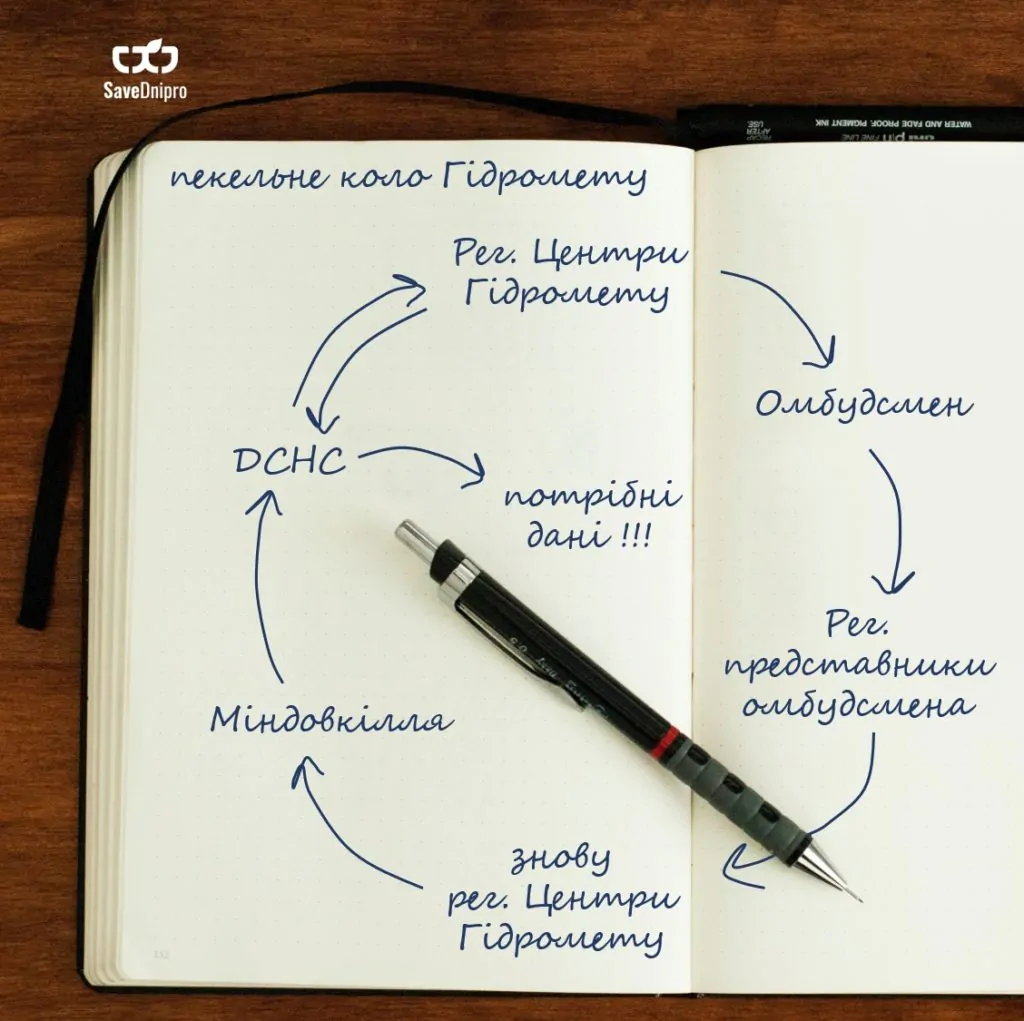
Hydromet’s bureaucratic circle of hell
We began defending our violated access rights. An odyssey of dozens of appeals to the Ombudsman, Ministry of Environmental Protection, State Emergency Service and Hydromet eventually brought the necessary data almost three months after our initial requests. The time and effort are striking. Consider how many official working hours it took simply to uphold the law on public access to environmental information:
- First, we complained to the Human Rights Commissioner about 21 instances of unlawful obstruction by regional Hydromet offices.
- The Ombudsman assigned the 21 refusals to regional representatives, who wrote to us confirming investigations and spent time establishing the circumstances.
- Eventually, the regional hydrometeorological centres said they did not hold the requested information and forwarded our requests to the Ministry of Environmental Protection: 21 letters went to the ministry.
- The ministryconsolidated these requests, told us it did not hold the information either, and forwarded the request to the State Emergency Service. Deputy Minister Viktoriia Kireieva signed the letter. This is what a deputy minister had to spend working time on.
- Finally, the State Emergency Service, which oversees Hydromet, obtained the data from it. We do not know how many internal requests or letters to regional centres this required.
- The State Emergency Service of Ukraine sent us the data.
We visualised this bureaucratic circle of hell for a post on social media.
The goal and the path towards it
Such a traumatic experience might discourage anyone, but not us. We took it as a challenge. Hydromet’s air quality data is extremely important, especially during wartime. Its six-monthly analytical reports were striking: for some pollutants, it recorded concentrations several times above maximum permissible levels. We saw such data nowhere else. Sharing it on social media always attracted a wide audience and media enquiries.
We therefore began campaigning for Hydromet’s data to become publicly accessible at a minimum, and ideally available in machine-readable open data format for independent app, website and service developers, analysts, scientists and journalists.
Remembering our earlier difficulties communicating with Hydromet, we decided to involve those already aware of the problem and whose responsibilities and interests included making this information accessible. On 6 March 2024, we initiated the first working meeting with representatives of the Ministry of Environmental Protection, Ministry of Digital Transformation, Ombudsman’s Office, State Emergency Service and Ukrainian Hydrometeorological Centre. A civil society organisation had brought these public bodies together to move an important issue forward.
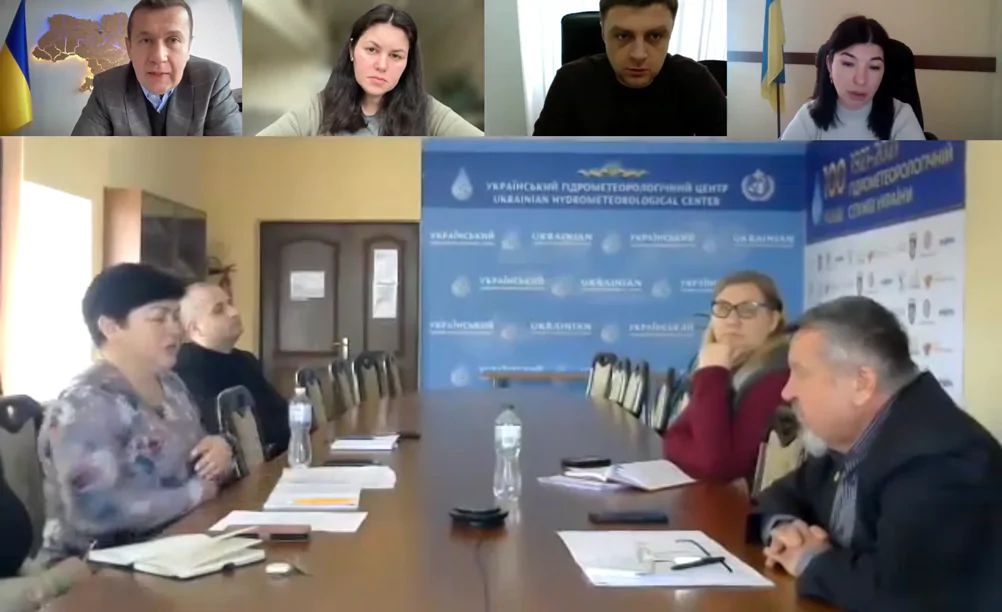
Fortunately, almost everyone we brought into the meeting supported change. Hydromet representatives explained their difficulties, including outdated equipment and lack of funding — which immediately brought to mind the invoices we had received. Understanding the challenges public institutions face, we always offer technical help to simplify such tasks. We proposed a service to collect information and convert it into machine-readable format.
Despite the tension — everyone remembered our requests — the meeting ended with agreement that Hydromet would work towards broader publication through the ministry’s EcoZagroza system and the State Open Data Portal. We also agreed to meet a month later to check progress.
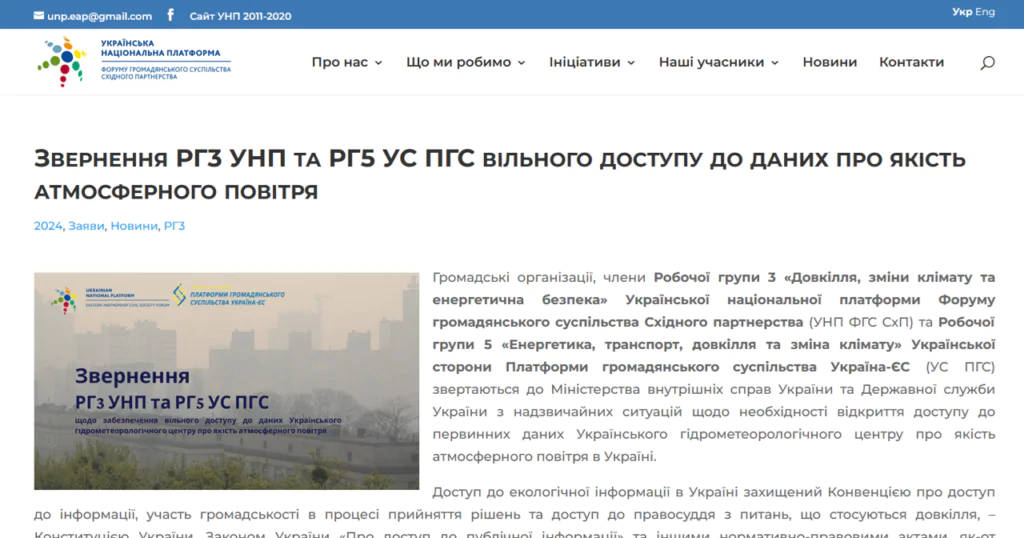
To maintain momentum, in April we initiated a joint appeal from Working Group 3 of the Ukrainian National Platform, representing twenty organisations, and Working Group 5 of the Ukrainian Side of the Civil Society Platform, representing 45. We stressed the need to publish raw observation data and asked the Ministry of Internal Affairs and State Emergency Service, which oversee Hydromet, to ensure its publication.
The next working meeting took place on 9 May 2024, again bringing together almost the same agencies. We learned that Hydromet had registered and begun submitting data to the Open Data Portal, although the Ministry of Digital Transformation had not yet completed moderation. Technical issues with publication on EcoZagroza remained unresolved. Although publication had not yet been achieved, we welcomed Hydromet’s progress and wrote about it on social media.
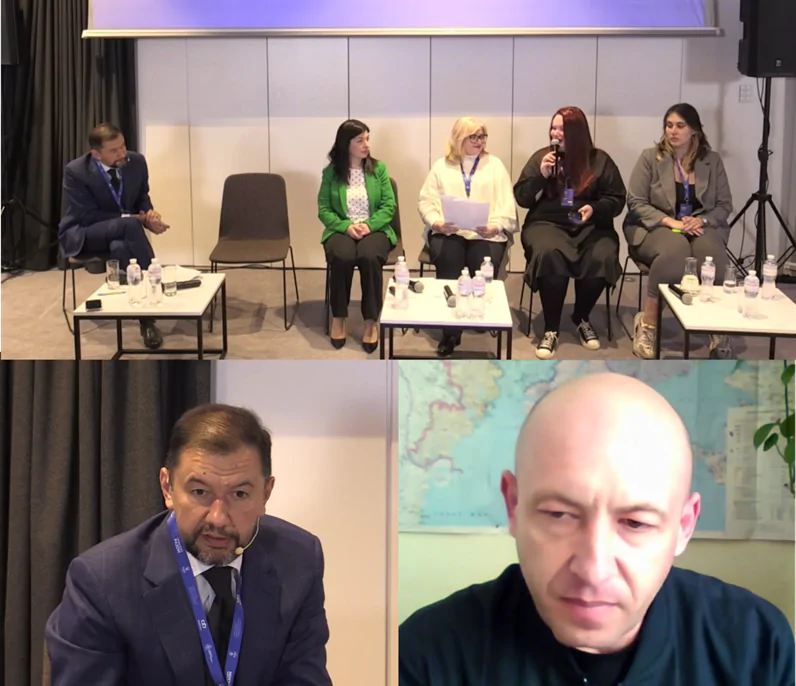
On 13 May 2024, at field hearings of the Verkhovna Rada’s environmental committee initiated by SaveDnipro, Bohdan Masovets, head of the State Emergency Service’s Hydrometeorology Department, confirmed that preparations for data publication were continuing.
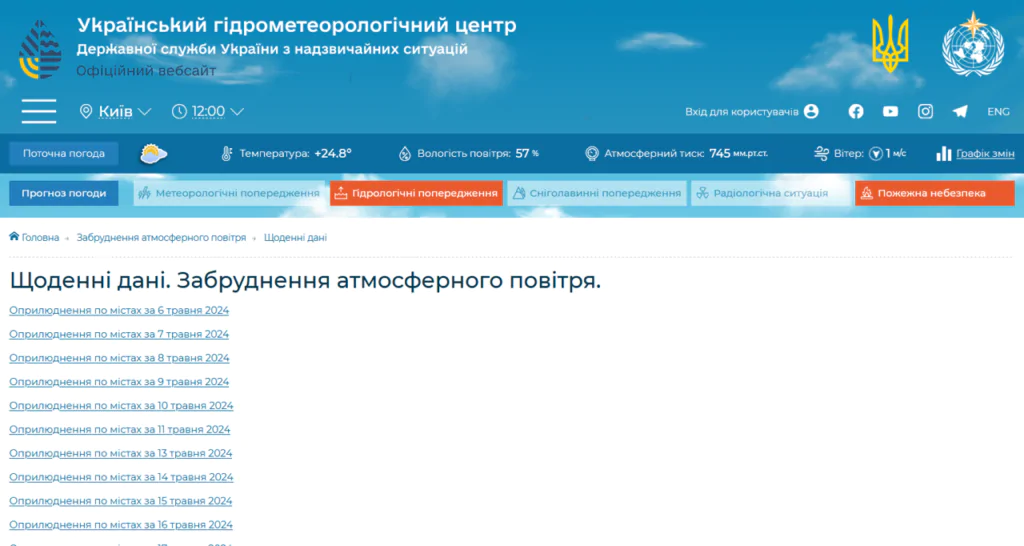
Then came good news. First, a new sectionappeared on Hydromet’s website with air pollution observations: monthly city averages and daily data from some posts, including individual measurements. This was a first step forward that we immediately acknowledged.
On 23 July 2024, a truly historic event followed. For the first time, the Ukrainian Hydrometeorological Centre published ambient air quality data on the Open Data Portal in machine-readable format.
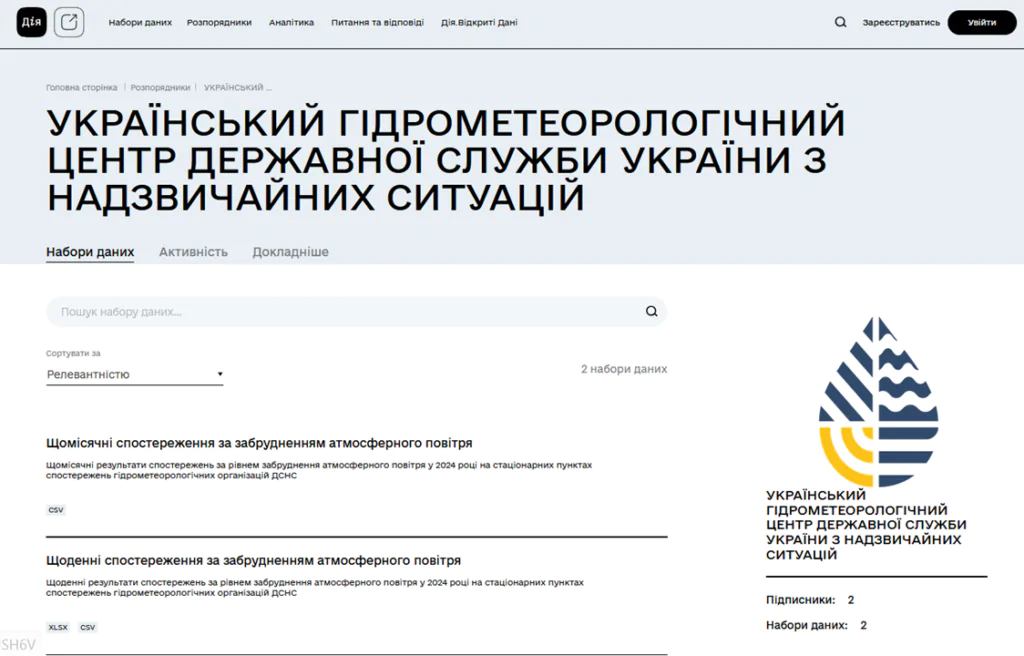
It published pollutant observations for the first six months of 2024 for selected settlements, including daily and monthly averages.
Only months earlier, Hydromet had barely understood what the public, including our organisation, meant by machine-readable format. We are therefore delighted by its prompt, constructive response to criticism, mobilisation of resources and adoption of a new publication format.
Hydromet needs support!
Of course, access to individual observations at every monitoring post, rather than daily or monthly averages, would be better still. Machine-readable data becomes more valuable the less aggregated it is.
Another weakness is timeliness. Improvement requires modern automated monitoring stations. Measurements are currently taken manually using outdated equipment, require time for verification and must then be entered manually into information systems. We therefore learn about air quality after the fact, with delays of days or weeks; the Open Data Portal is updated monthly. Outdated equipment also prevents Hydromet from monitoring all necessary substances.
Modern automated stations are expensive: one monitoring point costs UAH 15–18 million. The ministry and State Emergency Service rely on assistance from Western partners. We call on the ministry and other authorities involved in securing that help to accelerate the process. Hydromet has shown that it works in the public interest and is open to cooperation, deserving comprehensive support.
Our gratitude knows no bounds
We sincerely thank everyone who helped this advocacy campaign: Viktoriia Kireieva, Serhii Vlasenko and Vitalii Bilousov at the environmental ministry; Ombudsman’s Representative for Information Rights Yuliia Derkachenko; Yanina Liubyva at the Ministry of Digital Transformation; Iryna Hrokhovetska and Hanna Doroshenko at the Hydrometeorology Department of the State Emergency Service of Ukraine; Denys Izotenko at the Digitalisation Department of the Ministry of Internal Affairs; Hydromet representatives Anatolii Prokopenko, Veronika Filonenko, Andrii Kutsyi and others. We also thank all organisations in Working Group 3 of the Ukrainian National Platform of the Eastern Partnership Civil Society Forum and Working Group 5 of the Ukrainian Side of the EU–Ukraine Civil Society Platformthat supported our joint appeals.
We are delighted to see a tangible result achieved through our shared efforts, especially those of the Ukrainian Hydrometeorological Centre.
This initiative was implemented through the EU-supported EMITTER project. The publication’s contents are the sole responsibility of SaveDnipro and do not necessarily reflect the views of the European Union.