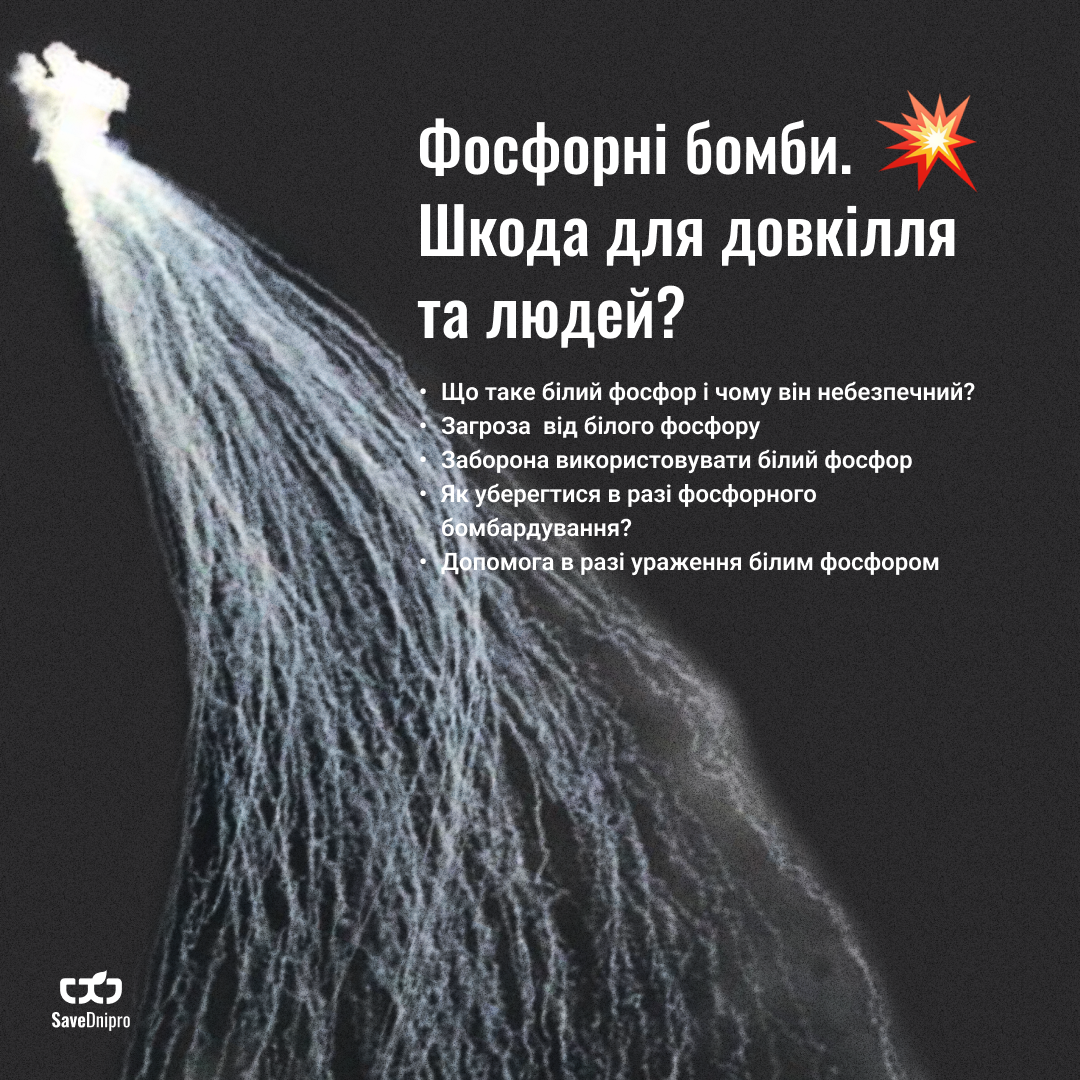
Translation note: This April 2022 article has been translated with corrections to first aid and the legal description. It is not a substitute for emergency instructions. Specific wartime weapon-use reports in the original were not independently verified for this translation. Sources: NIOSH white phosphorus guidance; ICRC: Convention on Certain Conventional Weapons.
russia’s war has brought death and destruction to Ukraine, along with the need to understand weapons hazards to protect ourselves and our loved ones.
Today we explain white phosphorus: its uses, dangers, legal restrictions and the importance of avoiding exposure.
What is white phosphorus and why is it dangerous?
White phosphorus is a colourless-to-yellow waxy substance that ignites readily in contact with air. It is used in various munitions, including shells, bombs, rockets and grenades, for smoke, signalling or incendiary effects.
When exposed to oxygen, phosphorus burns intensely and can spread burning particles over a wide area. Effects vary with the munition and conditions. Bright particles and dense irritating white smoke may be visible, but appearance alone cannot reliably identify a weapon.
The dangers of white phosphorus
1. Environmental effects
Burning phosphorus can start severe fires. Particles may continue burning or reignite when exposed to air. Fires can spread across large areas, threatening people, vegetation and equipment.
Combustion products and phosphorus residues can contaminate soil and water. Excess phosphorus compounds can disrupt ecosystems, although environmental effects depend on the chemical form and local conditions.
2. Human health
Particles on skin or clothing can cause deep, painful burns. Smoke can damage the eyes and respiratory system; absorbed phosphorus can cause serious systemic poisoning. Exposure can be fatal, but not every exposure is inevitably fatal.
Contaminated water and residues pose additional risks. Elemental white phosphorus should not be confused with all phosphate compounds; the forms have different toxicological properties.
Legal restrictions on use
There is no blanket international ban on every use of white phosphorus. Protocol III to the 1980 Convention on Certain Conventional Weapons restricts incendiary weapons, including their use against civilians and certain attacks near concentrations of civilians. Its definition excludes some munitions designed primarily for smoke or signalling. General rules protecting civilians apply in all cases; the legal assessment depends on the weapon and its use.
At publication, Ukrainian reports alleged use of phosphorus munitions in Popasna, Avdiivka and other places in Donetsk region. The original article also cited broader UN reporting on prohibited weapons. Those statements should not be treated as independent confirmation by this article of the composition of each munition.
How can you reduce the risk during bombardment?
Seek appropriate shelter and avoid smoke and burning particles. Do not approach or touch unexploded munitions or residues.
Leave firefighting and handling residues to trained responders. Phosphorus particles can reignite on contact with air.
Helping someone exposed to white phosphorus
The original article referred to initial actions from Ukraine’s Environment Ministry. The following translation includes safety corrections:
- Do not touch phosphorus particles with bare hands.
- If safe, keep affected areas wet with cool water while awaiting emergency care; avoid exposing particles to air again.
- Remove contaminated clothing only if safe, without spreading particles or exposing yourself. Do not pull away material stuck to burns.
- Use cool water and a wet dressing; do not apply home chemical mixtures, oils, ointments or peroxide. Removing embedded particles is work for trained personnel.
- Call emergency medical services. Do not give sedatives or other medicines on your own, especially if breathing or consciousness is affected.
IMPORTANT: white phosphorus burns require specialist medical treatment. Do not delay emergency care.
Take care of yourself!
The original publication drew on material from TSN, Ukraine’s Environment Ministry, M. V. Hlushchenko