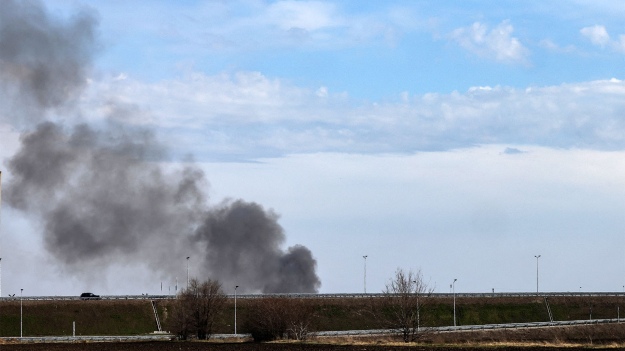
During the night of 10 April 2022, Russian forces againstruckan infrastructure facility near Dnipro airport several times.

Smoke rises from Dnipro airport on 10 April 2022 during Russia’s full-scale invasion of UkrainePHOTO: RONALDO SCHEMIDT / AFP
Residents heard explosions at around 03:00. The Dnipropetrovsk Regional Military Administration confirmed the information later that day.
Publicly available Ukrainian Hydrometeorological Centre data showed that,a southerly wind blew at five metres per second throughout the night of 9–10 April, making it likely that smoke from the airport-area fire travelled towards the city.
TheSaveEcoBotsystem, developed by SaveDnipro, combines pollution and polluter data with environmental protection tools in a chatbot and map. It automatically gathers air quality data from almost every available online system in Ukraine, making them accessible on amapand through an API also used by the National Security and Defence Council and Environment Ministry.
Looking at Dnipro’s air quality map at 04:00 on 10 April, some household stations remained operational despite many residents having left and potentially switched off appliances.
 Dnipro air quality map at 04:00 on 10 April 2022
SOURCE: SAVEECOBOT
Measurement histories show large particulate spikes at several stations.
A station on Heroiv Avenue in Peremoha-6 recorded PM2.5 of 214.23 µg/m³ and PM10 of 304.15 µg/m³ at 03:24. The chart below shows PM2.5, PM10 and the PM2.5 AQI calculated using NowCast. Air quality on Heroiv Avenue, Dnipro, 9–11 April 2022
SOURCE: SAVEECOBOT
A city-centre station on Serhiia Yefremova Street recorded PM2.5 of 44.7 µg/m³ and PM10 of 77.75 µg/m³ at 03:51.
 Air quality on Serhiia Yefremova Street, Dnipro, 9–11 April 2022
SOURCE: SAVEECOBOT
The charts also show the PM2.5 Air Quality Index calculated using US EPA’s NowCast method for fine particulate matter, a major air pollutant. The index translates pollution measurements into health-related categories and uses observations from the preceding 12 hours.
The NowCast AQI rose rapidly from green, good air quality, to orange, unhealthy for sensitive groups. EPA identifies people with heart or lung disease, children and older adults as particularly vulnerable to particle pollution.
This meanseven short-term air pollution can significantly harm people. Fires lasting hours or days at oil depots, warehouses or forests can cause even greater harm.
These stations lie downwind of the airport. Google Maps puts Peremoha-6 about five kilometres away in a straight line, a distance the plume could cover in roughly 20–30 minutes at five metres per second. Around 30 minutes later, emissions could reach the city centre, ten to eleven kilometres from the airport.

Locations of Dnipro stations recording PM2.5 and PM10 spikes
SOURCE: GOOGLE MAPS
We therefore have community monitoring evidence consistent with air pollution from the strike and resulting fire, supporting documentation of environmental harm and possible war crimes against Ukraine and its people.
What can we conclude?
- Environmental data must remain open even during warboth to inform people and to document environmental war crimes.
- Installcommunity air quality monitoring stationsto collect more data and warn people promptly about polluted air.
- Be sure toreport environmental war crimesthrough theSaveEcoBot chatbotto the Environment Ministry’s operational headquarters, helping prepare compensation claims against the aggressor before the International Court of Justice.
- We ask state institutions, local authorities, private businesses and other monitoring station owners:open your data rather than closing themso more people can analyse and use them for civilian safety.
Some argue that online air quality data and working monitoring stations could help the enemy. I disagree: the enemy already has satellites and drones able to obtain detailed information over long distances and in many weather conditions.Closing important civilian data can instead benefit the enemy.
Do not publish photos or videos of missile impacts or missiles in flight. Do not help the enemy!
Defeat to the enemy! Glory to Ukraine!
Pavlo Tkachenko, Head of IT at SaveDnipro
Source: Ukrainska Pravda