
Translation note: This is a historical account of a 2023 conference. Figures, forecasts, contact details and descriptions of reactor conditions below reflect the speakers’ statements at that time, not current emergency instructions. Follow present-day official alerts for health and safety decisions.
We have gathered the key quotations, points and facts from four hours of conference discussions. If you did not have time to watch the broadcast, this article is for you.
To watch a particular speaker’s contribution after reading the main points, – simply click their surname. Let us begin.
‘Russia’s war in Ukraine has terrible consequences for people and the environment. Damage to the Kakhovka dam has compounded the situation. The full extent and depth of the consequences still require verification and assessment, but documenting, analysing and understanding the impacts, including environmental ones, is important now.’
Gregory Tsouris, EU representative in Ukraine
PANEL DISCUSSION 1.
THE KAKHOVKA ATTACK: ASSESSMENT AND EXPECTED CONSEQUENCES
Moderator: Maksym Nefyodov
Oleh Bondarenko, chair of the environmental policy committee:
- A comprehensive assessment is difficult because some consequences will emerge over the long term.
- Parliament responded immediately with a working group meeting, appeals to international partners and organisations, and preparations to activate the EU Civil Protection Mechanism.
- ‘This is the largest technological disaster since Chornobyl.’
Tetiana Tymochko, adviser to the environmental minister:
- The event should be classified as ecocide:
- more than 5,000 square kilometres flooded;
- UAH 10.5 billion in fish mortality damage, excluding future losses of young fish;
- 333 plant and animal species threatened with extinction;
- the global population of marine pike-perch has died, and the species no longer exists;
- 25 protected sites affected.
- The climate of a vast area will change, with a risk of desertification. Huge volumes of freshwater and pollutants entering the Black Sea have dealt an unprecedented blow to its ecosystem.
- Ten thousand hectares of agricultural land are covered in silt, and most irrigation systems have been lost: a blow to global food security.
- The environmental ministry is monitoring pollution directly in the combat zone.
- There is insufficient capacity to process biological remains of dead animals.
Maksym Nefyodov, co-founder of Technologies of Progress:
- Satellite imagery was used to determine water rises in the flooded area:
- nearly 7.5 million square metres flooded;
- 51,000 homes and other buildings inundated;
- at least 20% of flooded buildings cannot be restored because of water depth, prolonged inundation, silting and infrastructure damage.
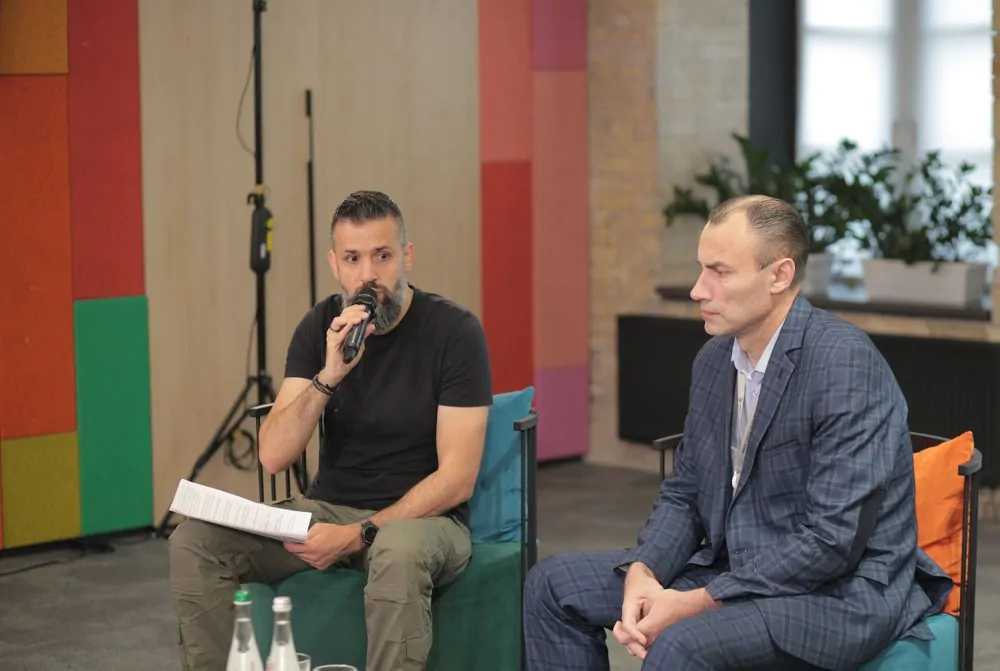
Oleksii Danylenko, director of the Ministry of Health’s Public Health Department:
- Epidemic risks are high, but no outbreaks have yet been recorded in the affected area.
- The main risks are drinking water and food.
- Use bottled water or water disinfection tablets. The hotline for obtaining tablets is 0 800 101 102.
- Do not consume food from flooded areas, including preserved foods.
- The ministry is prepared to receive infectious disease patients from affected areas. Preventive measures have so far been effective, with no outbreaks recorded.
Yuliia Ovchynnykova, MP and member of Parliament’s environmental policy and nature management committee:
- ‘The environment has no borders. Everything happening in our country affects environmental conditions in Europe and worldwide.’
- Ukraine is among the few countries defining ecocide in law. Legal definition problems must nevertheless be resolved for the Criminal Code provision to work.
- International recognition of ecocide is critical. Including it in the Rome Statute and other countries’ laws will enable future reparations.
Dmytro Zaruba, First Deputy Head of the State Environmental Inspectorate
- We are taking water samples despite equipment and reagent shortages. Soil sampling comes next. Data goes to law enforcement, which has opened an ecocide criminal case.
- The Inspectorate has damage calculation methods, including for protected areas. These calculations will be included in international claims against the aggressor.
- The EU is helping purchase environmental monitoring equipment, but not all needs have been met.
Oleksii Vasyliuk, chair of the Ukrainian Nature Conservation Group:
- ‘Nature has suffered the greatest damage. This area has Ukraine’s highest concentration of protected sites, fitting together like a jigsaw across the flooded territory.’
- Rising groundwater will kill some insects and animals even beyond the flooded area.
- This is a historic opportunity to remove a monument to Stalin — the Kakhovka dam. We should not restore the reservoir:
- nature has a chance to recover in the historic Velykyi Luh area;
- communities gain additional territory;
- irrigation pumps can draw directly from the Dnipro channel.
- Silt analysis results from the reservoir bed will soon clarify what is needed to restore natural ecosystems there.
Olha Chevhaniuk, chief operating officer of UAnimals:
- We are rescuing animals in the disaster zone.
- We inform the international community about ecocide, which matters amid information warfare.
- Nature reserves lack funding to do their work. We know this from helping them.

PANEL DISCUSSION 2.
FUTURE THREATS AND CHALLENGES.
Moderator: Viktoriia Voitsitska
Oleh Pashchenko, director of the Kakhovka Hydropower Plant:
- Losses from the plant’s destruction:
- river transport to Zaporizhzhia has stopped;
- 6,000 square kilometres of fields producing two million tonnes of grain have lost irrigation;
- 335 MW of renewable generation and the plant’s flexible capacity have been lost.
- Ukrhydroenergo and Ukrhydroproject have a reconstruction vision accounting for military threats.
- The reservoir could return to 12.7 metres, sufficient for the Zaporizhzhia plant and other water intakes, within a year if a temporary dam is built. EBRD and European Investment Bank loans are needed, and negotiations are underway.
Yurii Nabyvanets, deputy research director of the Ukrainian Hydrometeorological Institute:
- The Institute modelled flooding before the attack and supplied the data to authorities.
- Some migratory birds have lost their food sources and will be unable to migrate.
- There are serious doubts that agriculture and affected cities can obtain enough water without the reservoir. Restoring it therefore makes sense.
The Radiation Accident Consequence Forecasting Centre at the Ukrainian Hydrometeorological Centre:
- Occupying forces dismantled automated radiation monitoring at the Zaporizhzhia plant. IAEA specialists take measurements, but not regularly or automatically.
- Hydromet’s nearest observation point is fifteen kilometres away in Nikopol.
- It cannot detect contamination spreading towards occupied territories where it has no observation points.

Tetiana Kutuzova, state inspector at Ukraine’s nuclear regulator:
- The plant’s regular radiation monitoring systems are not switched off, but their data is available only through the IAEA, not automatically. The IAEA also receives other reactor operating parameters, access to which Russia has blocked for Kyiv.
- On 8 June, the regulator ordered Unit 5 into cold shutdown. Russian forces ignore this order, keeping it in hot shutdown. Even if the cooling pond loses water, however, some time would remain before nuclear fuel overheats.
- ‘In the reactors’ current state, the greatest radiation risks are close to the plant, within the first kilometres, including Enerhodar. The rest of Ukraine is not in the high-risk zone. But if occupiers deliberately bring a unit to power, we face a major disaster affecting Ukraine and territory across its borders.’
- Iodine tablets should not be taken under the current reactor conditions: radioactive iodine as a fission product is absent when a reactor is not operating at power.
- We do not know the enemy’s plans and are preparing responses. Radiation monitoring is essential. SaveEcoBot’s independent monitoring lets everyone follow conditions online.

Pavlo Tkachenko, lead developer of SaveEcoBot
- A year ago, we saw enormous demand for radiation data when occupying troops entered the Chornobyl zone.
- SaveEcoBot first combined all publicly available radiation readings on one map. We then began installing additional stations, including around the Zaporizhzhia plant.
- By continuously providing public information, SaveEcoBot reduces public anxiety when media discussion of the plant intensifies.
Marharyta Makarenko, deputy laboratory head at the State Scientific and Technical Centre for Nuclear and Radiation Safety
- The worst scenario is a complete blackout, preventing backup cooling systems from working.
- Even then, radioactive elements would remain inside reactor containment, and the principal consequence would be losing the plant from Ukraine’s energy system.
- If containment is destroyed externally while a reactor operates at minimum power, radiation consequences would be much more serious. The affected zone would depend on weather.
PANEL DISCUSSION 3.
RECOVERY PLAN
Moderator: Martyna Bohuslavets
Andrii Vedmid, deputy department director at the Ministry for Communities Development:
- Southern Dnipropetrovsk region, including Kryvyi Rih, Marhanets and Nikopol, obtained water from the Kakhovka Reservoir and now faces supply problems. Drinking water needs are currently met by bottled deliveries, while the State Emergency Service supplied additional treatment systems.
- Alternative supply projects have begun. The regional military administration is also extending intakes towards the Dnipro’s new channel. Kryvyi Rih’s southern reservoir holds enough water for about four months.
- Kherson uses drinking-quality well water. Ostriv district suffered most, and its wells cannot currently be used.
- Before the war, Mykolaiv depended on the Dnipro. Fighting disrupted that pipeline last year, so the city now uses other sources.
Andrii Kachko, deputy mayor of Marhanets:
- Drinking water needs are fully covered by rail and road deliveries. Well sites have been selected, and the first borehole is already drilled near the city hospital. Work is coordinated with district and regional military administrations.
Serhii Kurasov, secretary of Pokrov City Council:
- Supplying the city from a local river requires treatment and pumping equipment. The municipal budget has shrunk considerably during the war, so assistance would help, though issues are being addressed even now.
Yevhen Khlobystov, expert at the Crimean Tatar centre
- Switching to local supply sources presents challenges concerning groundwater and surface water quality.
- Some land will have to be withdrawn from agriculture, harming communities’ socioeconomic situation.
- Flooding has increased internal displacement. Ukraine has the world’s largest forcibly displaced population, with 5.2 million citizens seeking assistance. Not everyone will return home, despite substantial state funding for housing reconstruction.
- Closing navigation will also harm the regional economy.
- Soil and water testing must continue for several more weeks.

Serhii Karelin, water supply technical consultant at USAID Ukraine
- Well water levels will fall, and quality must also be monitored.
- Communities should hold brainstorming sessions with water specialists. Artesian wells are no panacea: sufficient groundwater does not exist everywhere.
- Major pipelines take a long time to build. Meanwhile, communities must economise and monitor remaining supplies in every settlement.
- A register of wells, pumps and underused reserves is needed to redistribute existing water to places facing shortages.
- USAID’s assistance programme covers ten regions. Contact information is available online.
Dmytro Teslia, project manager at Water Mission
- Water Mission is a US Christian organisation that began Ukrainian operations during Mykolaiv’s water crisis last year.
- Twenty reverse-osmosis systems are now installed in Mykolaiv. We have also installed dozens near combat areas in Donetsk and Zaporizhzhia regions, cooperating with the Ministry of Infrastructure. We check quality twice monthly wherever systems operate. Requests for help can be made through Water Mission’s website.
- There is no well register. Even local communities may be unaware of mothballed boreholes.

Olha Hvozdik, SaveDnipro:
- Neither wells nor water deliveries solve the water supply problem: they are temporary measures.
- Mykolaiv provides a successful assistance example. Its authorities prepared in advance, which mattered greatly.
- Fourteen wells were commissioned through cooperation among civil society, international partners, charities and city authorities, with EU financing and crowdfunding.
Michal MIADOK, Emergency Response Officer, European Commission:
- The EU Civil Protection Mechanism combines 27 countries’ resources. A country unable to cope with a crisis sends a request. Since Russian aggression began, Ukraine has submitted over 150 requests and received over EUR 600 million in equipment, experts, evacuation and overseas medical treatment support. About three hundred transport operations facilitate assistance.
- After the Kakhovka attack on 6 June, we immediately received Ukraine’s request and supplied rescue boats, water treatment systems, generators, environmental expertise and other assistance.
- Assistance through the EU Civil Protection Mechanism requires an official request from a responsible ministry.

Conclusions
Participants agreed that Russia’s destruction of the Kakhovka plant is the largest technological disaster since Chornobyl. Mass plant and animal deaths and complete destruction of some endemic species provide grounds to describe the crime as ecocide.
Nuclear safety experts stressed the adverse consequences for the still-occupied Zaporizhzhia plant. They examined accident scenarios with and without containment destruction. Because reactors are currently in cold or hot shutdown, containment failure without additional external interference is considered unlikely.
Views differed on restoring the reservoir. A new hydraulic infrastructure project already exists, however, and EBRD and European Investment Bank financing negotiations continue.
The conference again demonstrated the need for state and NGO cooperation. NGOs effectively help disaster-zone communities obtain drinking water, rescue animals and make radiation data public.
Participants thanked the European Commission representative for the EU’s support and assistance to Ukraine.
***
The conference received financial support from the European Union. Its contents are the sole responsibility of the organisers and speakers and do not necessarily reflect the EU’s position.
When quoting, credit the organisers: the conference ‘The attack on the Kakhovka Hydropower Plant: consequences, threats and solutions’ was organised by SaveDnipro with financial support from the European Union.