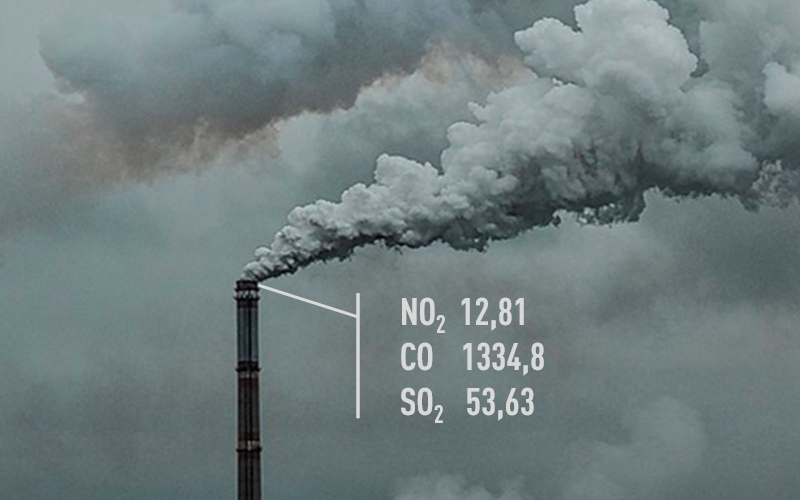
Suppose you see a company polluting the air or water. Can you obtain information about its pollutant emission volumes? Can the company or a public authority refuse to provide it?
It turns out they cannot. Commercial secrecy is no ground for refusal. If the requested information directly concerns the environment’s condition, it cannot be classified as secret. Article 50 of Ukraine’s Constitution explicitly states: ‘Everyone is guaranteed free access to information about the state of the environment, the quality of food and household goods, and the right to disseminate it. No one may classify such information as secret.’
Martial law does not restrict this article. The Constitution specifies which rights and freedoms may be limited, and Article 50 is not on that list.
The right to know about the environment
The best-known example of the cost to Ukrainians of missing environmental information is Chornobyl. Radiation contamination data was withheld for a long time, exposing many people to avoidable radiation. But environmental information matters beyond technological disasters. Companies’ routine operations can sometimes be no less dangerous: regular pollution has cumulative health effects. Knowing what we breathe, what flows in our rivers and what contaminates soil is therefore crucial.
This information is also needed to defend rights in court. Article 50 guarantees ‘the right to an environment safe for life and health and to compensation for damage caused by violation of this right’. Proving responsibility and damage requires environmental information. Researchers, journalists, entrepreneurs and public officials also need it.
Our right to know is protected not only by the Constitution, but also by:
- the Convention on Access to Information, Public Participation in Decision-making and Access to Justice in Environmental Matters, the Aarhus Convention, ratified by Ukraine on 6 July 1999 and taking precedence over domestic law;
- Article 9 of Ukraine’s Law ‘On Environmental Protection’;
- Article 13 of Ukraine’s Law ‘On Information’;
- Cabinet of Ministers Resolution No. 835 of 21 October 2015 approving the rules on datasets to be published as open data.
Article 13 of the Law ‘On Information’ establishes the sole exception for restricting environmental information: data on military facility locations. No other exceptions are provided by that law.
What happens in reality?
Government bodies and businesses have never been particularly eager for openness. Public pressure and these legal instruments nevertheless produced some progress. Officials gradually learned the Aarhus Convention’s requirements. After the full-scale invasion, however, large amounts of environmental data were closed, something legislation did not provide for even in those circumstances.
The logging permit register, for example, was closed. What secret could the enemy find in records of rights to harvest timber? Public oversight of logging, however, became impossible. The EIA Register suffered a similar fate: closed for a long time, it only recently became partly available with mandatory login, which is unacceptable because it violates free access rights. Many other registers and datasets remain entirely closed, leaving considerable work for activists campaigning to reopen them.
There are also remnants of legislation contradicting these principles. For example, the still-valid Cabinet of Ministers Resolution No. 1102 of 26 October 2011 lists paid Ukrainian Hydrometeorological Centre services. Under Annex 3, summarised air pollution information for cities with fixed observation posts is chargeable. Hydromet invokes this resolution to withhold raw observations too, depriving us of lawful free access to urban air pollution information. Neither the Constitution nor other legislation specifies that only a particular form of information must be free and accessible, so such exclusions are unlawful.
When does data become even more useful?
Data is more convenient when machine-readable, allowing automatic processing without human intervention. It can underpin numerous services and analyses. A familiar example is an app showing public transport movements. The city authorities did not create the app; they simply made municipal vehicle tracking accessible to everyone.
Open data means machine-readable data that can be freely used and distributed. More open data creates more opportunities for activists, investigative journalists, researchers, programmers, entrepreneurs and others. Ordinary citizens ultimately benefit, as with the public transport app.
In September 2016, Ukraine joined the International Open Data Charter, a foundational open data document. The same year, the Unified State Open Data Portalbegan operating. Since then, Ukrainian public bodies have had to publish datasets specified in Cabinet of Ministers Resolution No. 835 of 21 October 2015. Many concern environmental conditions.
Do officials comply? Not all, not fully, and since the invasion, far fewer datasets are published. Yet remarkably, Ukraine has made spectacular progress in international open data rankings even under these conditions. In the European Open Data Maturity ranking, it rose from seventeenth in 2020 to the top three in 2022 and 2023.
How is that possible?
The ranking’s methodology reveals an interesting detail: it is based on self-assessments by officials responsible for open data. Users — software developers, researchers and investigative journalists — were not surveyed. We are not alone in viewing Open Data Maturity results critically).
Ukraine must therefore recognise its own data access problems and correct them. This will be particularly important during post-war reconstruction, whose foundations are already being laid. As developers of SaveEcoBot, the largest environmental information aggregator, we want real progress and do everything we can to accelerate it.
This material was prepared with support from the European Union and the International Renaissance Foundation under the joint European Renaissance of Ukraine initiative. It represents SaveDnipro’s position and does not necessarily reflect that of the European Union or the International Renaissance Foundation.
