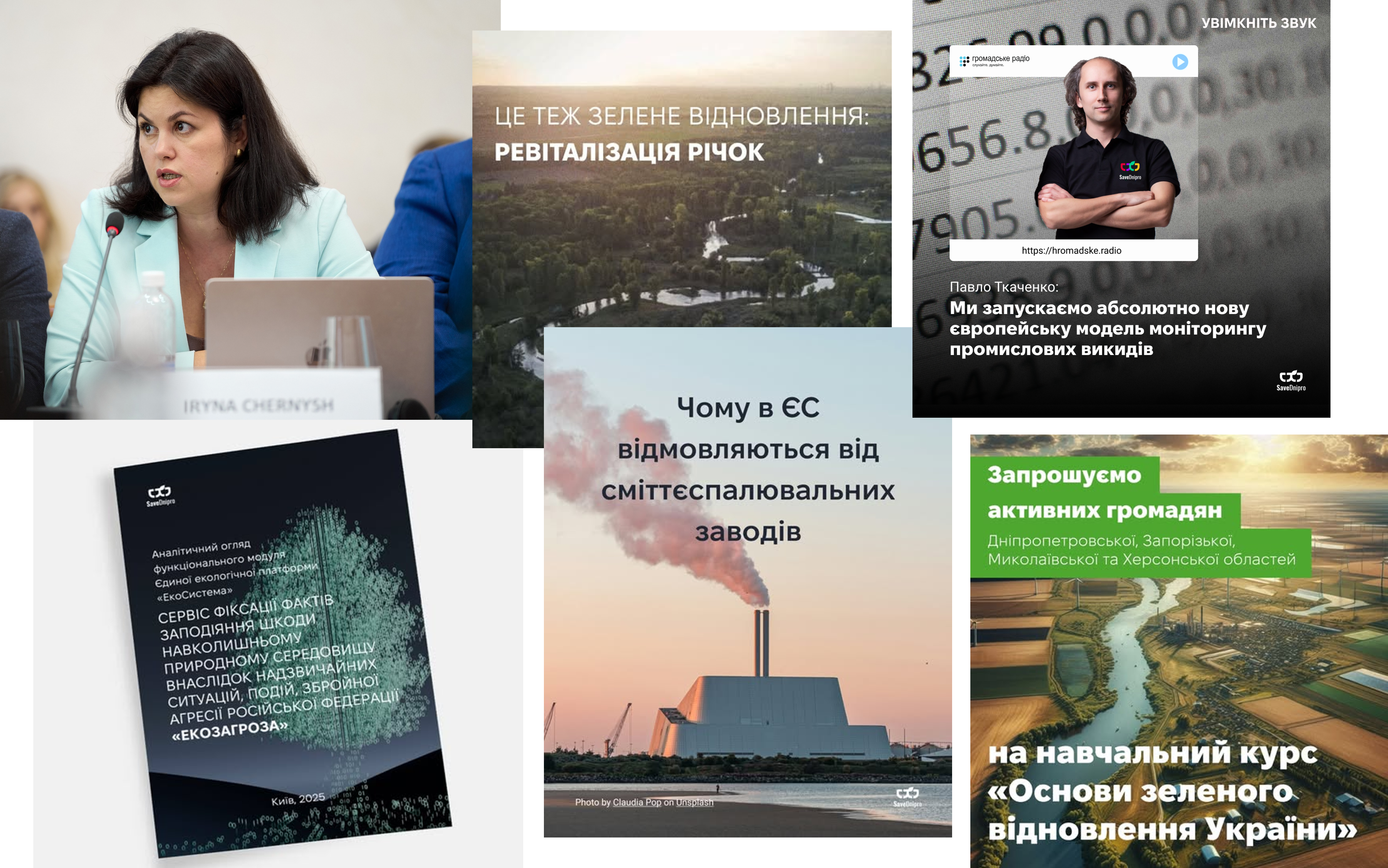
In September 2025 the SaveDnipro team worked to protect public health in Dnipro, advance continuous emissions monitoring, advocate green recovery and industrial pollution reform, analyse the performance of the EcoZagroza service, and monitor radiation levels and air quality across Ukraine every day.
Protecting public health in Dnipro. Iryna Chernysh commented on Channel 11 in Dnipro about plans to build a waste processing plant immediately next to the Prydniprovsk residential district. On our social media, we raised questions about the merits of building waste incineration plants, which are not a sustainable technology under the EU Taxonomy.
Bringing continuous emissions monitoring closer. On 25 September 2025, Ukraine’s Cabinet of Ministers adopted a resolution approving the procedure for transmitting emissions monitoring results in real time. Pavlo Tkachenko played a key role in drafting it. He explained its importance for controlling industrial emissions on Hromadske Radio.
Working to improve government digital environmental services. We presented an analytical reviewof the government’s EcoZagroza service, covering legal compliance, a technical assessment, data integrity and quality analysis, and a UX/UI review. We identified significant shortcomings in its operation and called for them to be addressed using our report’s findings and recommendations.
Strengthening public participation in green recovery. We recruited participants for the course ‘Fundamentals of Ukraine’s Green Recovery’ among residents of Dnipropetrovsk, Zaporizhzhia, Mykolaiv and Kherson regions. A remarkable 288 people registered for the course, which will take place in October. We drew our social media readers’ attention to aspects of green recovery such as river restoration and managing debris from destruction.
Helping build green finance infrastructure in Ukraine. We took part in the international strategic dialogue ‘Green Finance Instruments for Ukraine’s Recovery’, which discussed the current state and prospects of attracting international green finance for post-war reconstruction and Ukraine’s green transformation. We helped the organisers bring financial sector representatives into the dialogue. Ahead of the event, Censor published Iryna Chernysh’s column ‘Will Green Finance Come to Ukraine?’
Seeking accountability for the aggressor and reducing its ability to continue the war. SaveDnipro and 58 other civil society organisations signed an open letter to EU leaders calling on them to stop buying liquefied natural gas (LNG) from Russia.
Advocating industrial pollution reform. After the Law ‘On Integrated Industrial Pollution Prevention and Control’ entered into force on 8 August 2025, further progress on the reform depends on adopting implementing regulations and businesses introducing best available techniques and management practices. These issues are examined in Iryna Chernysh’s column ‘How to Reform Industrial Pollution Regulation’ on Ekonomichna Pravda. On our own social media, we shared important details of public participation in integrated environmental permitting, which we learned at training delivered by the Ministry of Economy with GIZ experts.
Protecting environmental interests threatened by the dissolution of the Ministry of Environmental Protection and its merger with the Ministry of Economy. We criticised the possible appointment of Liudmyla Tsyhanok as director of the environmental assessment department, arguing that she cannot ensure a balance between the interests of business, society and the environment.
We called for the problem of false public radiation alerts to be addressed. Five false radiation alarms in six months in different Ukrainian regions indicate systemic shortcomings and a lack of safeguards against erroneous activation.
Continuing our public education work:
- We explained the adverse effects of polluted air and heat on child development, drawing on the Stress in Pregnancy Study by US researchers. In this context, we highlighted the shrinking area of green spaces in Kyiv, which should help mitigate the urban heat island effect.
- We published a list of Ukraine’s ten cities with the most polluted air in the first half of 2025, using data from the Borys Sreznevskyi Central Geophysical Observatory.
- We examined which Ukrainian cities have worse air quality than in 2021.
- We analysed the state’s Single Project Pipeline for public investment in 2026, which contains many green recovery measures. However, they appear fragmented and isolated. We stressed the need for a national green recovery strategy.
- We compared environmental expenditure in the draft 2026 State Budget with the revised 2025 State Budget. Reduced spending on environmental oversight may indicate that the Ministry of Economy does not intend to reform this area.
- We explained the penalties for carrying out a planned activity without an environmental impact assessment (EIA) conclusion. This issue became particularly relevant after construction began on a wind farm on the Runa mountain meadow in the Carpathians without an EIA conclusion.