
Translation note: This interview records assessments and institutional arrangements in May 2022. Numbers, access restrictions, legal proposals and nuclear-site conditions describe that period. The English translation corrects unsafe improvised chemical first-aid suggestions; follow current official emergency guidance. Sources: CDC chemical emergency guidance.
What environmental damage are russian occupying forces leaving behind? How can it be documented to hold russia accountable? And what should green reconstruction of Ukrainian towns and villages look like? We explore these questions in this interview.
The russian forces that invaded Ukraine on 24 February have left a wide range of environmental problems: destroyed transport, water, heating and electricity infrastructure, logging, fires, damaged nitric acid tanks and seized nuclear facilities, where radiation readings rose in the first days of the full-scale war.
From the first days of the war, the organisation “SaveDnipro”and its environmental partners began documenting crimes against the environment by russian occupying forces, seeking future accountability and compensation. SaveDnipro also continued explaining what environmental crimes are, how witnesses can report them and how people can protect themselves and their families from their consequences.
We asked SaveDnipro head Iryna Chernysh.


Iryna Chernysh
— How did your team’s work change after 24 February? Had you prepared for war?
— However much we wanted to ignore or dismiss the threat before the full-scale invasion, we understood it. We developed an internal policy triggered by martial law or aggression in regions where our colleagues lived. We focused first on their safety and financial support, knowing that rapid evacuation would require money, and on internal communication so we could stay informed even if access to information was disrupted.
On the morning of 24 February, my husband, son and I woke to explosions and knew we had to leave; our bags were ready. I contacted colleagues and we activated our response policy. There was no period of organisational disorientation: we were in touch from the first hours. Despite payment-system disruption, we supported staff effectively. Some were in Kyiv, others in Dnipro; some began evacuating west, others stayed home. Most importantly,we were working in our shared context from the very first hour of the war,as Ukraine’s largest aggregator of air quality information from available online systems. During the war we also assembled the most comprehensive radiation dataset. We had already collected some readings, but after events in the Chornobyl Exclusion Zone and plant we realised we needed a wider range of data holders and sought additional information.
— russian forces seized Chornobyl on the first day. Did they understand the global danger? What signals did you observe?
— On the night of 24–25 February we sawradiation readings spike in the Chornobyl Exclusion Zoneby as much as thirty times. Foreign media and researchers contacted us. State websites were already down following russian cyberattacks, so effectivelywe were the only available source of radiation data in Ukraine.I was in Lviv. To avoid panic and understand what was happening, we informed the Environment Ministry and the Armed Forces’ press service. It was the middle of the night and we received no immediate answer. We had information but did not know whether it reflected real conditions or technical faults, or whether publishing it would create unnecessary panic. In the morning the Ministry said it was processing the information and the Armed Forces had received it. About an hour later Ecocentre attributed the spikes to heavy vehicles disturbing contaminated soil. International researchers have questioned that explanation, andthe readings may instead have reflected interference affecting highly sensitive sensors. It is difficult to say with certainty. The problem was that after the spike the data disappeared: transmission had stopped by the morning of 25 February.
“In the first days, the Environment Ministry asked us to create a tool for collecting reports of environmental war crimes by the russian army.”
— How did the full-scale war change your work? Were projects suspended?
— The war changed our plans substantially. We had major projects intended to shape the next two years. Our work from the first day has included this:in the first days, the Environment Ministry asked us to create a tool for collecting reports of environmental war crimes by the russian army.Tools for reporting war crimes generally were already appearing. After discussing it as a team, we decided toadd a SaveEcoBot function that would collect reports from the public and send them to the Ministry’s operational headquarters.We launched it about a week later and made it the chatbot’s main feature.
Previously, our principal task was air monitoring. People could also report environmental violations by companies or other entities to initiate inspections, and we provided information about public participation in environmental impact assessment. Public participation in environmental procedures is now absent. It is fundamental to us: our initiative, and later our organisation, grew out of it. Through public participation, we secured environmental improvements at Prydniprovska Thermal Power Plant, Dnipro’s largest polluter.
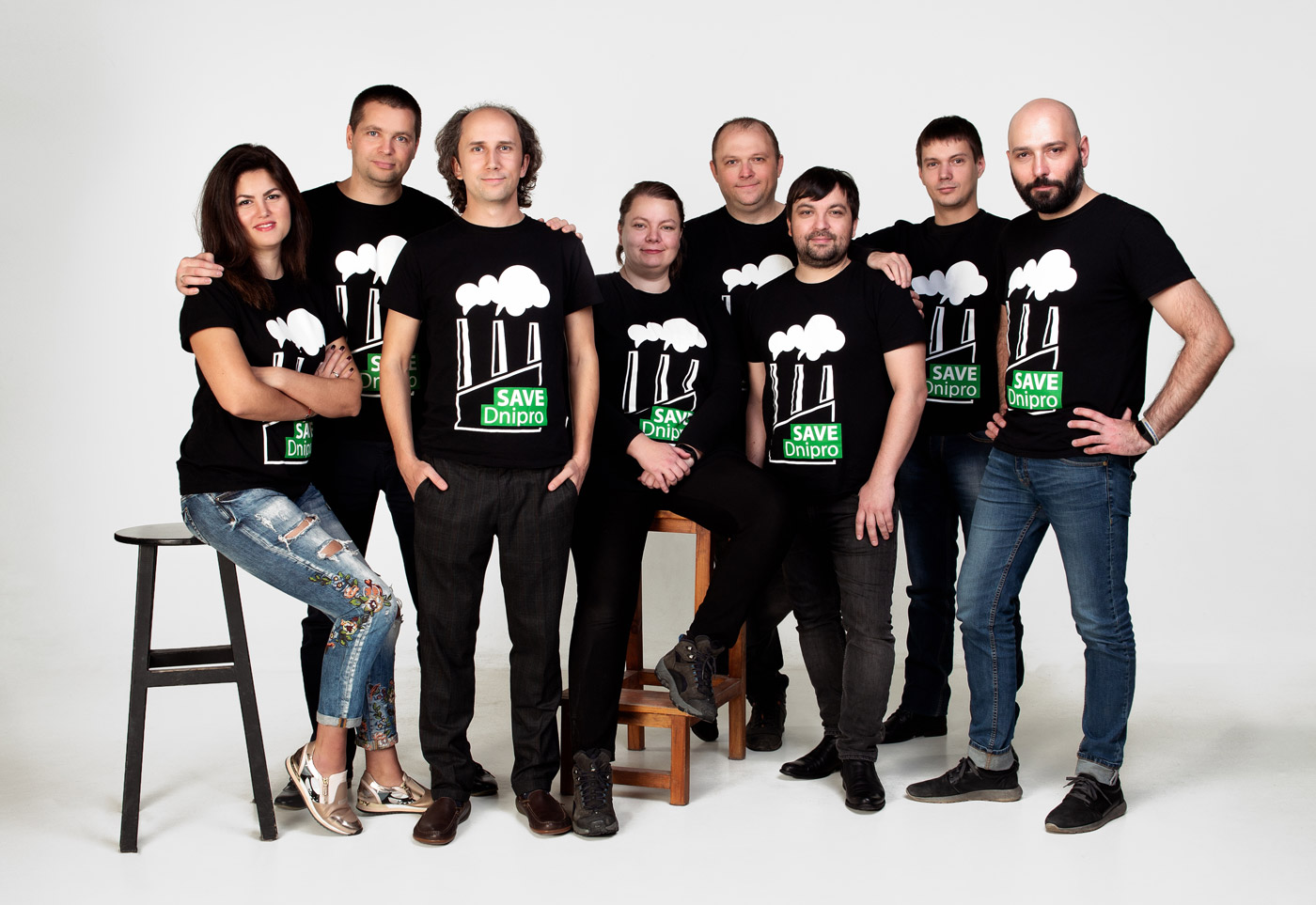
The SaveDnipro team
— Does the public currently have access to environmental information?
— Access has been restricted under measures introduced by the state, but it remains central to our work. Public participation in documenting crimes is another focus.
After Chornobyl monitoring data became unavailable and the threat of russian nuclear terrorism increased, we knew we needed as much information as possible. If conditions were normal, people needed reassurance; if not, they needed prompt, accurate information to protect themselves. The sudden closure of information made this difficult. We partnered with the Environment Ministry, approached businesses taking manual readings and the Health Ministry’s regional centres, which until recently were measuring even in temporarily occupied Kherson. In other words,people continue doing their jobs even in dangerous places. Previously these readings were mostly for internal use because there was no major aggregator bringing them together. We managed to collect them and continue doing so.
Last week the Ministry also presentedEcoZagroza, which uses our radiation and air quality data. Digitalisation and open environmental information are central to our work. We also monitor fires, which can cause environmental disasters, particularly in the Chornobyl Zone, and severe air pollution elsewhere. We use NASA satellite data to locate high-temperature areas quickly. Combat sites also appear in these detections, but the information remains useful for analysis.
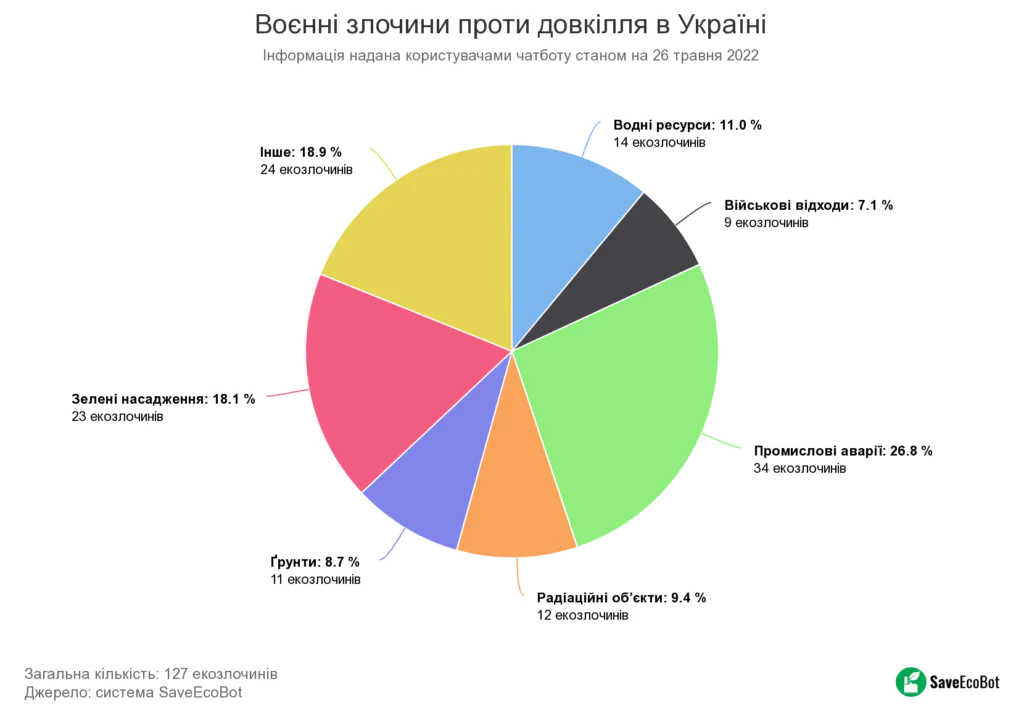
“We have received 125 witness reports of environmental crimes, mostly industrial accidents, but also damage to vegetation, soil, radiation facilities and water, and military waste.”
— How does SaveEcoBot work, and what information can people submit?
— Reports are depersonalised, not open to chatbot users, and sent directly to the Ministry’s operational headquarters. We also keep statistics. We currently have 125 witness reports, mostly about industrial accidents. Other categories cover vegetation, soil, radiation facilities, water resources and military waste.
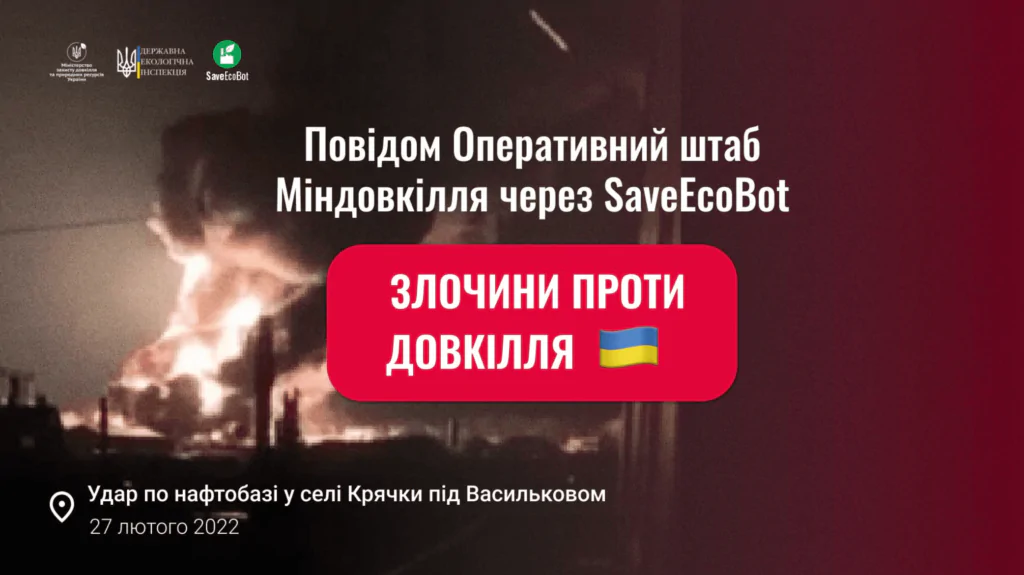
— You mentioned 125 reports. In what format do people usually send information?
— SaveEcoBot is available in Telegram and Viber.
- Open the chatbot and choose the option to submit evidence of a war crime;
- select the category;
- briefly describe what happened;
- provide the location;
- upload photographs or video and submit.
We do not disclose the reports; they are automatically transmitted to the Environment Ministry. They now appear in EcoZagroza and are processed for inclusion in the register.
— Which public bodies and companies do you work with? Who receives environmental crime information?
— We have begun productive work with central government bodies, including the Specialised Environmental Prosecutor’s Office within the Prosecutor General’s Office, providing information for environmental crime investigations. As the largest air-data aggregator, we prepare air quality and wind analyses to help build evidence. We are also starting a project with Ecocentre, the state enterprise responsible for radiation monitoring in the Exclusion Zone, to establish a radiation-data baseline. We work with the Hydrometeorological Centre and plan to support its digitalisation.
Another project, an environmental analysis of Kyiv, has changed significantly. We had nearly completed it when the war began. That pre-war baseline may help prove environmental crimes in court. We are also resuming cooperation with Kyiv Metro. An air quality information project for passengers was due to launch in late February; I hope passengers will soon receive that information.
— How did you establish communication with the Ministry and other bodies? Do they restrict information under the pretext of martial law?
— We see that andraise the alarm about information being closed. Environmental information is protected by Ukraine’s Constitution and the Aarhus Convention; an administrative order cannot override them. What helps us work with central government?
First,experience. We did this before the war. We had nearly launched a major electronic air-emissions permit service for the Ministry, digitising an important administrative process previously done on paper. It digitises both the application and permit and creates a proper public participation procedure, reducing corruption risks and preventing the public being ignored. The system was ready, but the war put its launch on hold.
When approaching a public body, we usuallycreate a win-win proposition. We show the benefit to the public and how it will simplify or improve the body’s work. For example, the Ministry wants environmental crime data and we want people to document it, so we automate collection. The Ministry gets data, people get a tool and everyone benefits.
The same applies to environmental prosecutors. They need data that we have; we do not want it sitting unused. We prepare analysis for their investigations so the information benefits Ukraine.
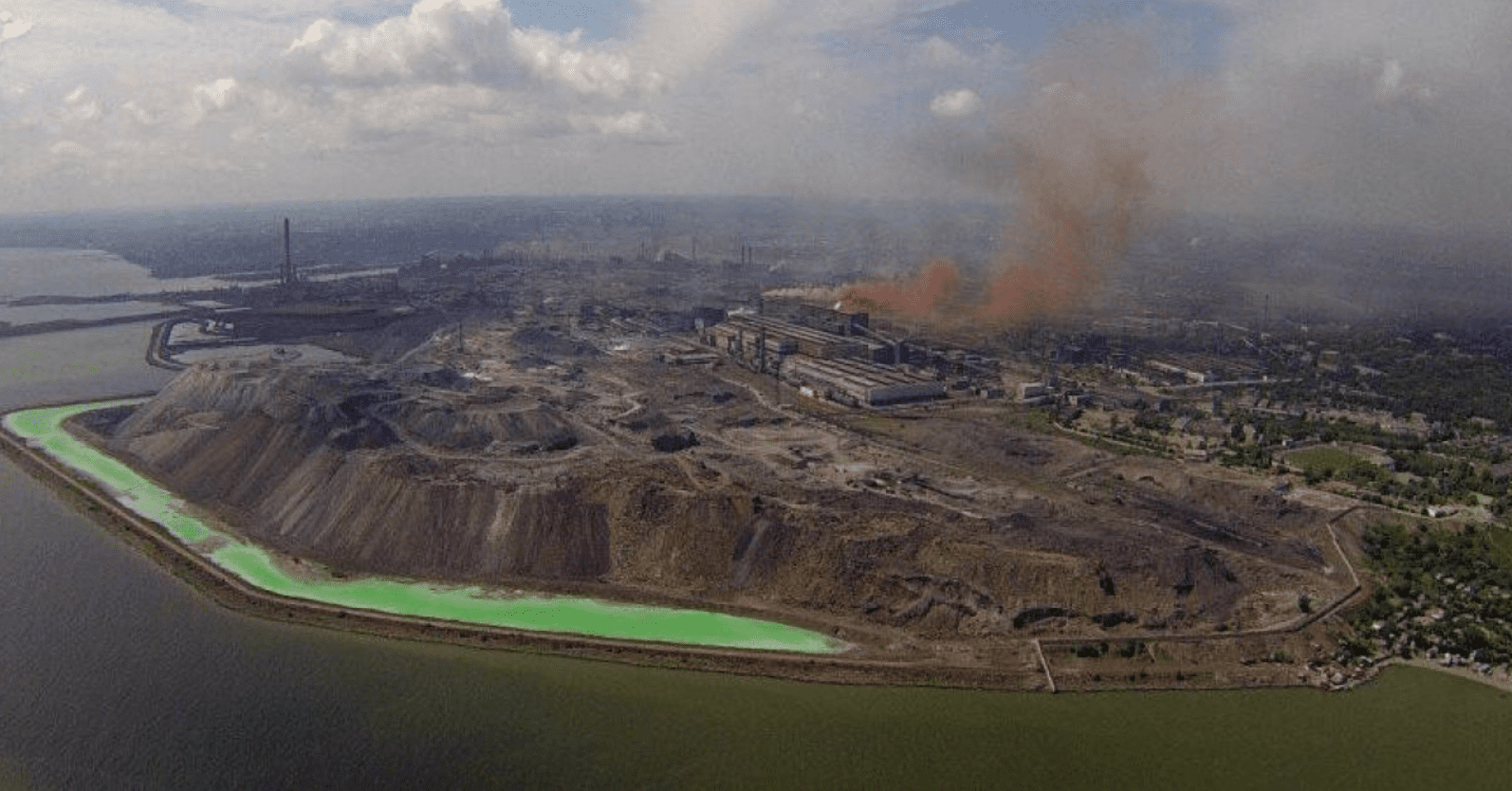
A structure at Azovstal described in the original caption as holding hydrogen sulphide. The caption warned of a potential release into the Sea of Azov during bombardment.
“Without environmental information, the public cannot participate. Without participation, it cannot protect Ukrainians’ rights.”
— What are the consequences of losing access to environmental information?
— Without environmental information, the public cannot participate in decisions. Without participation, it cannot protect the rights of Ukraine’s population. We always work with open data and promote it within the environmental movement, because information is fundamental. Much information unrelated to civilian security is now being closed because of the war, such as regional air quality readings. How does knowing that threaten local people? It does not. Or how does knowing where logging is planned threaten Ukraine? It does not, but secrecy creates ample room for corruption, because without data there is no oversight..
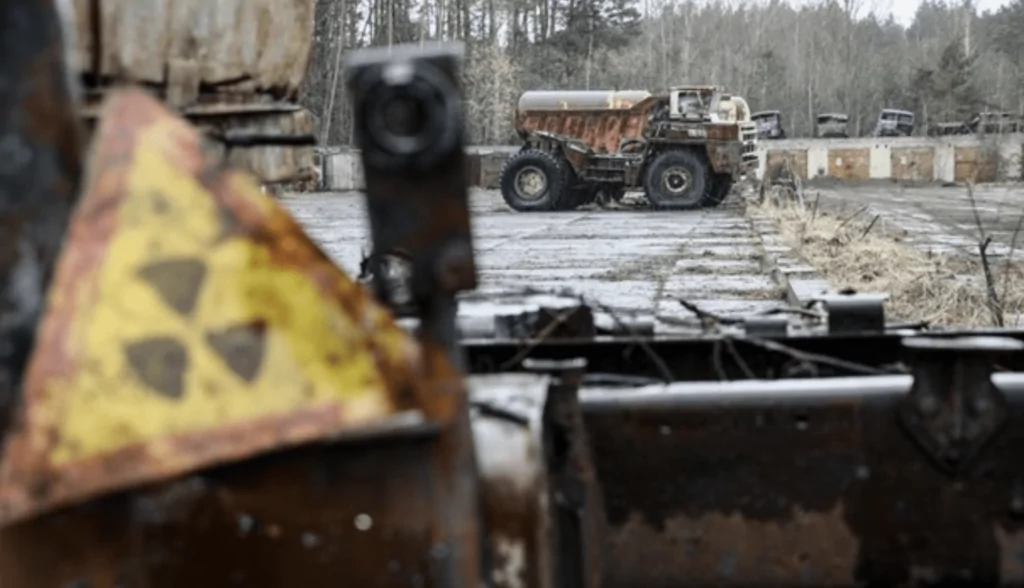
The same applies to nuclear plant radiation readings. We are still pressing Energoatom to release them. We now have Chornobyl data, but not data from the other plants, although Energoatom holds it. Its websites were closed over hacking concerns, yet it publishes electricity generation figures and not radiation data. This has been our most difficult dialogue. We offer technical solutions if separating environmental information is the obstacle. There must also be a national commitment, because even civil society voices say this is “not the time”. Butwar should test how well Ukrainians’ environmental rights are protected. People say the environment is not a priority, forgetting that houses and roads can be rebuilt, but if the environment becomes uninhabitable, we can do nothing there.The Chornobyl Zone demonstrates that. We must address this now, show that laws work and that European practices are being implemented, and demonstrate that public participation did not stop on 23 February.
— Can restricting information be seen as the authorities tightening control?
— Ultimately, yes, though reasons vary. The approach seems to be “close everything now and sort it out later, because the enemy might use some of it”. I understand that some industrial details in the environmental impact assessment register could be misused. Restrict those technical documents specifically. Otherwise, dishonest officials may exploit the war to exclude the public from decisions involving corruption or other interests.
— Your organisation was founded in Dnipro and initially monitored its air. How do you assess conditions in the city and region now?
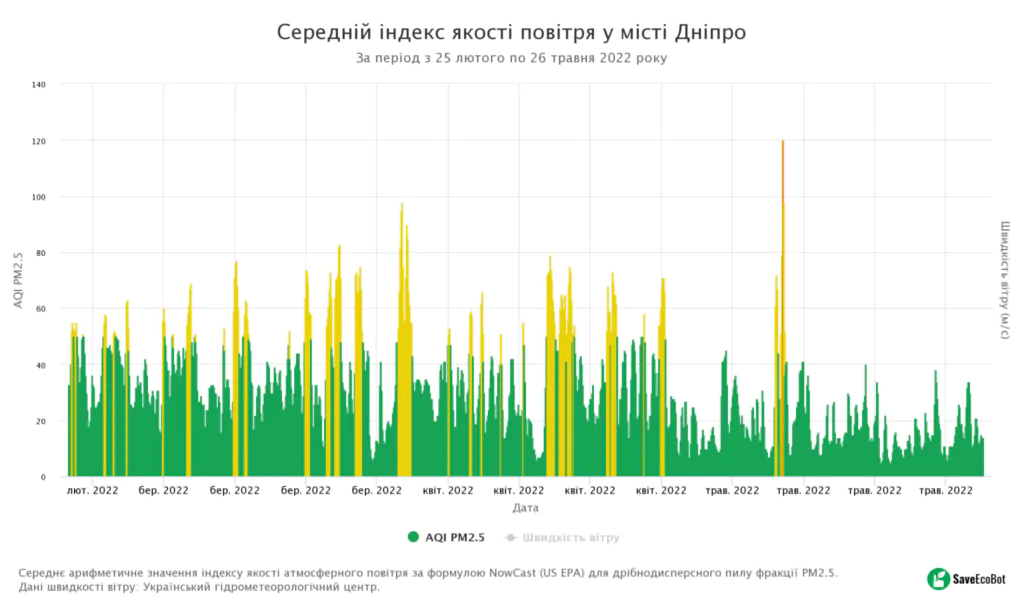
— We have recordedeleven environmental crimesin Dnipropetrovsk region. On 6 May, air readings spiked to around 120 against a reference value of 25, probably linked to a particular event. An earlier spike occurred at 08:00 on 24 February, likely around the first strikes, as in other settlements. Overall, air quality has been relatively stable, butwar’s effects on air quality remain noticeable.Industrial pollution has also fallen because fewer industrial businesses are operating in Dnipro.
“War destroys ecosystems, disrupting their overall balance and affecting specific areas.”
— How do russian environmental crimes affect the environment and human health?
— Environmental conditions are inseparable from quality of life, alongside financial security and healthcare. Living with polluted air, soil and water affects people’s lives. War destroys parts of ecosystems, disrupting their balance and damaging specific places.
We have recorded 36 missile strikes on oil infrastructure. Each damaged site can pollute air, water and soil, with lasting consequences.
Polluted water can expose people to heavy metals and other hazardous compounds. Impacts may persist, and the number and geographic spread of damaged sites make this a major concern.
This scale of damage and the effort to obtain compensation will be unprecedented for us. I fear more illness and shorter lives as environmental resources and food quality deteriorate. The longer the war lasts, the more industrial facilities are destroyed and the more chemical hazards arise, the greater the risks to Ukrainians’ health and life expectancy.
— Which environmental crimes are most common in your data, and where?
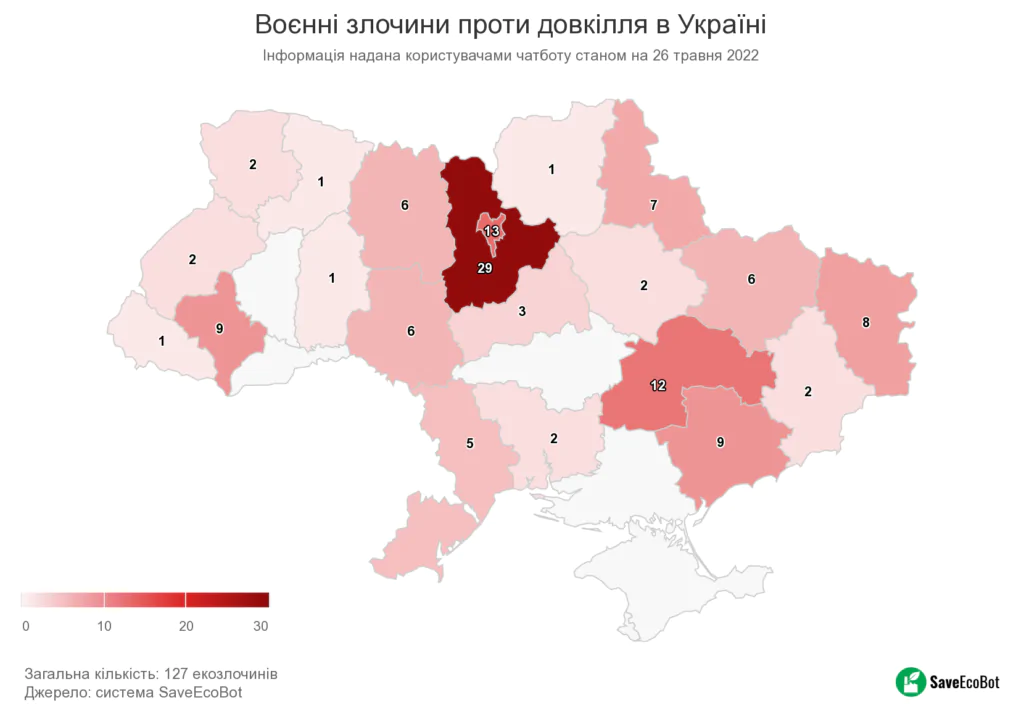
— The highest number has been reported inKyiv region, with 29 incidents, followed by Kyiv city with thirteen and Dnipropetrovsk region with eleven. These are reports from witnesses using our platform. Information about events has become less accessible than at the beginning of the war.
— What should someone do if they witness an environmental crime?
We have a video guide. The steps are:
- Record the damage in photographs or video if safe. Note details such as the affected area of vegetation or which part of an industrial facility was hit. A strike on a waste disposal area, for example, may cause a spill or release hazardous substances. Gather as much evidence as possible without putting yourself in danger.
- Open SaveEcoBot in Telegram or Viber, choose “report a crime” and answer the chatbot’s questions.
This sends information to the Environment Ministry’s operational headquarters, which aggregates evidence for international proceedings and environmental compensation claims.
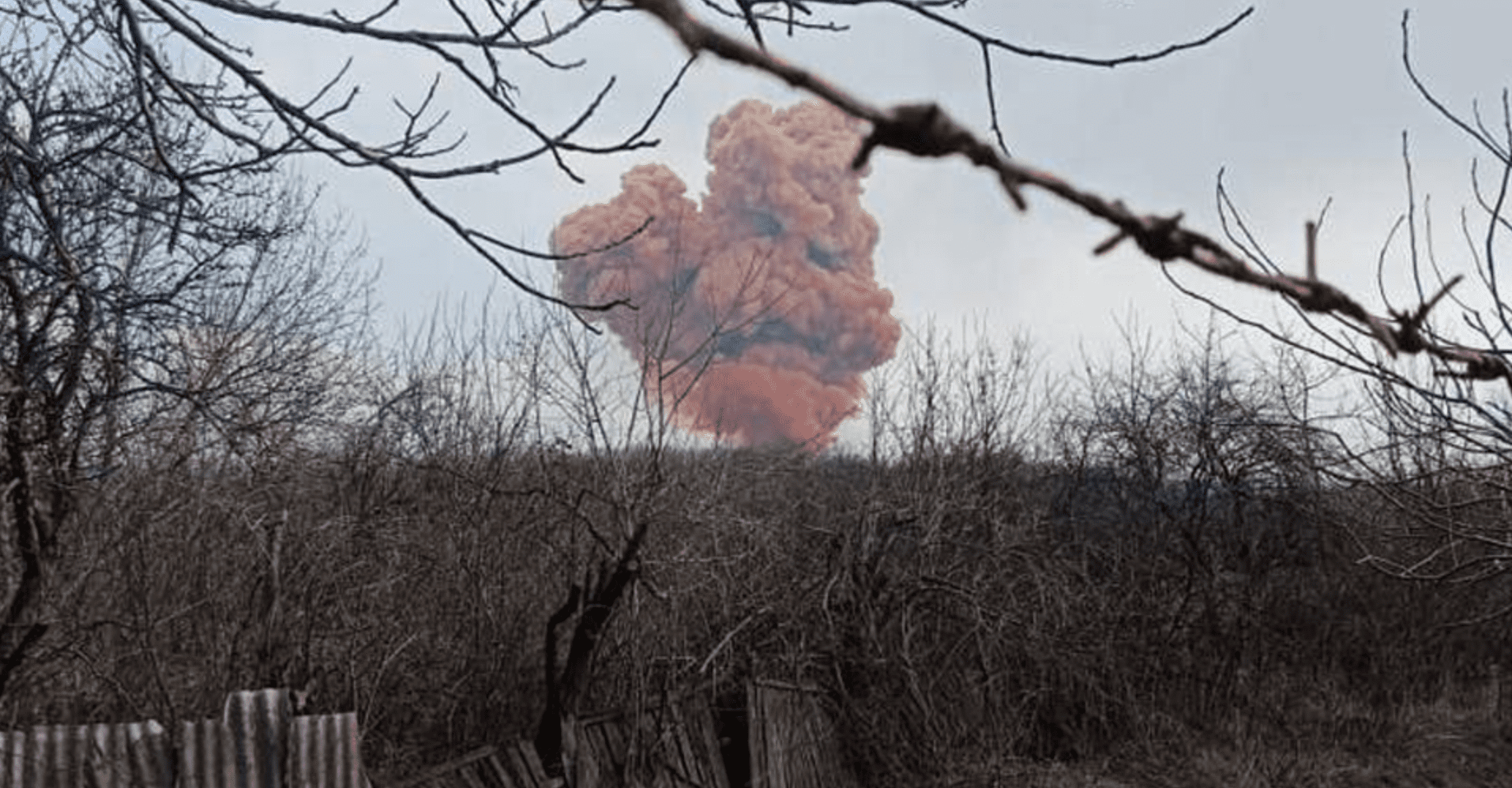
A chemical release in Rubizhne, described as ammonia in the original caption
— What should residents do to protect themselves and their families after a chemical release such as the one reported following shelling in Rubizhne?
— After the war began, we started a Knowledge Base series on what people should do near chemical hazards.
- Protection from inhalation is critical, but damp masks do not reliably protect against chemical gases. Follow official shelter or evacuation instructions rather than relying on improvised masks.
- For contamination on skin, the appropriate response depends on the substance. Do not attempt household chemical neutralisation; seek emergency guidance and medical help. For many liquid exposures, prompt removal of contaminated clothing and water washing are advised.
- Sheltering or evacuation depends on the release and the chemical. Some vapours collect near the ground, but smell is not a reliable way to identify a substance or decide an area is safe.
We prepared guidance on our website and social media for this purpose; consult current official instructions in any emergency.
— Do we know how environmental and health losses from the war will be assessed?
— This is one of Ukraine’s hardest challenges. There is no single universal methodology: air, soil and other environmental damage each require different approaches. Moreover,Ukraine has not yet decided which international legal route to pursue. There are permanent courts and other mechanisms that can be established for a particular situation.
The response to Iraq’s invasion of Kuwait offers experience of a dedicated compensation mechanism. But the scale and range of damage in Ukraine are different, so comparisons are limited. Some experts involved in that experience now contribute to working groups. Officials say the immediate priority is tocollect the necessary information while possible legal routes are assessed.
The first task isto record as much evidence of each event as possible, promptly. Experts can later apply different methods to calculate the cost.We need enough evidence to answer the aggressor state when itin,turn asks: “What was it like before the war?” That means collecting as much baseline information as possible.Analyse satellite images, industrial waste-site documentation and sanitary protection zones. Record strikes and fragments safely, and investigate soil and other damage. Building this evidential foundation is Ukraine’s immediate task while legal routes are chosen with international experts, the World Bank and others offering financial and methodological support. Without timely evidence collection, these efforts may not work.
“Our priority is defending environmental legislation through closer cooperation between environmental organisations and a broad civil society coalition already forming around these challenges.”“
— What priorities has your organisation set?
— As always, we will defend access to environmental information so the public has data to create tools, precedents and projects needed during the war. We willbuild digital tools for people and public bodies to improve how they work.This was already our top priority, and the war has made its urgency clear because public bodies are not always technically equipped to respond quickly. We willbuild a coalition around collecting information and defending access to it. Another priority isdefending environmental legislation, becausewar is not a reason to stop reforms; it is a time for active European integrationand environmental reform. The sector has long faced industrial lobbying, and recent achievements are now being rolled back.
For example, bill 7282 on urgent urban planning reform was passed rapidly, without proper environmental committee scrutiny or agreement from the relevant Ministry. It removes strategic environmental assessment requirements for reconstruction areas, although such assessment underpins subsequent projects. What green recovery is possible if environmental procedures are bypassed? Regional officials and elites may exploit the opportunity for quick profits, leaving us in a situationevenworse than before the war. That is why our priority is defending environmental legislation through closer cooperation between environmental organisations and a broad civil society coalition already forming around these challenges.
Source: Rubryka
Author: Liudmyla Tiahnyriadno