Translation note: This article describes the situation as of 4 March 2023. Statements about institutions, plant conditions and monitoring coverage refer to that date and are not a current nuclear safety assessment.
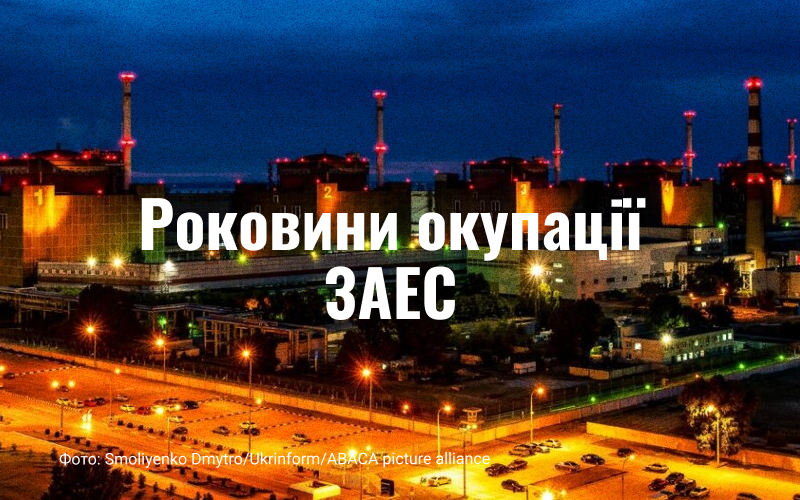
On 4 March 2023, Europe’s largest nuclear power plant, Zaporizhzhia, marks one year under occupation. The seizure of this nuclear facility is unprecedented in world history. For 12 months, Russian forces have used it as a primary instrument of pressure and blackmail against Ukraine and the world. Humanity has repeatedly come close to nuclear disaster during this period, and the risk remains considerable. It is time to draw conclusions about the situation around Zaporizhzhia and the response of international organisations responsible for global radiation safety.
Nuclear terrorism: a reality no one was prepared for
After the Second World War, a security system and its legal foundations were established, yet they clearly failed to prevent a destructive full-scale war. The Geneva Conventions and their later Additional Protocols regulate armed conflicts and seek to limit their effects. Article 56 of the First Additional Protocol of 1977 protects works and installations containing dangerous forces, specifically including nuclear power plants. These rules apply to both Ukraine and Russia as parties to the agreement. Paragraph 1 prohibits attacks on nuclear power plants even when they are military objectives if an attack could release dangerous forces and consequently cause severe civilian losses. In the case of nuclear plants, the danger is radioactive exposure.
This fundamental agreement, requiring strict distinction between civilian and military targets and allowing attacks on military targets only under specified conditions, failed to protect the plant. Zaporizhzhia demonstrates how limited international law can be in a concrete crisis. Paragraph 5 of the Additional Protocol urges parties to avoid locating military objectives near these installations. Nevertheless, on the night of 3–4 March 2022, Russian troops began firing on the plant with tanks, struck a power unit and caused a fire, as described in the original account.
Before the full-scale invasion, there were no effective mechanisms to prevent wars of conquest and the use of nuclear plants to pursue an aggressor’s aims
The Geneva Conventions’ protections did not stop Russia from seizing Zaporizhzhia. No effective means existed, or yet exists, to stop an aggressor using a nuclear facility for blackmail. Russia openly threatened Ukraine and the world on three occasions with actions that could have triggered a nuclear disaster at Zaporizhzhia. One example cited in the original article is the statement attributed to Major General Valery Vasilyev of Russia’s radiation, chemical and biological defence forces: “This will either be Russian land or a scorched desert.” According to the assessment of Institute for the Study of War experts, Russian forces were escalating threats around the occupied plant to deter a Ukrainian counteroffensive and force the international community to recognise Russian ownership of it.
There is currently no mechanism to force Russia to leave Zaporizhzhia quickly
Unfortunately, no mechanism can quickly and painlessly compel Russia to vacate the plant and end blackmail involving Ukrainian nuclear facilities. Despite international concern and numerous documents calling on Russia to leave, the occupation continues.
In September 2022, SaveDnipro and other civil society organisations sent a joint open letter to the IAEA’s governing and executive bodies and held a corresponding protest in Vienna during the Agency’s 66th General Conference. Civil society demanded Russia’s removal from the Board of Governors, suspension of its IAEA membership rights, removal of Russian citizens from executive duties, and suspension of ongoing technical cooperation and scientific and technological exchanges between the Agency, Rosatom and Rosenergoatom.
The IAEA has proved ineffective in confronting nuclear terrorism
The International Atomic Energy Agency was not createdto counter a crisis in which one member state launches military aggression against another. Its Statute sets out the objective of accelerating and enlarging the contribution of atomic energy to peace, health and prosperity worldwide. As far as it is able, the Agency seeks to ensure that assistance provided by it, at its request or under its supervision or control is not used to further any military purpose.
The IAEA establishes nuclear and radiation safety standards to protect people and the environment, provides technical assistance to member states and promotes exchanges of scientific and technical information on peaceful nuclear applications in the economy, science and medicine. Its standards guide member states when incorporating them into national legislation. However, the original article argues that the standards system lacks provisions specifically governing nuclear facility safety when one member state attacks another, including occupation of facilities and nuclear terrorism involving seized nuclear materials and installations.
Despite this lack of preparedness, over the past year the IAEA not only formulated seven indispensable pillars of nuclear safety and security to be maintained during Russia’s invasion and the occupation of Chornobyl and Zaporizhzhia, but also secured access for its experts to occupied Zaporizhzhia. Their presence had continued for almost 200 days by publication. Yet Russia still had a representative on the Board of Governors, and the Agency’s cooperation with Rosatom and Rosenergoatom continued.
Overcoming nuclear terrorism requires joint Ukrainian and international efforts
Russia’s lack of principle and determination to continue nuclear terrorism make this crisis difficult to resolve. Since Russia’s leadership is unlikely to order a withdrawal from Zaporizhzhia soon, Ukrainian and international actors must find a comprehensive approach combining sanctions with restrictions on the Russian nuclear sector’s rights and privileges. To help develop a mechanism for radiation safety, SaveDnipro organised the interagency roundtable “Ukraine’s Nuclear Safety Is the World’s Safety: An Action Plan for Ukraine”, held on 21 February.
Participants included representatives of Ukraine’s Energy, Foreign Affairs and Environment ministries, the State Emergency Service, Ukrainian Hydrometeorological Centre, State Nuclear Regulatory Inspectorate and Cherkasy Regional Military Administration. Civil society and expert participants included SaveDnipro, Greenpeace nuclear energy and energy policy experts who had undertaken missions to Chornobyl and Zaporizhzhia, the International Centre for Ukrainian Victory and Ecoaction.
The roundtable aimed to develop a roadmap for the main stakeholders’ further efforts to uphold Ukraine’s interests in wartime nuclear safety at both international and domestic levels.
Ukraine’s emergency background radiation monitoring system needs improvement
When the full-scale invasion began and Russian forces seized Chornobyl, Ukrainians were deeply afraid, remembering the accident and its consequences. Fear intensified on the night of 24–25 February when spikes in background radiation readings were recorded at and around the plant. This situation reflected not only the fact that no one expected nuclear terrorism, but also weaknesses in Ukraine’s background radiation monitoring system.
A broad, autonomous system capable of recording data and publishing them openly under any conditions would have made it easier to cope with Chornobyl’s occupation, the terrifying night Zaporizhzhia was seized and its continuing occupation. Background radiation readings near these and other Ukrainian nuclear sites can be checked on our background radiation map.
Ukraine must continually improve open access to data
Improving radiation monitoring is not enough: the results must be available to the public. A single, intuitive system would enable people in Ukraine and worldwide to check radiation conditions around nuclear plants and other nuclear facilities whenever needed. Nuclear terrorism at Zaporizhzhia also sets a precedent; there is no guarantee that something similar will not happen again. We cannot afford negligence or to be unprepared for such dangerous situations. If a nuclear accident occurred, Ukrainians would need timely information to protect themselves.
After a year of Zaporizhzhia’s occupation, some conclusions are clear. The world was not simply unprepared for nuclear terrorism during full-scale war: it was too naive to believe it could happen. Addressing this form of Russian aggression now requires sustained, coordinated work by Ukraine and the international community. Ukraine must also intensify efforts to expand and improve radiation monitoring and public access to the resulting data.