Humanity must phase out coal generation as quickly as possible and close its notorious coal-fired power plants. They inflict irreparable harm on health, the environment and climate. Replacing them, however, is not simple. Installing wind turbines and solar panels is only half the task. The other half is rapidly increasing electricity generation at peak demand or when the sun is not shining and the wind is not blowing. Thermal plants currently do this.
In our article ‘Are Coal-Fired Power Plants Irreplaceable?’ we examined other generation technologies capable of doing so. Another way to balance the system rapidly is to store surplus electricity when demand is low and return it to the grid when supply is insufficient. This article explores electricity storage methods.
Good old pumped storage
The earlier article discussed pumped storage hydropower. This technology represents 95% of global energy storage capacity and is successfully used in Ukraine. The Dnister, Kyiv and Tashlyk pumped storage plants have about 2 GW of combined installed capacity: a substantial balancing resource, equivalent to quickly switching on two nuclear units whenever the system operator needs them.
Further expansion has limits, however. Ukraine’s flat landscape offers relatively few suitable locations. Pumped storage requires a hill near a large water body. A reservoir on the hill receives pumped water when electricity is plentiful; when supply is short, water flows back down through a turbine. The arrangement works well except that existing Ukrainian expansion proposals raise serious scientific and environmental concerns, discussed in documents of the Verkhovna Rada’s environmental committee. Increased evaporation and reduced rainfall from climate change further diminish the prospects.
Even this established technology can see breakthroughs. Media recently reported British tests of a small pumped storage system using fluid 2.5 times denser than water. Its greater weight allows a generator turbine to operate with only a small hill.
Giant batteries
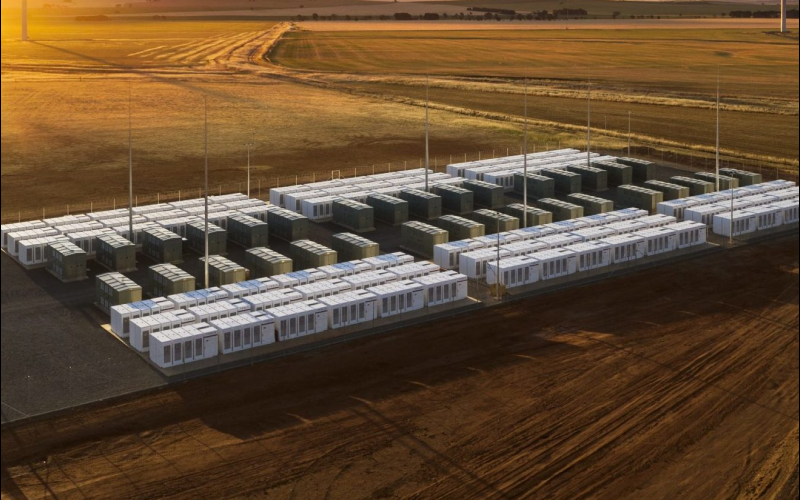
In December 2017, Elon Musk commissioned a giant 100 MW battery that now balances South Australia’s electricity system. He had promised to build it within one hundred days or provide it free. Tesla completed it in sixty days, using the same lithium-ion technology as its cars.
The story may appear heavy on publicity, but in 2019 local authorities decided to increase capacity by 50%, recognising its effectiveness. Media reported that the USD 66 million project saved consumers USD 50 million in less than two years.
Around the same time, Tesla introduced the container-sized Megapack. Each roughly 4 MWh unit is a module for a storage facility of any scale. One of the largest, in Australia’s Victoria state, comprises 212 units with 350 MW of total power, comparable to a coal unit used to balance Ukraine’s electricity system.
It may seem we need only wait for scale to bring prices down further. It is not so straightforward. First, lithium extraction may diverge sharply from demand. Lithium-ion batteries are used in gadgets, electric cars and now large storage systems. Demand will grow exponentially. Can mining keep up?
Second, the cheapest lithium-ion batteries are made in China. Becoming dependent on Chinese batteries, as Ukraine once depended on Russian gas, is not an option.
Third, while lithium-ion batteries store the most energy per unit volume, they have drawbacks: no acceptable disposal technology, a relatively limited number of charge-discharge cycles, and comparatively short discharge duration at operating power, from one to eight hours. Flow batteries reduce the latter two disadvantages.
Flow batteries store charge in large external tanks of liquid electrolyte. They are expensive but offer key advantages: a longer life of twenty to twenty-five years and almost unlimited recharge cycles. Their discharge duration at operating power is also somewhat longer than lithium-ion batteries’.
Other battery storage technologies exist but currently fall behind lithium-ion in many characteristics. Technological breakthroughs are nevertheless highly likely.
Gravity storage
Gravity storage resembles pumped hydropower but uses cranes instead of pumps. Monolithic blocks are raised one hundred metres or more, then lowered when energy is needed. The world’s first commercial gravity storage facility was built in Jiangsu province near Shanghai, China. It has 25 MW of power and 100 MWh of capacity, giving four hours of full discharge. For now, it is a lighter-duty counterpart to a lithium-ion station. The technology has prospects, particularly where a deep disused mine shaft can accommodate moving weights.
Compressed air
Air is compressed into a reservoir, then released through a turbine to generate electricity when needed. Until recently, the technology was considered dependent on underground salt caverns or depleted oil and gas wells large enough to hold substantial compressed air. Canadian developer Hydrostor recently said it had solved this through artificial caverns that can be built almost anywhere. Altering the underground landscape and requiring a surface water reservoir remain environmental impacts and disadvantages. A promotional video on the company’s website claims installations of up to 500 MW. Rapid generation start-up is another advantage.
A giant flywheel
This storage system uses the kinetic energy of a rotor spinning almost without contact, suspended magnetically in a vacuum. It is commercially available and particularly useful for short-term storage requiring rapid response and many daily cycles, such as voltage fluctuation management and frequency control. Drawbacks include limited scalability because of rare minerals and complex manufacturing, alongside significant upfront investment. A 500 kW flywheel project has operated on Flores in Portugal’s Azores since 2005.
Molten salt
Molten salt stores energy by heating it directly from renewable sources such as concentrated solar power, or indirectly through electric heaters or heat pumps. The stored heat can later generate steam for heating or drive a steam turbine to produce electricity. Storage can last ten to twelve hours or longer. Molten salt can be particularly useful in the fossil fuel transition because existing coal plants, for example, can be retrofitted. Reusing generating units and cooling systems while adding electric heaters and molten salt heat exchangers for steam production can create a genuinely decarbonised facility with less investment than building a new plant.
Hydrogen
Converting surplus electricity into hydrogen through electrolysis preserves energy indefinitely: its main advantage. Its main drawback is the inefficient conversion from electricity to hydrogen and back again, retaining only about 30% of the original energy.
For large volumes and long periods, such as seasonal storage, underground hydrogen storage is more suitable than tanks. Ukraine has enormous underground gas storage facilities that could serve this purpose in future.
A final thought
This far from exhaustive review shows how rapidly new technology is changing energy storage. Humanity’s challenges will drive further development. Ukraine must quickly assess different technologies and create conditions for introducing the most promising. We hope specialists are collecting and processing storage information and have real influence on state energy policy.
For now, Ukraine’s progress is limited. DTEK reportedly installed a 1 MW lithium-ion battery, a tiny amount for our system. That happened before the full-scale invasion at the Zaporizhzhia thermal power plant in Enerhodar, now under occupation.
This publication was produced with financial support from the European Union. Its contents are the sole responsibility of SaveDnipro and do not necessarily reflect the views of the European Union.