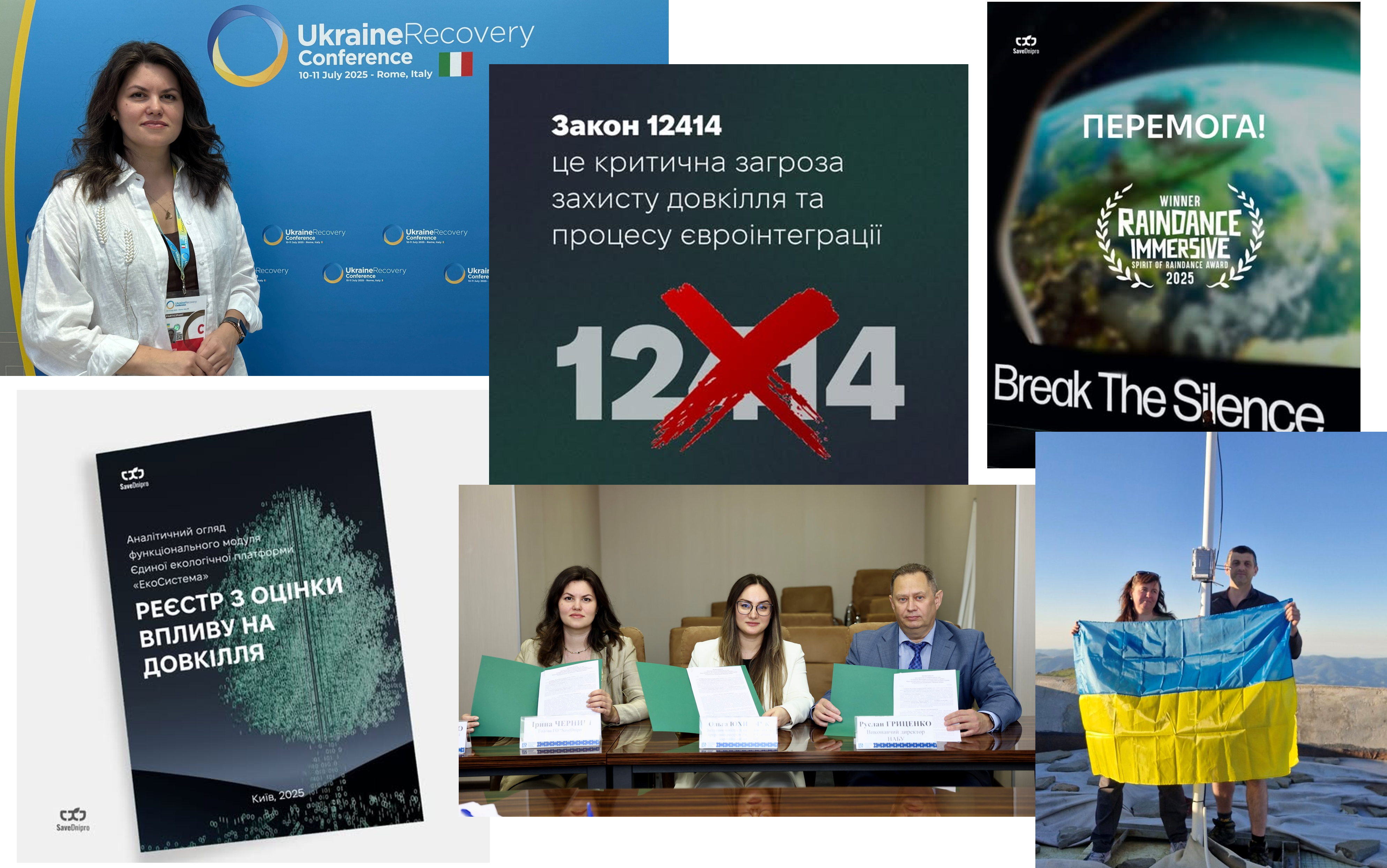
In July 2025 the SaveDnipro team worked for better environmental digitalisation, advocated green recovery, outlined the risks of dissolving the Ministry of Environmental Protection, and monitored radiation levels and air quality across Ukraine every day.
Working to improve government digital environmental services. We held an expert discussion on the EIA Register’s usability and completeness of functionality for the public. We presented an analytical reviewcovering legal compliance, a technical assessment, data integrity and quality analysis, and a UX/UI review of the EIA Register. We sent the document to Ukraine’s Ministry of Economy, Environment and Agriculture and the Ministry of Digital Transformation, calling for the identified shortcomings to be addressed.
We also sent a letter to Minister of Economy, Environment and Agriculture Oleksii Sobolev and Minister of Digital Transformation Mykhailo Fedorov. It highlighted growing risks to the uninterrupted operation of the unified EcoSystem environmental platform and preservation of important environmental data as the platform is transferred to a new custodian following the dissolution of the Ministry of Environmental Protection. We called for a full audit of all digital systems and solutions previously held by that ministry and, where problems are identified, a plan to resolve them.
Advocating Ukraine’s green recovery. We took part in the Ukraine Recovery Conference 2025. We called on European leaders to seize the opportunity to rebuild Ukraine according to principles of sustainability and environmental responsibility. Ahead of URC 2025, we shared a joint statement on the state of environmental reforms.
At URC 2025, we also reached agreements with local government representatives from Dnipropetrovsk, Mykolaiv, Kherson and Zaporizhzhia regions on implementing the Green Recovery of the South project, through which we plan to teach the public the fundamentals of green recovery and environmental procedures.
We contributed to the development of a roadmap for Ukraine’s sustainable recovery: a joint document of the Build Ukraine Back Better platform setting out priority reforms, policies and structural changes to be implemented over the next two to three years to ensure environmentally sustainable and resilient recovery.
Focusing authorities’ attention on important environmental policy issues.
- First, we issued a statement opposing the dissolution of the Ministry of Environmental Protection. We warned against a decision that could deprive environmental protection of an independent voice, create conflicts of interest and slow the pace of EU integration reforms.
- After the Government nevertheless decided to dissolve the ministry, we initiated a joint appeal and called on Minister of Economy, Environment and Agriculture Oleksii Sobolev to discuss the new ministry’s environmental action plan with civil society.
- We analysed progress on the Ukraine Facility’s environmental indicators and highlighted future risks arising from the ministry’s dissolution and reduced state administrative capacity.
- We recalled that the Environmental Compact for Ukraine is based on the concept of planetary boundaries. We expressed serious concern that dissolving the ministry reflects a view of the environment as an economic resource whose use is subject to no limits.
- We opposed Law No. 12414, which not only restricted the independence of anti-corruption bodies but also created critical risks for environmental protection and EU integration.
- We commented on the National Security and Defence Council decision ‘On introducing legal and organisational measures for a moratorium on unjustified inspections and interference by state bodies in business activities and stimulating economic growth in Ukraine’. In this context, we recalled the proposals from Green Alternative of Ukraine, in partnership with SaveDnipro, to improve the business risk assessment criteria used by the State Environmental Inspectorate.
- We highlighted a European Joint Research Centre report finding that Ukraine still lacks an adequately funded and staffed air quality monitoring network with transparent reporting. We called on the Ministry of Environmental Protection to integrate data from citizen networks, which the report rated highly, into the state air quality monitoring system.
Advocating a digital platform for Ukraine’s green transformation and recovery. We published the concept for a digital platform for Ukraine’s green transformation and recovery. Developed jointly with the Ministry of Environmental Protection, it reflects future users’ needs and the general green recovery principles underlying the draft Law ‘On the Principles of Ukraine’s Green Recovery’. The document describes the digital platform’s key tasks and functions. We shared information about the concept on social media.
On 1 July, Ukrainska Pravda published Iryna Chernysh’s column ‘Green Recovery and Its Home Page’. It makes the case for a top-level digital platform serving as an information hub for all green recovery processes. The column received more than 4,000 views.
Promoting ESG standards and digital tools for assessing environmental and social risks. We initiated and helped hold a roundtable entitled ‘Sustainable Finance in Ukraine: Regulatory Challenges and Prospects’, involving members of the Independent Association of the Banks of Ukraine, the chair of the Verkhovna Rada’s environmental committee, and representatives of the Ministry of Environmental Protection, Ministry of Economy, National Bank of Ukraine, State Environmental Inspectorate and other institutions and organisations.
We signed a tripartite memorandum between the Independent Association of the Banks of Ukraine, the Ministry of Environmental Protection and SaveDnipro to promote Ukraine’s green recovery, develop sustainable finance and strengthen the banking sector’s role in adopting environmentally, socially and governance-responsible approaches (ESG).
Developing the network of autonomous radiation monitoring stations. In cooperation with Vasyl Stefanyk Carpathian National University, we installed a Radnote radiation monitoring station on Mount Pip Ivan Chornohirskyi (2,028.5 metres), one of the highest peaks in the Ukrainian Carpathians. Pavlo Tkachenko took part in an online event marking the station’s launch.
Another Radnote station was installed in Chernivtsi with assistance from the Chernivtsi Regional Military Administration, with which SaveDnipro signed a cooperation memorandum, and the regional State Emergency Service unit. Forty-three Radnote stations are now installed in Ukraine, with plans for more than one hundred in total, provided by our international partners Safecast and Blues.
Once again, we debunked a false claim about a spike in radiation levels near the Zaporizhzhia Nuclear Power Plant. Data from SaveEcoBot was also used on the page of the State Nuclear Regulatory Inspectorate of Ukraine. Almost all publicly accessible automatic radiation monitoring stations within one hundred kilometres of the Zaporizhzhia Nuclear Power Plant were installed by SaveDnipro with support from uRADMonitor, Greenpeace and Safecast, and with help from residents of the region.
Protecting public health in Kyiv. We promptly warned Kyiv residents against spending time outdoors in air polluted by combustion products after missile and drone attacks on 4 July and 10 July.
Strengthening public participation in green recovery. We launched a new project to explain how the public can participate in procedures influencing environmental decisions. The project includes a training course, which we have already begun preparing. Its geographical focus is Odesa, Mykolaiv, Kherson and Zaporizhzhia regions, but key course materials will be available online to all Ukrainian citizens.
Winning international awards. Our VR film ‘Break the Silence’ received the SPIRIT OF RAINDANCE AWARD at the tenth anniversary Raindance Immersive competition in London. The VR experience immerses viewers in an environment devastated by war and conveys a message: restoring Ukraine’s nature requires international efforts.